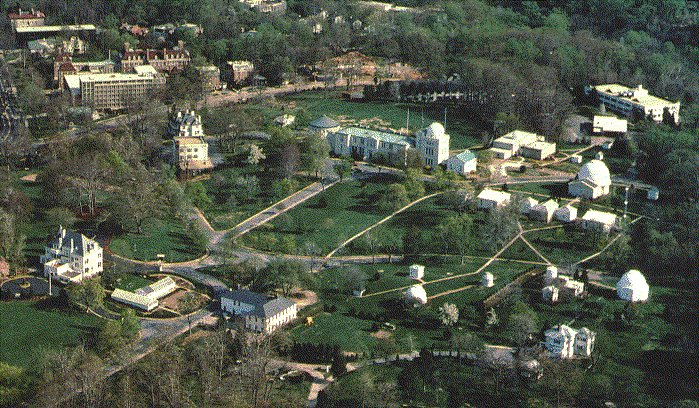
United States Naval Observatory
Observatory in Washington, D.C., United StatesWikipedia
42
MENTIONS
28
EPISODES
26
PODCASTS
Search complete. 42 mentions across 28 episodes found for "United States Naval Observatory".
Oct 5, 2026

speaker_2HOST
It is literally the most precise way humans can measure a second.
speaker_2HOST
So Hafele and Keating synchronized these clocks with a master clock at the US Naval Observatory.
speaker_0HOST
And then they just bought them plane tickets?
speaker_2HOST
Yes.

John MulkinsHOST
The government is failing to address their concerns, and an entire generation is watching it happen in real time.
John MulkinsHOST
White and Koerbel compare political time to the master clock at the Naval Observatory in Washington.
John MulkinsHOST
The American political landscape keeps a clock of its own.
John MulkinsHOST
Every generation or so, a president like Lincoln, Roosevelt, or Reagan resets it.
7 MINS LATER
John MulkinsHOST
You know? And that's kinda goes back to the argument that Paine had about the necessity of government because people are not all angels, and neither are people in government always virtuous people.
John Kenneth WhiteGUEST
As Madison testified in The Federalist Papers.
John MulkinsHOST
You and Matthew Kerbel use the metaphor of the Naval Observatory master clock.
John MulkinsHOST
Thought that was interesting, the idea that Reagan reset political time for a generation.

James M. McCanneyGUEST
that was going on, absolutely insane times, which we later found out was completely orchestrated by the CIA.
James M. McCanneyGUEST
And they started it in around 1991 when Robert Harrington of the Naval Observatory literally discovered Planet X.
James M. McCanneyGUEST
And it was a planet that was down in the lower solar system.
James M. McCanneyGUEST
It had a companion.
James M. McCanneyGUEST
And he was the head of the Naval Observatory.
James M. McCanneyGUEST
Tom Van Flander was his assistant.
James M. McCanneyGUEST
And in the 80s, Van Flander gave him the impetus to start looking for this thing because Uranus and Neptune were being pulled down in their orbits.

Tim GallaudetGUEST
And it intrigued me.
Tim GallaudetGUEST
And so I carried that with me through my career and having an interest, but not really pursuing it until I worked at the Naval Observatory, the US Naval Observatory as the superintendent, the commanding officer.
Tim GallaudetGUEST
And I started really learning more about cosmology and astrophysics and getting this appreciation for how large the universe is.
Tim GallaudetGUEST
And just extraordinary ideas like a billion stars and a hundred billion stars in our galaxy.

Dean KarayanisHOST
She was vice president.
Dean KarayanisHOST
I've never lived in the Naval Observatory.
Dean KarayanisHOST
He's a senator.
Dean KarayanisHOST
She's a congressman.

Gary ArndtHOST
In 1842, Maury was placed in charge of the US Navy's Depot of Charts and Instruments in Washington.
Gary ArndtHOST
And when the US Naval Observatory was formally organized, he became its first superintendent in 1844.
Gary ArndtHOST
And that position gave him access to something enormously valuable: old ship's logbooks.
Gary ArndtHOST
And here I need to shift gears a bit and explain exactly what ship logbooks are and why they are kept.
Gary ArndtHOST
Maury offered charts and sailing directions to captains who agreed to participate in his observational program.
Gary ArndtHOST
They received standardized log forms and instructions explaining how observations should be recorded.
Gary ArndtHOST
Captains recorded information during their voyages and returned these observations to the Naval Observatory.
Gary ArndtHOST
Maury's staff analyzed the new information and incorporated it into future editions.

Lindy LiGUEST
We'll give you access to the White House.
Lindy LiGUEST
We'll give you a chance to go to the vice president's Naval Observatory residence.
Lindy LiGUEST
We'll give you access to this and that." And it was just, it was their way of life.
Lindy LiGUEST
That's how they made a living.

Lindy LiGUEST
Two things, though.
Lindy LiGUEST
So I used to go to the Naval Observatory, like, on a monthly basis, and she would always give me a lavish gift.
Lindy LiGUEST
I thought it was cute.
Drew PinskyHOST
Mm-hmm.
Lindy LiGUEST
... lavish candle.
Lindy LiGUEST
It's, like, a really heavy candle, and it was, um, monogrammed and engraved with her signature and Doug's signature, and it had a photo.
Lindy LiGUEST
It ha- it wa- the s- it w- the Naval Observatory was stenciled on the candle itself.
Lindy LiGUEST
It was a really expensive gift.

Nia RogersHOST
Maintained by the Navy, right.
John AughenbaughHOST
Yeah, the Naval Observatory.
John AughenbaughHOST
So that's actually pretty cool.
John AughenbaughHOST
You get two offices.

Wendy BellHOST
Listen.
Lindy LeeSOUNDBITE_SPEAKER
I got talking points from the White House and the Naval Observatory and the DNC every day.
Lindy LeeSOUNDBITE_SPEAKER
It got to the point where I created Gmail filters so I wouldn't have to read them.
Lindy LeeSOUNDBITE_SPEAKER
And I would not even see them.
18 more episodes mention United States Naval Observatory.
Create an account to see the whole feed, search across every transcript, and follow the entities you care about.