United States–Mexico–Canada Agreement
2.2k
MENTIONS
967
EPISODES
496
PODCASTS
Search complete. 2216 mentions across 967 episodes found for "United States–Mexico–Canada Agreement".
Sep 16, 2026

Kimberly DanielsGUEST
I, I think that ev- I, I think that there's more nuance than fair or unfair.
Kimberly DanielsGUEST
I think that there's a lot of, um, negotiations that have to happen when you're doing any sort of trade deal, and the fact is, is that, you know, he was the creator of USMCA in his first term, so [laughs] I'm not really sure how he negotiated a deal that was unfair.
Kimberly DanielsGUEST
[laughs]
Jerry AgarHOST
Well, right.

Sean SpeerGUEST
And although I know I, I find myself in the minority here, I think that we may rue the day that we didn't sign the deal that was negotiated because, as I say, those terms may not have been the first best choice, of course, but given the situation we're living in, actually represents, um, a, a pretty positive, in my view, outcome, uh, out of the, the whole, uh, maelstrom that, that really started when President Trump, uh, started talking about, uh, ripping up NAFTA and renegotiating the, the underlying assumptions of the Canada-US free trade ar- ar- arrangement.
Lindsay SmithHOST
So and that's-- So there's a lot to unpack there, and I think these are important points, is that CUSMA, USMCA, um, did replace NAFTA.
Lindsay SmithHOST
It was, you know, under Donald Trump that this deal was struck.
Sean SpeerGUEST
Yes.

Sean SpeerGUEST
And although I know I, I find myself in the minority here, I think that we may rue the day that we didn't sign the deal that was negotiated because, as I say, those terms may not have been the first best choice, of course, but given the situation we're living in, actually represents, um, a, a pretty positive, in my view, outcome, uh, out of the, the whole, uh, maelstrom that, that really started when President Trump, uh, started talking about, uh, ripping up NAFTA and renegotiating the, the underlying assumptions of the Canada-US free trade ar- ar- arrangement.
Lindsay SmithHOST
So and that's-- So there's a lot to unpack there, and I think these are important points, is that CUSMA, USMCA, um, did replace NAFTA.
Lindsay SmithHOST
It was, you know, under Donald Trump that this deal was struck.
Sean SpeerGUEST
Yes.

James M. LindsayHOST
The anger that so many Canadians feel toward the United States is understandable.
James M. LindsayHOST
Ever since the signing of the nineteen eighty-eight US-Canada Free Trade Agreement, which morphed into NAFTA and later the USMCA, Canada has bet its future on deepening its economic integration with the United States.
James M. LindsayHOST
As of last year, seventy percent of Canadian exports went to the United States.
James M. LindsayHOST
Trump, however, has weaponized that integration.
James M. LindsayHOST
For decades, Washington and Ottawa bickered over fishing rights in the Atlantic Ocean.
James M. LindsayHOST
The United States long resisted construction of the St. Lawrence Seaway, one of the great engineering accomplishments of the twentieth century, because it threatened the livelihood of US railroads in eastern ports.
James M. LindsayHOST
Tensions continued even with NAFTA and the USMCA.
James M. LindsayHOST
Just ask anyone in the office of the US trade representative about Canadian softwood lumber or Canada's supply management system for dairy, poultry, and egg production.

Mary KisselGUEST
And so maybe I'll stop there, but I do think it's important to separate out the various incentives that both sides have to come together.
John BatchelorHOST
There was an agreement, the USMCA, from the first Trump administration, as I recall.
John BatchelorHOST
You participated in that administration.
John BatchelorHOST
The USMCA returning with amendations built into the treaty.
John BatchelorHOST
You can suggest that you want this change and that change over many years.
John BatchelorHOST
Is that going to serve as a bridge or is this right now joining the EU? Is that the end of the USMCA?
Mary KisselGUEST
Well, reportedly a deal was on the table and Prime Minister Carney walked away from it.
Mary KisselGUEST
It is interesting that we haven't seen the details of that, which suggests to me it probably was a palatable deal.

Scott HarrisHOST
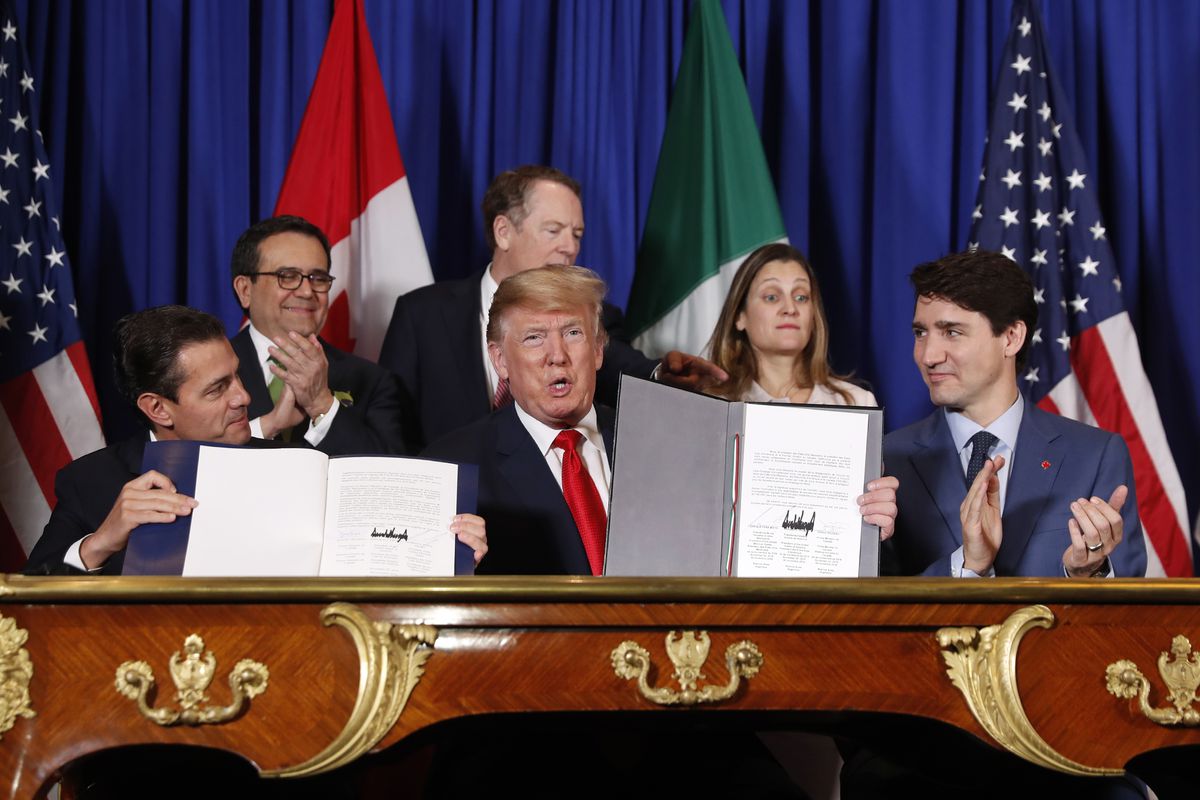
In his first term, Trump negotiated the United States-Mexico-Canada Trade Agreement that replaced the widely criticized North American Free Trade Agreement, or NAFTA, in January 2020.
Scott HarrisHOST
Although at the time Trump called his USMCA deal the greatest trade deal ever, not long after returning to the presidency, he condemned his own trade deal and launched a trade war against Canada, America's second-biggest trading partner, in February last year.
Scott HarrisHOST
Trump justified his imposition of a general 25% tariff and a 10% energy tariff on Canadian imports by stating that new trade sanctions were imposed to stop illegal migration and fentanyl from entering the US, where neither charge was true.
Scott HarrisHOST
The confrontation escalated sharply in July when Trump imposed a 50% tariff on nearly $28 billion worth of Canadian goods.

Caleb CollierHOST
I haven't been a fan of them.
Caleb CollierHOST
You know, the USMCA, for example, I, I was not a fan of.
Caleb CollierHOST
Um, but, uh, it did go through.
Jeff CrouereGUEST
Yeah.

Tony KellerGUEST
So just on the trade level, there are opportunities.
Tony KellerGUEST
We have a free trade agreement with Europe, though it's not as extensive as the USMCA, as CUSMA.
Tony KellerGUEST
And it's not fully implemented because there are a number of European states that haven't ratified it.
Tony KellerGUEST
So there are a lot of wrinkles.
Tony KellerGUEST
So just on the trade level, there are opportunities.
Tony KellerGUEST
We have a free trade agreement with Europe, though it's not as extensive as the USMCA, as CUSMA.
Tony KellerGUEST
And it's not fully implemented because there are a number of European states that haven't ratified it.
Tony KellerGUEST
So there are a lot of wrinkles.

Kevin PettersenGUEST
There's always challenges.
Kevin PettersenGUEST
Getting through that kind of uncertainty, the CUSMA, the Canadian-U.S.-Mexico Free Trade Agreement, allowed many, many goods to still go under that agreement.
Kevin PettersenGUEST
Tariffs didn't impact things so much.
Kevin PettersenGUEST
But I think that one of the things that we have to recognize is that certainly with the forest industry and things like that, we've had to deal with a lot of uncertainty with some of the commodity-based products.
957 more episodes mention United States–Mexico–Canada Agreement.
Create an account to see the whole feed, search across every transcript, and follow the entities you care about.