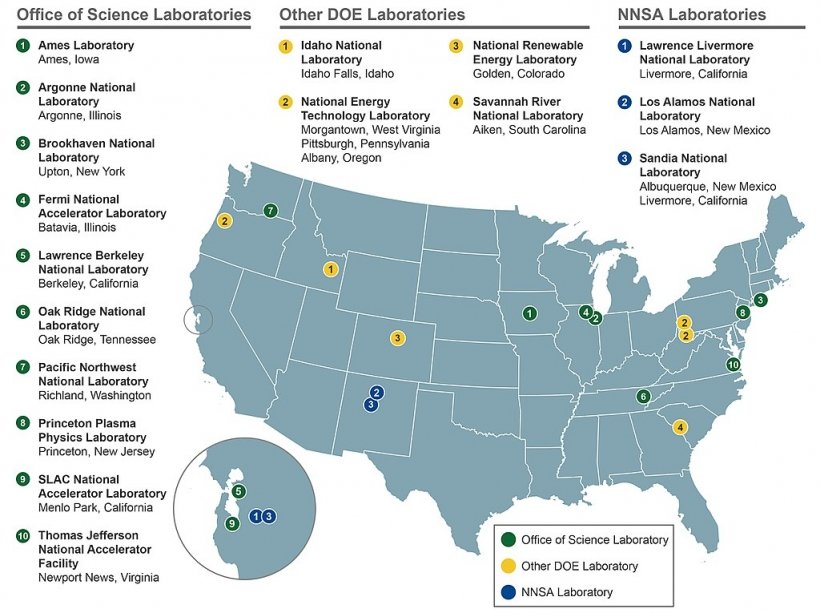
United States Department of Energy National Laboratories
Government departmentWikipedia
27
MENTIONS
11
EPISODES
11
PODCASTS
Search complete. 27 mentions across 11 episodes found for "United States Department of Energy National Laboratories".
Sep 22, 2026

Elliot FowlerGUEST
Yeah.
Elliot FowlerGUEST
yeah i mean you know that's a good point um i think the cool thing about working at a national lab or you know working in this um situation is that um it's it's a stereotype at sandia that um like the uh like the decay time for your interactions with people is like super long so like relationships are super important because you often are interacting with the same people for like 25 years.
Elliot FowlerGUEST
So like that leads to good and bad things culturally in terms of people's behavior sometimes because humans are still humans regardless of where they work.
Elliot FowlerGUEST
But it does mean that, yeah, you get to have a chance to really like see things progress over a much longer timeline than I would guess you guys get the opportunity to do with a lot of the folks you work with.
Elias MalfavonHOST
Yeah.
Elliot FowlerGUEST
Yeah.
Elliot FowlerGUEST
I mean, I never thought eight years ago before I started at a national lab job, that I would actually care enough about what's going on on C-SPAN to check and see if Congress is making any progress.
Elliot FowlerGUEST
I never thought I'd actually open up one of those bills that they post on whatever.gov and read the full text.

DennisCORRESPONDENT
Fluxneum thinks it has solved the problem of how to extract uranium from seawater.
DennisCORRESPONDENT
Using technology developed at U.S. Department of Energy National Labs, the company has an approach that could be competitive with existing uranium mines.
DennisCORRESPONDENT
The startup recently closed a $7 million seed round.
Imran SheikhHOST
And folks, that's your Daily Crunch.

Tony BoccanfusoGUEST
A lot of Jews came to the United States and were very smart, and they came from Germany.
Tony BoccanfusoGUEST
And so we had this great opportunity to, what are we going to do? And that led to the creation of the National Science Foundation, the growth of places like NIH, the DOE, which ran the National Labs, all came out of that.
Tony BoccanfusoGUEST
We're now at an inflection point, and we could do a whole other podcast on that.
Tony BoccanfusoGUEST
What's the next
Tony BoccanfusoGUEST
Right.
Tony BoccanfusoGUEST
So what's happening now is you're seeing, you know, companies partner with other groups, not just universities.
Tony BoccanfusoGUEST
It could be national labs, contract research groups, standalone research organizations.
Tony BoccanfusoGUEST
You know, you got a great one there in Wisconsin, for example, like the Mogridge Foundation.

Nancy WhiteHOST
You can't just rip and replace because there isn't necessarily a quick replacement.
Nancy WhiteHOST
So how do they move forward? Do they pull in third party like the National Labs to investigate? These are all questions that if you're interested, I encourage you to go watch.
Nancy WhiteHOST
Today's the 16th.
Nancy WhiteHOST
So go today and watch that or go watch the webinar after the fact if you don't catch it today.

Christine JaegerHOST
She holds a PhD in inorganic chemistry from Yale.
Christine JaegerHOST
She spent three years as a postdoc at the National Laboratory of the Rockies, formerly known as National Renewable Energy Lab.
Christine JaegerHOST
And there she was developing low energy catalysts to break down plastic waste.
Christine JaegerHOST
And in 2024, she spun one of those projects.

Tom KingGUEST
And so I was very fortunate to be able to be part of two separate teams.
Tom KingGUEST
One was led by Rocky Mountain Institute and the other was led by Syracuse University, whom both, and there were many other team members, Tatum, Cycle Architecture, Stangle Engineering, Lawrence Berkeley, National Labs.
Tom KingGUEST
I'm sure I'm missing a few, but it was, they were two, I guess what I would refer to as powerhouse teams with little tiny TKF and its concept also on these awards.
Tom KingGUEST
So, Yeah, it was great to have the, I guess, trust and faith in those institutions to be able to say, yeah, let's do this.

Pramit KolaparaMODERATOR
First, Maggie Cauley, the executive director of OpenStreetMap, whom many of you will know well.
Pramit KolaparaMODERATOR
Nagendra Singh, the senior scientist at Oak Ridge National Laboratory.
Pramit KolaparaMODERATOR
Frank Donnelly, head of GIS and data services at Brown University Libraries.
Pramit KolaparaMODERATOR
And Joel Gurin, president of the Center for Open Data Enterprise.
11 MINS LATER
Pramit KolaparaMODERATOR
Thank you, Frank.
Pramit KolaparaMODERATOR
And so next, Nagendra.
Pramit KolaparaMODERATOR
give us a flavor of where Oak Ridge National Laboratory fits into this picture, as well as talking a little bit about your role vis-a-vis High Field Open, a data collection, of course, that Denise mentioned in her keynote and that many in our audience, I think, are gonna be really interested in learning about in a bit more detail, kind of the history of how it came about, what were the challenges in putting together different data layers and kind of what the lessons would be for folks trying to work on similar efforts in the non-federal sphere.
Nagendra SinghGUEST
Thank you, Puneet, and thank you for inviting me.

Andrew WongGUEST
If you're gonna be developing this technology on a benchtop, how do you have an eye for where it's actually gonna be used, and be able to design it or to do the technology development so that it actually is usable?
Matthew PowellNARRATOR
At Lawrence Livermore National Laboratory, the Science of Scaleup is asking how scientists can identify the problems that emerge in new technologies at scale earlier, and shorten the path between breakthrough and impact.
Andrew WongGUEST
Those are the kinds of things we think about, things that have the opportunity to impact thousands, tens of thousands, millions, potentially even billions of lives.
Matthew PowellNARRATOR
Welcome to the Big Ideas Lab, your exploration inside Lawrence Livermore National Laboratory.
Matthew PowellNARRATOR
Hear untold stories, meet boundary-pushing pioneers, and get unparalleled access inside the gates.
Matthew PowellNARRATOR
From national security challenges to computing revolutions, discover the innovations that are shaping tomorrow, today.
Matthew PowellNARRATOR
Lawrence Livermore National Laboratory is hiring.
Matthew PowellNARRATOR
If you're passionate about tackling real-world challenges in science, engineering, business, or skilled trades, there's a place for you at the lab.

JC BtaicheGUEST
One is academia, just go the pure PhD academic route.
JC BtaicheGUEST
The second path is work in the national security environments, like at the national labs.
JC BtaicheGUEST
And both of those were not as appealing.
JC BtaicheGUEST
I had done some research at academic labs and didn't really jive well with the pace of progress there and the culture.
JC BtaicheGUEST
And the national labs, they had some amazing plans back from, you know, that are decades old on roadmaps and designs.
JC BtaicheGUEST
And when you look around, China is essentially building those plans, and people in the national labs are saying it's hard to get funding, it's hard to move fast.
JC BtaicheGUEST
And we'll get into that later, probably in the conversation.
JC BtaicheGUEST
But that led me to the third path, which I believe is also an American competitive edge, which is to start a company.

Olof HallonstenGUEST
Well, somewhat simplified story, but nonetheless.
Olof HallonstenGUEST
So for example, the US National Labs, previously overseen by the Atomic Energy Commission, was suddenly put into the Department of Energy, which was a huge bureaucratic colossus in Washington DC that wanted to steer all this.
Olof HallonstenGUEST
So you're onto something in your description there that at some point, probably during the 1970s, we passed from a state where politics and bureaucracy supported innovation to when it became like rather like put a lid on it by controlling away the natural tendencies, so to speak, of creativity that is inside in science, putting things in boxes, ticking boxes, you know, formulaic research programs where you had to prove that you had a sustainability perspective, not that there's anything wrong with that, or a gender perspective, not that there's anything wrong with that either, but you have to tick these boxes rather than be free in the creative process.
Olof HallonstenGUEST
And that's where bureaucracy becomes then coercive instead.
Olof HallonstenGUEST
So it was really timely of showing that many of the things that have been progress during the 20th century became instead fears among people.
Olof HallonstenGUEST
And that in turn then creates a need to control things.
Olof HallonstenGUEST
A need to make sure that all the, for example, all the atomic research or the particle physics done in the national labs or whatever, fulfills all the safety requirements that we have.
Olof HallonstenGUEST
And that of course adds to the bureaucracy.
1 more episode mentions United States Department of Energy National Laboratories.
Create an account to see the whole feed, search across every transcript, and follow the entities you care about.