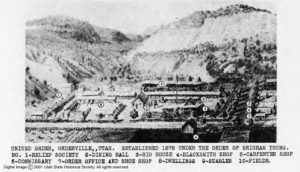
United Order
26
MENTIONS
5
EPISODES
5
PODCASTS
Search complete. 26 mentions across 5 episodes found for "United Order".
Oct 27, 2026

Casey GriffithsHOST
Brigham Young's proposal to build the temple in St. George was approved at the church's October 6, 1871 conference, which is just two months before workers placed the final stone in the tower of the St. George tabernacle.
Casey GriffithsHOST
And the newly organized United Order in St. George helped make this ambitious new project possible.
Casey GriffithsHOST
Just five weeks after the temple was approved, Workers broke ground and construction began moving ahead.
Casey GriffithsHOST
The cornerstone was laid on April 1st, 1874.
Casey GriffithsHOST
Yeah, and just like Nauvoo, they dedicate the font before the temple is finished.
Casey GriffithsHOST
So Erastus Snow dedicates the font, and then on August 11th, it was put to use for a particularly interesting purpose.
Casey GriffithsHOST
Members who were entering the United Order in St. George were invited to be re-baptized.
Casey GriffithsHOST
So Charles L. Walker recorded the occasion in his journal.

Makelle BistlineGUEST
Yeah.
Makelle BistlineGUEST
And then all the changes with particularly the United Order, which was a system Gnomes and I were both into.
Makelle BistlineGUEST
I think we got in around, I was around 10 years old.
Makelle BistlineGUEST
She was around 14.
Meagan ElizabethHOST
It was not fun.
Meagan ElizabethHOST
Right.
Meagan ElizabethHOST
How did they choose people to be in the United Order?
Makelle BistlineGUEST
Oh, my God.

Greg MatsenHOST
That's changed a little bit today.
Greg MatsenHOST
And Christianity, or even with Latter-day Saints, the idea of the united order and the law of consecration.
Greg MatsenHOST
These are not the same thing.
Greg MatsenHOST
They're not even close.
7 MINS LATER
Greg MatsenHOST
Okay, this is important and this would be an interesting book to read It's called a radical convergence Latter-day Saints and their utopian socialist origins Okay, this is a misnomer That this is not a utopian socialist origin.
Greg MatsenHOST
It might be utopian origins but it's not utopian socialist origins and And this is the problem, because you have Latter-day Saints in that time that are, you know, in 1912, for example, that are still looking at what they had been trying in the past.
Greg MatsenHOST
There were several attempts at a communal type of living, right? The United Order, of course, the Law of Consecration, and different efforts and programs that were put into place.
Greg MatsenHOST
Now, in 1890...

Lynne Hilton WilsonHOST
Moving ahead two years to April 34.
Lynne Hilton WilsonHOST
In April, April 23rd, we get Section 104, which is a publishing cooperation where the United Firm and the United Order are reorganized again after the destructions earlier.
Lynne Hilton WilsonHOST
In 1838, on July 8th, we receive section 119, where tithing is broadly generalized and defined in a way that includes our consecrated efforts.
Lynne Hilton WilsonHOST
That same year, 1838, in October, is when the extermination order is given and the saints have to leave.
Lynne Hilton WilsonHOST
that everyone is a steward over his own property, not just those in these different organizations that are trying to fund the buildings.
Lynne Hilton WilsonHOST
By 1860 to 1883, Brigham Young and John Taylor organized these church cooperatives in Utah.
Lynne Hilton WilsonHOST
And some people have mistaken that united order with the law of consecration.
Lynne Hilton WilsonHOST
But I was so grateful for President Gordon B. Hinckley's clarification of this in 1996.

CadeHOST
[laughs]
Christopher BlytheGUEST
Um, and then his final one is about the United Order in 1874, about how we need to establish this and the Lord won't bless us fully-
CadeHOST
Oh
Christopher BlytheGUEST
... till we have it.