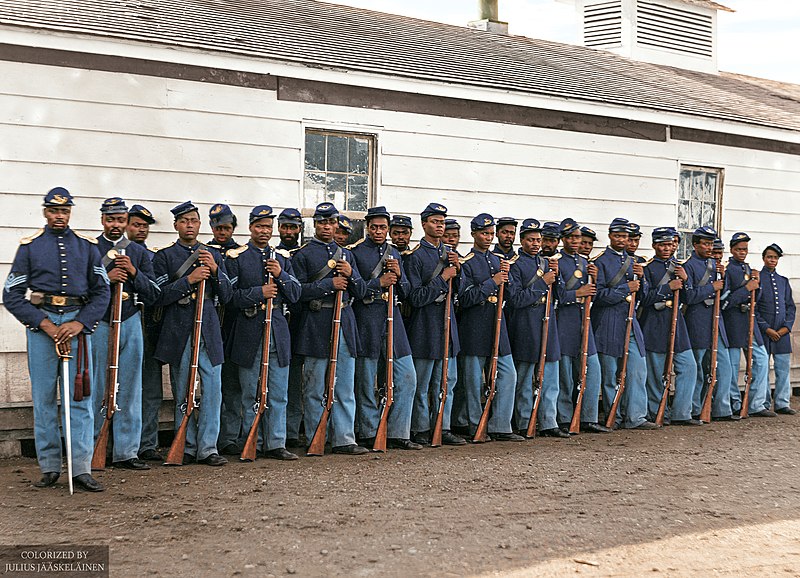
Union Army
InfantryWikipedia
999
MENTIONS
277
EPISODES
203
PODCASTS
Search complete. 999 mentions across 277 episodes found for "Union Army".
Oct 27, 2026

Roger McGrathGUEST
Doc's father, Henry Holliday, is an attorney.
Roger McGrathGUEST
who fights the Indians in 1838, the Mexicans in 1846, and the Yankees in 1861, rising to the rank of major in the Civil War before being forced by illness to resign his commission.
Roger McGrathGUEST
Doc has a comfortable middle-class childhood and receives a good education.
Roger McGrathGUEST
His mother, Alice, is a classic Southern belle.
Roger McGrathGUEST
Doc is only nine years old when the Civil War erupts in 1861.
Roger McGrathGUEST
Three years later, the family flees General Sherman's march to the sea and moves farther south to Valdosta, where Doc is enrolled in the Valdosta Institute and studies all the subjects common to classical education, including rhetoric, history, and Latin.
Roger McGrathGUEST
He wishes that instead of studying, he was fighting the Yankees.
Roger McGrathGUEST
Nonetheless, Doc is a good student and receives an excellent education considering the Civil War, which by the fall of 1864 is ravaging Georgia.

Darren MarlarHOST
The Battle of Antietam Creek, the bloodiest single day of the Civil War.
Darren MarlarHOST
The battle was fought on September 17, 1862, during some of the most brutal days of the war for the Union Army.
Darren MarlarHOST
They had been badly beaten at Manassas and were in the midst of turmoil as President Lincoln fired ineffectual general after general.
Darren MarlarHOST
At this point, it still looked as though the Confederacy might actually win the war.

speaker_5NARRATOR
Yet he had had previous experience in Indian fighting, and at the age of eleven he had killed his first Indian.
speaker_5NARRATOR
Shortly afterward the Civil War began, and Cody enlisted in the Union Army, serving as a scout.
speaker_5NARRATOR
When the fighting was over he returned to the far west.
speaker_5NARRATOR
the transcontinental railways were in process of construction a romantic episode in american history fittingly depicted in the glowing pages of zane gray's the u p trail the builders of the kansas pacific railroad wanted buffalo meat to feed their laborers and cody undertook the contract in eighteen months eighteen sixty seven to sixty eight he killed four thousand two hundred eighty buffaloes and thereby earned his title of buffalo bill In 1868 Cody rejoined the Army as scout and guide, and quickly made a reputation as a man of infinite endurance and daring.

David SenraHOST
Garfield was anxious to join the battlefield.
David SenraHOST
He was made a lieutenant colonel in the Union Army.
David SenraHOST
Soon after, at 30 years of age, he was promoted to colonel.
David SenraHOST
At this point, Abraham Lincoln is still alive.
David SenraHOST
Abraham Lincoln famously said, I hope to have God on my side, but I must have Kentucky.
David SenraHOST
So Garfield was actually sent to win Kentucky for the Union Army, although he was hopelessly inexperienced.
David SenraHOST
outmanned and outgunned, Garfield accepted the assignment.
David SenraHOST
After he received his orders, he worked through the night, hunched over a map of eastern Kentucky.

Courtney McInvaleGUEST
And Now it's a beautiful scenic area, but they have a monument there of cannonballs where Union General Haig, who was this beloved Norwegian man who had moved to Wisconsin, he had a mortal wound there.
Courtney McInvaleGUEST
And the Union Army went into mourning for him.
Courtney McInvaleGUEST
But he has this cannonball monument.
Courtney McInvaleGUEST
And I sort of went there.

Lynn ThompsonNARRATOR
The next day, June 28, he spent burying the dead, reorganizing for another offensive movement, and attempting to divine McClellan's plans.
Lynn ThompsonNARRATOR
lee reported to jefferson davis that the bridges over the chickahominy in rear of the enemy were destroyed and their reconstruction impracticable in the presence of his whole army and powerful batteries we were therefore compelled to wait until his purpose should be developed by nightfall however he realized that mcclellan was headed for the james river and made his plans accordingly early next morning june twenty ninth long street and a p hill were to cross the chickahominy at new bridge and take the darbytown road to where it met the long bridge road huger and magruder already on the south side of the river in front of richmond were ordered in pursuit of the federal forces huger by charles city road and magruder by the williamsburg road in the meantime jackson would cross grapevine bridge and sweep down the south side of the river to get in mcclellan's rear again lee's strategy was brilliant the charles city road met the long bridge road at a place called glendale or frazier's farm lee planned to have all his divisions converge there at about the time the middle of mcclellan's long column should be passing the impact of the expected blow would undoubtedly split the union army and with jackson's corps in the rear of one half the other half could be cut off and annihilated once again however the staff work and tactics were pitiful mcclellan's rearguard was posted about savage station on the richmond and york river railroad facing west richardson's division of sumner's corps was in an open field north of the railroad tracks and back of the station sedgwick's division held the center in another open field south of the tracks with its left resting on the williamsburg road general william f baldy smith's division of franklin's corps took position in the woods south of the williamsburg road mcgruder reached the vicinity of savage station about noon june twenty ninth but did not attack as he realized his four brigades were badly outnumbered he halted and waited for jackson who was supposed to turn the federal right flank along the chickahominy and get in their rear but jackson was delayed by the necessity of reconstructing grapevine bridge magruder then mistakenly reported mcclellan advancing and sent for two brigades from huger to support him lee canceled the order when he realized that what magruder had hit was only the rear guard covering the federal army's passage across white oak swamp what lee did not realize however was that jackson was not in position and would not reach savage station until three the following morning finally about five that afternoon magruder attacked with his four brigades and two regiments but it was too late with too little the federals withdrew hastily but safely in their haste they were forced to leave two thousand five hundred sick and wounded men in the field hospital at savage station and to abandon or destroy a vast amount of supplies and equipment glendale frazier's farm lee now ordered magruder to follow longstreet and a p hill down the darbytown road the next day june thirty longstreet and hill came upon the union troops of mccall and carney across the long bridge road about a mile west of the charles city road intersection at glendale hooker held the left or south flank with slocum on the right guarding the charles city road approach sedgwick was in the rear in reserve longstreet and hill halted and waited for huger coming down the charles city road and jackson supposedly coming on the federal rear from the white oak swamp meanwhile general t h holmes who had come from the south side of the james river with part of his division and general henry a wise's brigade had been sent by lee down the river or new market road in an attempt to get between mcclellan and the james river mcclellan anticipated the move however and warren of sykes division stopped holmes south of malvern hill lee then ordered magruder on the darbytown road to reinforce him but magruder's forces did not get there in time to help huger was delayed by obstructions mostly felled trees with which the federals had blocked his path instead of going around the obstructions huger continually halted to clear the road thus it resolved itself into a question of whether huger could clear the trees as fast as the union soldiers cut them down in this so-called battle of the axes huger lost and did not get to glendale in time to participate in the engagement about four that afternoon however longstreet heard artillery firing from huger's direction which was supposed to indicate his approach and expecting jackson's appearance momentarily he opened with one of his batteries and thus brought on the battle jackson never did show up being held north of white oak swamp by the artillery of richardson smith and did not get to glendale until the next day the fight was particularly vicious with many pockets of hand-to-hand combat but without the expected support of huger and jackson longstreet could not break the union lines in time to inflict any serious damage or to interrupt the withdrawal lee stated in his report could the other commands have cooperated in the action the result would have proved most disastrous to the enemy gone was lee's last chance to cut mcclellan's army in two malvern hill mcclellan had already selected another naturally strong position this time on malvern hill for the last stand before reaching the james river on the morning of july one morrell and sykes divisions of porter's corps were drawn up on the crest of the hill west of the quaker road east of the road couch's division of key's corps held the front with kearney and hooker of henselman's corps flanked to the right and rear somers's troops were in the rear in reserve the position was flanked on either side by creeks in deep ravines less than a mile apart and across this narrow front porter placed his batteries with the guns almost hub to hub in front the ground was open sloping down to woods marshes and swamps through which the confederate forces had to form for attack within range of the federal artillery lee had jackson on his left facing kearney hooker and couches right d h hill was in the center opposite couches left and morrell's right lee then ordered magruder to the right of hill but magruder was delayed by taking the wrong road so instead two brigades of hugers were placed on hill's right longstreet and a p hill their ranks decimated from the actions at gaines mill and glendale were held in reserve the terrain rendered it almost impossible for effective use of confederate artillery and the few batteries that did get into position were quickly cut to pieces by the massed union guns owing to ignorance of the country the dense forests impeding necessary communications and the extreme difficulty of the ground lee reported the whole line was not formed until a late hour in the afternoon the first real assault did not take place until after five and then it was uncoordinated and confused the signal for the attack was to be a yell from one of huger's brigades after the confederate artillery had blasted a hole in the union lines this put the responsibility of where and when to begin the attack on a mere brigade commander the artillery was unable to put concentrated fire in any one spot but huger attacked regardless and was beaten back with heavy losses then d h hill attacked only to suffer the same fate magruder finally sent his troops in a gallant charge across the open fields right up to the cannon's muzzles only to be mowed down like wheat at harvest time late in the battle jackson sent his own division to magruder's and hill's support but in the heavily wooded and swampy ground they got lost and did not arrive in time to help darkness finally put an end to these hopeless attacks as d h hill declared bitterly it was not war it was murder during the night mcclellan continued his withdrawal and the next day found the army of the potomac safe at harrison's landing under the protection of the federal gunboats on the james the seven days were over total casualties army of northern virginia twenty thousand six hundred and fourteen army of the potomac fifteen thousand eight hundred and forty nine in his official report of the campaign lee stated under ordinary circumstances the federal army should have been destroyed its escape was due to the want of correct and timely information this fact attributable chiefly to the character of the country enabled general mcclellan skilfully to conceal his retreat and to add much to the obstructions with which nature had beset the way of our pursuing collins but his other objective had been achieved richmond was safe at least for the time being while mcclellan had successfully changed his base of operations from the york to the james river and saved his army in the process he had failed in his first objective of capturing richmond and possibly ending the war the decision to remove the army from the peninsula rather than reinforce it for another attempt on richmond was made in washington over mcclellan's strong objections he wrote to general henry w halleck it is here on the banks of the james that the fate of the union should be decided although mcclellan wisely realized the advantages of another assault on richmond on the line of the james it was his own mistaken view of lee's strength that was the major reason for the withdrawal as halleck explained to him you and your officers at one interview estimated the enemy's forces in and around richmond at two hundred thousand men since then you and others report that they have received and are receiving large reinforcements from the south general pope's army covering washington is only about forty thousand your effective force is only about ninety thousand you are thirty miles from richmond and general pope eighty or ninety with the enemy directly between you ready to fall with his superior numbers upon one or the other as he may elect neither can reinforce the other in case of such an attack if general pope's army be diminished to reinforce you washington maryland and pennsylvania would be left uncovered and exposed if your force be reduced to strengthen pope you would be too weak to even hold the position you now occupy should the enemy turn around and attack you in full force in august the army of the potomac was transported by water back to washington to support pope's campaign in northern virginia mcclellan's failure to capture the confederate capital combined with lee's failure to destroy the union army assured the nation a long bitter war that became one of the great turning points in american history the years between in august eighteen sixty two lee wrote to jefferson davis if we are able to change the theatre of the war from the james river to the north of the rappahannock we shall be able to consume provisions and forage now being used in supporting the enemy so lee moved into northern virginia to meet pope's threatened overland campaign against richmond at second manassas bull run the union army was defeated again and withdrew into the fortifications around washington lee took advantage of this opportunity and made his first invasion north into maryland only to be defeated by mcclellan at antietam sharpsburg in september lee then withdrew into virginia and at fredericksburg in december he severely repulsed general ambrose burnside's move on richmond In the spring of 1863, the Union Army, now under Hooker, attempted to flank Lee's left and rear to cut him off from Richmond, but it was decisively defeated at Chancellorsville and driven back across the Rapidan.
Lynn ThompsonNARRATOR
Lee then made his second thrust north, penetrating into Pennsylvania, but was beaten back by Meade at Gettysburg in the summer of 1863 and, once again, retired into Virginia.
Lynn ThompsonNARRATOR
These gallant armies fought each other across the fields of Pennsylvania, Maryland, and Virginia before they clashed again in the outskirts of Richmond two years later.
Lynn ThompsonNARRATOR
part two the final struggle for richmond eighteen sixty four sixty five section four lincoln's new commander in march eighteen sixty four president lincoln appointed general ulysses s grant as commanding general of all the union armies said grant in the east the opposing forces stood in substantially the same relations toward each other as three years before or when the war began they were both between the federal and confederate capitals battles had been fought of as great severity as had ever been known in war from the james river to gettysburg with indecisive results he hoped to change this situation by putting pressure on all confederate armies at the same time something that had never been done before grant's plan called for gen benjamin f butler to march up the south side of the james and attack petersburg or richmond or both gen fran siegel to push down the shenandoah valley driving gen jubeau early before him thereby protecting washington general nathaniel banks in new orleans to march on mobile general william t sherman to cut across georgia driving johnston before him take atlanta and if necessary swing north to richmond meade's army of the potomac with grant in command to push lee's army of northern virginia and capture richmond as grant stated lee with the capital of the confederacy was the main end to which all were working lee's objective now was to stop grant and protect richmond said lee we must destroy this army of grant's before he gets to the james river if he gets there it will become a siege and then it will be a mere question of time the campaign started in the spring of eighteen sixty four when the army of the potomac crossed the rapidan river and the army of northern virginia blocked its path at the wilderness after a particularly vicious and costly battle grant instead of retreating to lick his wounds as other federal commanders had done executed a left flank movement still heading south and trying to get between lee and richmond a few days later the two armies clashed again at spottsylvania in a series of grim battles but still indecisive as far as major objectives were concerned although grant's losses were staggering he was slowly but methodically destroying lee's ability to wage offensive war again grant executed a left flank movement to get around lee and then by a series of flanking marches which the confederate soldiers called the sidling movement and the union soldiers the jug handle movement grant gradually worked his way down to cold harbor cold harbor where and what was cold harbor cold harbor was a seedy-looking tavern squatting by a dusty crossroads eight miles from richmond on the flat featureless plain intersected by hundreds of small creeks gullies and swamps that is characteristic of the land between the pamunkey and the chickahominy rivers there wasn't a harbor for miles and it was anything but cold it was the only cold harbor in the united states although there were many cold harbors on the stagecoach routes along the thames river in england the name indicated a place to get a bed for the night and something cold to drink but not hot meals but these dusty crossroads were strategically important if grant was to attack richmond and both lee and grant realized it also it was grant's last chance to continue his strategy of trying to get between lee and richmond any more flanking movements and lee would be in the entrenchments around the confederate capital where grant did not want to fight him as grant stated richmond was fortified and entrenched so perfectly that one man inside to defend was more than equal to five outside besieging or assaulting it is significant that lee also did not want to fight in the intrenchments around richmond there he would be on the defensive and in such a position could not possibly destroy grant's army so both commanders were willing for the test and what of the lowly foot-soldier the unsung hero in the ranks the poor bloody infantryman was he ready for the awful test to the average soldier this whole campaign was fast becoming just a series of hazy indistinct recollections like the fragments of a half-forgotten dream long columns of sweat-soaked soldiers marching over hills and rivers and swamps across ploughed fields and cornfields down endless dusty roads through dark lonely woods thirty days of marching by night and fighting by day until it must have seemed to them that the only things left in life were stupefying fatigue merciless heat choking dust smoke and noise mud and blood in the union ranks many of the men began to find out for the first time what hunger really was they had moved so fast and so often the ration wagons were left far behind hardtack was selling for a dollar apiece if you could find a seller and here at cold harbor the soldiers wrote their names and regiments on pieces of paper and pinned or sewed them to the inside of their dirty blouses with the forlorn hope that if and when they were killed some one might take the time to find out who they were to lee's barefoot ragged veterans hunger had been a constant companion for a long time but at cold harbor they approached starvation a confederate sergeant recorded in his diary when we reached cold harbor the command to which i belonged had been marching almost continuously day and night for more than fifty hours without food and for the first time we knew what actual starvation was when scurvy appeared among the men owing primarily to a lack of fresh vegetables lee advised them to eat the roots of the sassafras and wild grape if they could find any in the race for initial possession of the cross-roads at cold harbor lee's cavalry won by a few hours but in the afternoon of may thirty one general philip sheridan's cavalry drove them out and held the crossroads until relieved by the federal sixth corps under general horatio wright most of sheridan's troops were armed with the new spencer repeating carbine which made dismounted cavalrymen effective infantry the next morning june one lee through gen richard anderson's corps longstreet's old corps longstreet having been wounded in the wilderness against the federal sixth corps in a bold attempt to seize the crossroads and roll up grant's left flank before he could reinforce it but anderson was repulsed grant then moved the eighteenth corps under valde smith which he had borrowed from butler's army bottled up on the south side of the james over to the right of the sixth corps that afternoon they attacked anderson now supported by general robert holt's division the assault failed to break the confederate line but it did bend it back in several places grant believed that with a greater concentration a breakthrough could be achieved consequently he ordered the second corps under general winfield hancock over to the left of the sixth corps between it and the chickahominy river and planned an all-out attack by the three corps for the morning of june two anticipating the move lee put a p hill supported by general john breckinridge's division over to his right between anderson and the chickahominy and waited the expected attack failed to materialize however hancock got lost in the woods and swamps moving to his assigned position and after an all-night forced march men were too exhausted to mount an attack any chance the assault might have had for success was now gone the delay was fortunate for lee because breckinridge also got lost and was not in position to support hill on the morning of june two the attack was then ordered for that afternoon but again postponed until four thirty the morning of june five and each corps commander received a telegram from grant's headquarters that read corps commanders will employ the interim in making examinations of the ground in their front and perfecting arrangements for the assault lee's veterans took advantage of this fatal twenty four hour delay to entrench themselves quickly and effectively using every creek gully ravine and swamp in such fashion that all approaches to their positions could be covered with a murderous fire a newspaper reporter present at cold harbor wrote a vivid description of these intrenchments they are intricate zig-zagged lines within lines lines protecting flanks of lines lines built to enfilade opposing lines works within works and works outside works each laid out with some definite design lee needed this strong position he would fight at cold harbor without a reserve he wrote to jefferson davis if i shorten my lines to provide a reserve he will turn me if i weaken my lines to provide a reserve he will break them grant's battle plan was relatively uncomplicated it was essentially a simple frontal assault hancock's second corps and wright's sixth corps between the chickahominy and the cold harbor road now state route one fifty six together with smith's eighteenth corps north of the road were to attack all out and break the confederate lines general gouverneur warren's five corps north of the eighteen was to be held in reserve while burnside's ninth corps on grant's extreme right was not to enter the fight unless lee weakened his line in that sector and then it would attack supported by the five corps lee did not strengthen any part of his line so these two corps were not engaged to any appreciable extent Thus, the battle actually took place on approximately a two-and-a-half-mile front, although the army stretched for six miles from south to north, with the Union army facing west.
Lynn ThompsonNARRATOR
Grant's total strength was over 100,000 men, but less than 50,000 were actually engaged in the struggle.
Lynn ThompsonNARRATOR
Lee now had A.P. Hill, supported by Breckenridge, on his south flank next to the Chickahominy, opposite Hancock and Wright.

speaker_2NARRATOR
Peyton Farquhar, Alabama planter, stood at the end of a plank.
speaker_2NARRATOR
A captain of the Union Army and a sergeant stood at the other end.
speaker_2NARRATOR
When they step aside, the plank will tip upward, and Peyton Farquhar, Confederate spy, will slip between the ties to hang until dead above the muddy water of Owl Creek.
speaker_2NARRATOR
The captain steps aside, draws his sword, flourishes it to a carry,

Nick FreitasSOUNDBITE_SPEAKER
Not to mention the fact that the militia system was used extensively in the Civil War.
Nick FreitasSOUNDBITE_SPEAKER
In fact, if you look at the Union Army, Malcolm, you're going to find that it was largely comprised of units like the 50th Pennsylvania, the 20th Maine, the 69th New York Irish Regiment.
Nick FreitasSOUNDBITE_SPEAKER
Why? Because we didn't have a large standing army in part because all of the founders were very skeptical of large standing armies as being used as a tool of impression.
Nick FreitasSOUNDBITE_SPEAKER
This is why they believed that the individual right to keep in their arms so that such people could be members of the militia so they could actually protect against government tyranny was absolutely critical.

AshleyHOST
But he's buried in Fort Hill Cemetery, and his widow later erected the monument.
AshleyHOST
And then his bravery was also honored in Knoxville, where the Union Army named Fort Dickerson after him in 1863.
RandaHOST
Love.
RandaHOST
I think that's very interesting.

Champ HerrenHOST
He had several hundred acres.
Champ HerrenHOST
He had served in the Union Army, particularly in the Home Guards.
Champ HerrenHOST
hart was a war hero and a union cavalry officer who owned several large pieces of land in green in christian county hart's wealth was assessed to be an excess of 25 000 at the time it isn't perfectly clear where the trouble between the brother-in-law began or the in-laws began Hart maintained that Davis was neglectful and perhaps abusive of his sister, Ann Eliza.
Champ HerrenHOST
He also alleged that Davis did not provide adequately for his family.
Champ HerrenHOST
I just couldn't find it.
Champ HerrenHOST
He had served under Hart in the cavalry.
Champ HerrenHOST
Hart had achieved early fame at the Battle of Wilson's Creek, where he served effectively as a scout for the Union Army.
Champ HerrenHOST
Early in the war, ahead of Wilson's Creek, Hart went into a Confederate camp to gain intelligence on the position of the State Guard and McCullough's Texans.
267 more episodes mention Union Army.
Create an account to see the whole feed, search across every transcript, and follow the entities you care about.