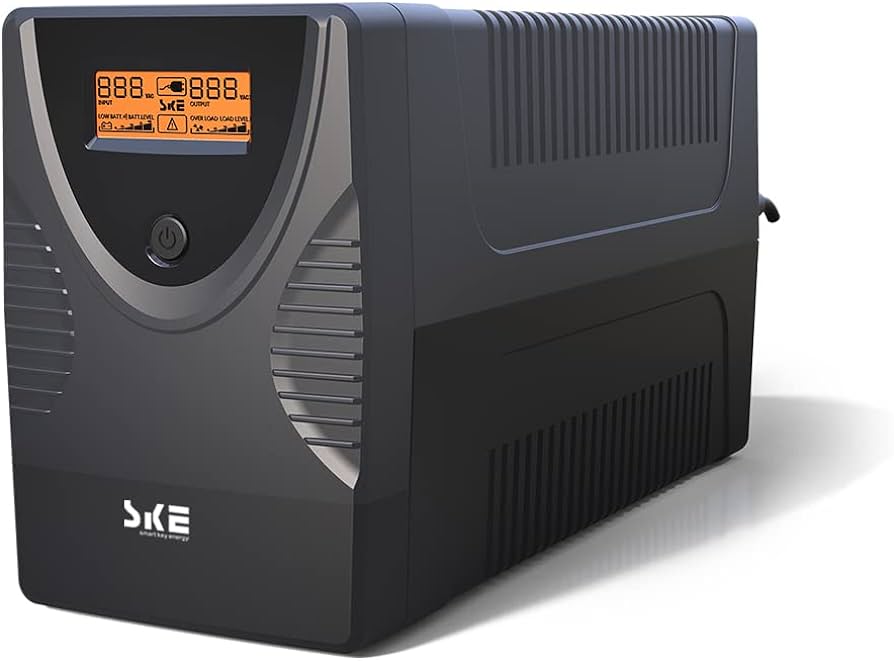
Uninterruptible power supply
111
MENTIONS
31
EPISODES
23
PODCASTS
Search complete. 111 mentions across 31 episodes found for "Uninterruptible power supply".
Oct 27, 2026

Stephen LaceyHOST
I do want to just talk about the kinds of batteries that we are discussing here.
Stephen LaceyHOST
Can we just differentiate traditional UPS batteries from the batteries outside of the data center, the much bigger batteries that we are talking about? Give folks a sense of the difference between the two.
Kelcy PeglerGUEST
Yeah, so batteries in battery energy storage systems, the world we live in, they look like AA batteries.
Kelcy PeglerGUEST
They're put in packs, and then they're put in shipping containers.
Hugh ScottGUEST
Yeah, I mean, I think you've got DC and AC and then back to DC again.
Hugh ScottGUEST
So how do you do that as efficiently as possible without losing power? And of course, there's multiple ways to do that.
Hugh ScottGUEST
I think the opportunity is to be able to take advantage of these huge shipping containers that Kelsey's talking about to provide that UPS.
Hugh ScottGUEST
It's funny, as Kelsey was describing the kind of space age liquid cooled, which is true, right? I mean, I was there too and I couldn't believe it, right? You're like, where's the sound? I'm reminded of, you know, I'm somebody that's been around data centers for, I'll just say decades without aging myself too much.

Tod HiginbothamGUEST
Our applications are far less than an hour.
Tod HiginbothamGUEST
Our core application, where about 80, 90% of our revenue comes from, is from data center UPS, backup power.
Tod HiginbothamGUEST
And the backup power system in data centers, basically the batteries are basically, we call it, they're active on the bus, which means is with any short, short duration blip, the batteries will discharge.
Tod HiginbothamGUEST
Make sure the servers don't reset, so you don't want to have any interruptions.
Tod HiginbothamGUEST
And that's right when we came in.
Tod HiginbothamGUEST
So our model of we can go to higher power and a smaller footprint, we were met with a lot of, we were welcomed because people were trying to do that.
Tod HiginbothamGUEST
And when I say that, think of the people who sell the UPSs are companies like Vertiv, Schneider, Eaton, Mitsubishi, Delta, sort of maybe the biggest ones.
Tod HiginbothamGUEST
Well, they've been increasing the power density of their inverters.

Scott BryanHOST
And the power doesn't just come in through, you know, a larger version of the outlet behind your desk.
Scott BryanHOST
At this scale, you're talking about utility transmission, major substations, high voltage transformers, medium voltage distribution throughout the campus, more transformers then closer to the equipment, switchgear, UPS systems, batteries.
Scott BryanHOST
It's really its own electrical ecosystem when you're talking facilities at that scale.
Gary SloperHOST
Yeah.

Seth JohnsonHOST
I got a little got something in the mailbag this week from listener Paul.
Seth JohnsonHOST
He says, now that you've replaced all your UPS batteries with three year batteries.
Seth JohnsonHOST
So, yeah, that was me.
Seth JohnsonHOST
I I had to replace all my all my old.
Seth JohnsonHOST
I don't know.
Seth JohnsonHOST
I don't want to go through that.
Seth JohnsonHOST
I guess some of these lithium UPSs are about what I paid for replacing all the batteries, but I wouldn't want to do this again.
TJ HuddlestonHOST
Yeah, I've seen people recommend these, but honestly, the SLA batteries, the sealed lead acid batteries that Seth is talking about, most of the time when you get a UPS, if you get the user-replaceable ones, it's 12-volt 7-amp batteries, and you can usually find them for like $20 or $30 each.

Ian HamiltonHOST
The tragedy of podcasting, yeah, you can't look at your toys.
Ian HamiltonHOST
Do you have a UPS in there, and how do you handle air conditioning? Those are the two questions I deal with when it comes to VR, because VR seems to increase the temperature about 10 degrees, and if you don't have air conditioning, you're in trouble.
Sean HollisterGUEST
It's true.
Sean HollisterGUEST
We are lucky enough that we were able to install a mini split system.
Sean HollisterGUEST
Here in the office, I get a little bit of cold.
Sean HollisterGUEST
And what was the second half of your question? It was air conditioning and then...
Ian HamiltonHOST
UPS power.
Ian HamiltonHOST
Yes,

Tom HarriesGUEST
And obviously, where space is a premium in a data center, that is very valuable.
Tom HarriesGUEST
If you can save the space on the UPS side of things, you can put in more racks and servers, etc., where you actually make your money as a data center operator.
Tom HarriesGUEST
The other side of it is where in that scheme of things does battery go? And I'll come to that in a second.
Tom HarriesGUEST
The other use case, the third one, so the first one was power supply.
Tom HarriesGUEST
The second one was the UPS.
Tom HarriesGUEST
The third one, along the side of power quality, is very simplistically a GPU, i.e. the chips that are in the data centers that perform the work.
Tom HarriesGUEST
They oscillate in power demand quite rapidly.
Mithun VarkeyHOST
So it's not just one application that's being implemented across multiple parts of the data center value chain.

Daniel BurkeHOST
Hartford Steam Boiler recommends contingency plans for shutting equipment down in order and restarting it in order, too.
Daniel BurkeHOST
The fix for interruptions is a UPS, which stands for uninterruptible power supply.
Daniel BurkeHOST
A UPS keeps regulated power flowing to your equipment for a period of time after the supply fails.
Daniel BurkeHOST
A rotary UPS uses a motor generator set and carries the load for a short time.
Daniel BurkeHOST
A static UPS uses power electronics and a bank of batteries.
Daniel BurkeHOST
Every UPS depends on properly maintained batteries.
Daniel BurkeHOST
Size it to how critical and how large the loads are.
Daniel BurkeHOST
where losing power would be severe, consider redundancy, and treat every component of the backup system as a point of failure.

Gene MitchellHOST
Uh, good chance to talk about them for a minute.
Gene MitchellHOST
There's UPSes and then there's good UPSes.
Gene MitchellHOST
Uh, most UPSes put out a square wave, which is all right for a computer because they operate on, uh, transformers or power packs that don't mind.
Gene MitchellHOST
But if you plug anything critical in it, what I mean critical, uh, shortwave receiver and stuff that, uh, has transformers right on their power.
Gene MitchellHOST
Um, transformers do not like square waves.

Tod HiginbothamGUEST
So yeah, the, the AI power spike, very, very interesting.
Tod HiginbothamGUEST
So, you know, our initial entrance in this market was for UPS or backup power for data centers.
Tod HiginbothamGUEST
It's been around forever.
Tod HiginbothamGUEST
You know, the reliability for data centers is extreme, you know, we call it critical, and they've always had batteries.
6 MINS LATER
Tod HiginbothamGUEST
We'd be heavier, we wouldn't last as long.
Tod HiginbothamGUEST
We're more expensive, so we'd, we'd love to do those applications, but, uh, we just have to stay in our little, in our little world here.
Tod HiginbothamGUEST
And when we started, it was a little bit like we had a solution looking for a problem because we knew what our battery could do, and then, you know, UPS data center was really booming, and then AI came.
Tod HiginbothamGUEST
So these are just our sweet spot.
21 more episodes mention Uninterruptible power supply.
Create an account to see the whole feed, search across every transcript, and follow the entities you care about.