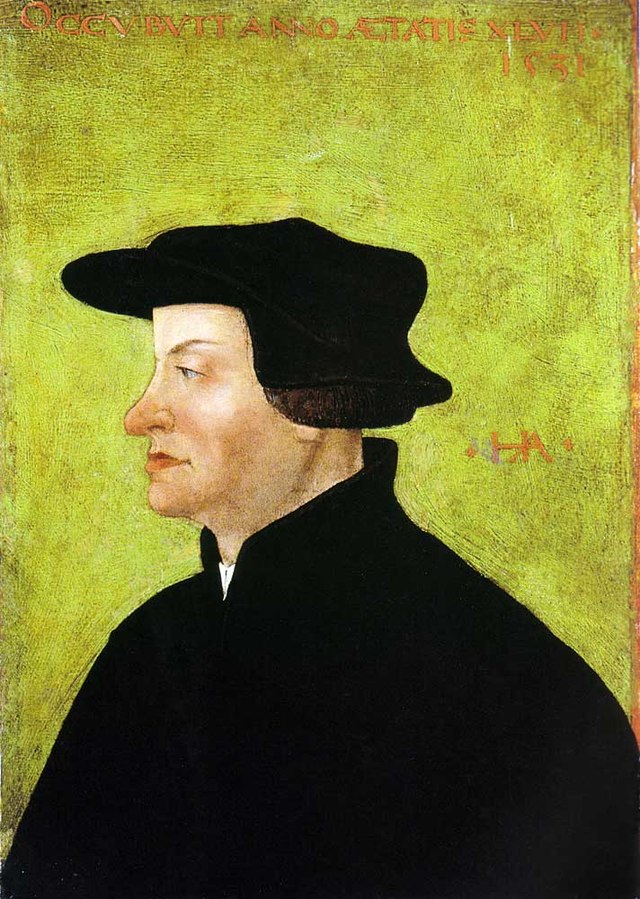
Ulrich Zwingli
Swiss theologianWikipedia
268
MENTIONS
67
EPISODES
57
PODCASTS
Search complete. 268 mentions across 67 episodes found for "Ulrich Zwingli".
Sep 15, 2026

John BradshawHOST
The Puritans of New England believed that religious freedom applied to you only if you lived and believed and worshiped as they did.
John BradshawHOST
But then along came Roger Williams, who introduced the concept of religious liberty for all, and then the truth would go marching on through men like Ulrich Zwingli in Zurich, and John Wesley and his brother Charles in England, through Philip Melanchthon, and Thomas Cranmer, and Hugh Latimer, and Nicholas Ridley, and Theodore Beza, and John Knox in Scotland, and Hassan Jerome, and William Farrell, and Roger Williams, and many others.
John BradshawHOST
So when did the Reformation end? Or has it ended? Perhaps there's still a work to be done, a work of reform, a work of calling people to faithfulness to God and to faith in the Word of God.
John BradshawHOST
Throughout the rest of this series, 500, you'll meet some of the great characters of the Reformation.

speaker_0HOST
Luther taught Christ was still somehow physically present, not that he changed and became, you know, the bread became him, but the bread was still the bread, but somehow he was in the bread of consubstantiation.
speaker_0HOST
Zwingli was another reformer who taught, no, it's just memorialist view.
speaker_0HOST
It's just we do this in memory of him, which we do in a sense.
speaker_0HOST
But we, as a reformed Presbyterian church, go with what John Calvin taught of this.

Joe AnadyHOST
Uh, the Lutheran view called consubstantiation.
Joe AnadyHOST
The memorial view, um, is associated with Zwingli, correct? That's the Zwinglian view.
Joe AnadyHOST
And then there's the, the view of Calvin, uh, which is that there's real presence, but it's not carnal or corporeal as you said earlier.
Joe AnadyHOST
Uh, Christ is really present spiritually in the bread and in the cup when the, the church partakes.
Ryan DavidsonGUEST
Yeah, that's a good summary, and I think, you know, if you dive into the scholarship, you know, there, there are gonna be offshoots.
Ryan DavidsonGUEST
There's, uh, perhaps some scholarship out there that would debate exactly did, did Zwingli's view shift over time-
Joe AnadyHOST
Sure
Ryan DavidsonGUEST
... or Lutherans who may say, "Well, I'm not comfortable with the word consubstantiation." So obviously our listener will have to just assume that we're just trying to give broad categories here, but yes, I think those are the four main, main categories.

R. Scott ClarkHOST
We talked about that a little bit before, and I said I would come back to this, and so here I am.
R. Scott ClarkHOST
Zwingli taught it, so did Bullinger.
R. Scott ClarkHOST
It's in the Second Helvetic Confession, so this isn't even just a private opinion among the Reformed.
R. Scott ClarkHOST
It made it into a confessional tradition.

Jacob PraschHOST
Other times it was Mennonites.
Jacob PraschHOST
The Mennonites and the Menno Simons were doctrinally far, far superior in their doctrine as an Anabaptist sect to Luther or Calvin or Zwingli or any of the Reformation churches.
Jacob PraschHOST
Their doctrine was right, much more right.
Jacob PraschHOST
They were practices of believers' baptism, among other things.

Pamela NagamiNARRATOR
Book 3, Chapter 12.
Pamela NagamiNARRATOR
The Reformation in Switzerland, Zwingli and Calvin, Part 1.
Pamela NagamiNARRATOR
A. Zwingli The Reformation movement in Switzerland naturally divides itself into two parts.
Pamela NagamiNARRATOR
The one is connected with the name of Zwingli and the town of Zurich, the other with the Frenchman Calvin and the town of Geneva.
Pamela NagamiNARRATOR
Zwingli was Luther's contemporary.
Pamela NagamiNARRATOR
Calvin belonged to a generation later.
Pamela NagamiNARRATOR
Zwingli's Reformation was accomplished in the German-speaking east of Switzerland, Calvin's in the French-speaking west.
Pamela NagamiNARRATOR
There was little direct connection between the two movements, and yet the one was a continuation of the other.

Bruce GordonGUEST
My interests are around the Reformation.
Bruce GordonGUEST
I spent a lot of time on the Swiss Reformation, Calvin, Zwingli, but more broadly also the kind of afterlife of the Reformation through to today.
Bruce GordonGUEST
I have a great interest in the history of death and dying, the culture of death in medieval through to the modern world, and the reason we're here today, a huge interest in the Bible in all its aspects, from translation and material forms to interpretation and illustration, and recently did a book called The Bible, A Global History.
Tony WatkinsHOST
which I have here.

Linda AllcockGUEST
But at the heart of it all really was the recovery of the Word of God and the power of the Word of God.
Linda AllcockGUEST
that really lit a fire in the hearts right from Wycliffe, through Luther, through Zwingli, Calvin, right on into the English Reformation.
Linda AllcockGUEST
And I think that it lit a fire in people's hearts that enabled them to see that change, reform, renewal was absolutely necessary.
Linda AllcockGUEST
And I think it's just quite encouraging to think, wow, God's word has done it over and over again in church history.

Andrew WilsonHOST
The Baptist view, which this person is describing, I think a lot of Baptists do get pretty close to going, it's just a symbol.
Andrew WilsonHOST
Baptists, this is a position at the time was held by Ulrich Zwingli, but often the Anabaptists went there as well, which is at the other end of the spectrum, which is, this is just a symbol.
Andrew WilsonHOST
It's just a way of trying to get you to remember what Jesus did.
Andrew WilsonHOST
It doesn't actually do, there's no spiritual welly or power or anything like that to the body at all.
speaker_1HOST
Now, some of your, you know, academic people, and especially in the Reformed camp, will know the Reformation till now.
speaker_1HOST
And they know Martin Luther and John Calvin and, and Zwingli and all those guys.
speaker_1HOST
Not so much the English Reformation, but the Continental Reformation.
speaker_1HOST
Um, so they'll know the start of the Reformation, but they may not know all of the ins and outs.
57 more episodes mention Ulrich Zwingli.
Create an account to see the whole feed, search across every transcript, and follow the entities you care about.