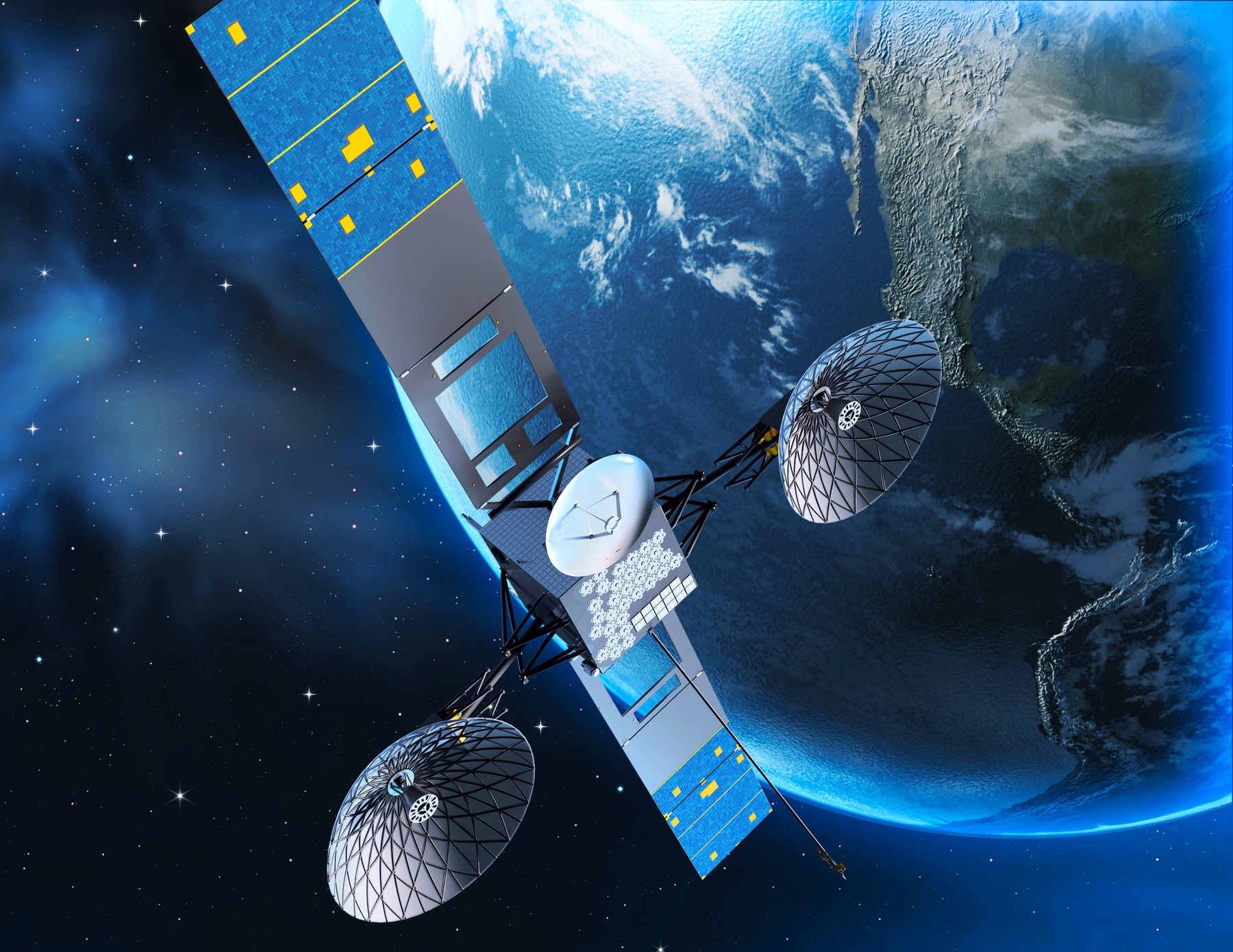
Tracking and data relay satellite
Satellite typeWikipedia
22
MENTIONS
12
EPISODES
9
PODCASTS
Search complete. 22 mentions across 12 episodes found for "Tracking and data relay satellite".
Nov 25, 2026

QuinnHOST
Her first mission was STS-6, carrying four crew.
QuinnHOST
It deployed the first tracking and data relay satellite, or TDRS, that would slowly replace NASA's network of international ground stations for actually talking to satellites.
QuinnHOST
So before these satellites, You can only talk to a satellite if it is in sight of a ground station somewhere.
QuinnHOST
These satellites, TDRS, they act as relays so that once they have enough of them in space, you can talk to any satellite anywhere in orbit from just by like bouncing the signals between them.
QuinnHOST
So it is like a pretty big deal there.
QuinnHOST
Also, it produced the first spacewalk for the shuttle.

Scott ManleyHOST
26th of March we had the Long March 3B-E carrying Tianlin 204 out of Qichang and this launched into geostationary transfer orbit.
Scott ManleyHOST
Obviously it's going to GEO and that means it's a communication satellite and this is actually like the Chinese equivalent of TDRS, right? It's a data tracking relaced communication satellite that's designed to talk to Chinese spacecraft in lower orbits.
Scott ManleyHOST
This is like second, third generation of these satellites, I believe, but it's obviously very important to Tiangong Space Station.
Scott ManleyHOST
26th of March, we had another Falcon 9 carrying 27 Starlink.

Mike SiegelGUEST
That was what made the telescope unique, that it would detect this flash of gamma rays, it would know where the Earth was, because it can't point too close to the Earth, where the Sun was, where the Moon was, and figure out a path through the sky to repoint itself automatically.
Mike SiegelGUEST
And then what it would do is it would send alerts through the TDRS system, this network of satellites around the Earth, to our ground stations to let us know.
Mike SiegelGUEST
And those would go out to our phones in the form of text messages that, in my case, was connected to a very loud alarm that would let us know that we detected something.
Mike SiegelGUEST
And so then we'd all get on our computers and look at the data and send out a notice to the community so that other telescopes, bigger telescopes, could look at it and get more data.

Mike SiegelGUEST
It would know where the Earth was because it can't point too close to the Earth, where the sun was, where the moon was, and figure out a path through the sky to repoint itself automatically.
Mike SiegelGUEST
And then what it would do is it would send alerts through the TDRS system, this network of satellites around the Earth, to our ground stations to let us know.
Mike SiegelGUEST
And those will go out to our phones in the form of text messages that, in my case, was connected to a very loud alarm that would let us know that we detected something.
Mike SiegelGUEST
And so then we'd all get on our computers and look at the data and send out a notice to the community so that other telescopes, bigger telescopes, could look at it and get more data.

speaker_0NARRATOR
Another highly specialized group of communication satellites is also stationed in geosynchronous orbit.
speaker_0NARRATOR
NASA currently operates 10 tracking and data relay satellites, TDRS.
speaker_0NARRATOR
Originally designed to provide a continuous communications link for shuttle missions, TDRS supports many near-Earth satellites, as well as the International Space Station, the Hubble Space Telescope, and some military applications.
speaker_0NARRATOR
Similarly, ESA has launched two of what will be a group of four data relay platforms to provide a continuous link with near Earth satellites.
speaker_0NARRATOR
Instead of transmitting to ground stations, only visible for brief parts of every orbit, many satellites now send signals up to a data relay spacecraft that can see it for half of each orbit.

John ShawGUEST
We've done this before.
John ShawGUEST
The TDRS system that has largely been used by NASA in the past was also used by the Department of Defense.
John ShawGUEST
And they were joint programs with joint dollars supporting those programs.
John ShawGUEST
So we have done that before.

Harrison LambertHOST
Communications had a huge week as billions of dollars poured into a number of different contracts.
Harrison LambertHOST
The headliner here is a $1.07 billion contract for NASA's TDRS replacement.
Harrison LambertHOST
So TDRS is the data relay system that NASA uses to communicate between their LEO satellites and Earth.
Harrison LambertHOST
It relays up to GEO satellites and comes back down.
Harrison LambertHOST
This constellation is aging, has been for a while.
Harrison LambertHOST
NASA's been rumored to be looking for a TDRS replacement, and this week they selected three.
Harrison LambertHOST
Those include Viasat, which won $460.9 million, SES, who won $340.4 million, and Astranis, who won $264.3 million.
Harrison LambertHOST
This is a very interesting breakdown.

Brian BarnettGUEST
And we used the Wi-Fi on board to post the first tweet from space using entirely commercial infrastructure.
Brian BarnettGUEST
So NASA had done that with the TDRS satellites, the government satellites, on the space station, I don't know, I think nine years earlier than we did.
Brian BarnettGUEST
So they did the first tweet from space using government infrastructure.
Brian BarnettGUEST
Solstar was the first company to use entirely commercial infrastructure to do that.
Brian BarnettGUEST
Took longer than I expected, but now that's happening because, so that's part of this is that you have to have, the market has to be ripe for what you're doing.
Brian BarnettGUEST
And that's what's happening right now with commercial space communications.
Brian BarnettGUEST
For instance, NASA has been doing what I've been talking about, this constant connectivity through the TDRS satellites, the tracking and data relay satellites that have been up there starting since the 80s that provides this SATCOM to the space shuttle and then the space station all these years.
Brian BarnettGUEST
So NASA's retiring the TDRS satellites starting, I think, 2030.

Jennifer PulleyHOST
The ballots are then routed up to NASA's tracking and data relay satellites, which relay them to its ground terminal in White Sands, New Mexico.
Jennifer PulleyHOST
Landlines from the TDRS ground terminal transmit the ballots to the Mission Control Center at NASA's Johnson Space Center in Houston.
Jennifer PulleyHOST
From there, Johnson electronically delivers the ballots back to the county clerk's office where the astronaut is registered.
Jennifer PulleyHOST
Many of the astronauts who have taken advantage of that right over the years remind all of us that voting really is our civic duty.
Scott ManleyHOST
It actually has to have multiple communication systems on board.
Scott ManleyHOST
On the command module itself there's like a flat panel antennas which speak to the TDRS spacecraft in low Earth orbit and then at a certain point They have to flip this around and start talking to the Earth directly by using Deep Space Network.
Scott ManleyHOST
I mean, and that is only sort of part of the explanation.
Scott ManleyHOST
There's a lot of other complicated problems that they have to deal with.
2 more episodes mention Tracking and data relay satellite.
Create an account to see the whole feed, search across every transcript, and follow the entities you care about.