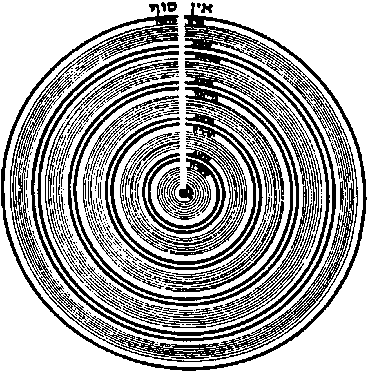
Tzimtzum
305
MENTIONS
114
EPISODES
36
PODCASTS
Search complete. 305 mentions across 114 episodes found for "Tzimtzum".
Sep 14, 2026

BenziHOST
We consist of the will to receive, but in it there is a part that stays restricted forever, which is the intention in order to receive, as opposed to that part that develops, called the intention, the faith, the tzedakah.
BenziHOST
It develops without having some kind of something called reward, feedback for the restricted will to receive, because if it were so, then... we breach the Tzimtzum.
BenziHOST
So Rabat explains, that faith, like charity, that I give someone something and I'm already no longer related to
BorisHOST
it.
9 MINS LATER
BenziHOST
Before one is rewarded with vessels of bestowal, he has no room for faith.
BenziHOST
Once he has vessels of bestowal and has been rewarded with faith, he obtains the purpose of creation which is to do good to his creations this means that he feels the delight and pleasure that the creator has created to do good to his creations at that time one is rewarded with peace but before one has been rewarded with his taka which is faith on the basis of vessels of the stole he does not have the killing to obtain the delight and pleasure Because we lack the vessels, we don't have the right perception.
BenziHOST
Since the good is lacking the correction of not being the bread of shame, for which there was the correction of Tzimtzum Aleph.
BenziHOST
Only when the creatures have the correction, that correction called vessels of bestow, there will be a place where the light of the Creator can be present.

speaker_2HOST
We consist of the will to receive, but in it there is a part that stays restricted forever, which is the intention in order to receive, as opposed to that part that develops, called the intention, the faith, the tzedakah.
speaker_2HOST
It develops without having some kind of something called reward, feedback for the restricted will to receive, because if it were so, then... we breach the Tzimtzum.
speaker_2HOST
So Rabat explains, that faith, like charity, that I give someone something and I'm already no longer related to
speaker_0HOST
it.
9 MINS LATER
speaker_2HOST
Before one is rewarded with vessels of bestowal, he has no room for faith.
speaker_2HOST
Once he has vessels of bestowal and has been rewarded with faith, he obtains the purpose of creation which is to do good to his creations this means that he feels the delight and pleasure that the creator has created to do good to his creations at that time one is rewarded with peace but before one has been rewarded with his taka which is faith on the basis of vessels of the stole he does not have the killing to obtain the delight and pleasure Because we lack the vessels, we don't have the right perception.
speaker_2HOST
Since the good is lacking the correction of not being the bread of shame, for which there was the correction of Tzimtzum Aleph.
speaker_2HOST
Only when the creatures have the correction, that correction called vessels of bestow, there will be a place where the light of the Creator can be present.

BensiHOST
It develops without having some kind of, uh, something called reward, feedback for the restricted will to receive.
BensiHOST
Because if it were so, then we breach the Tzimtzum.
BensiHOST
So Rabash explains that faith, like charity, that I give someone something and I'm already no longer related to it.
BensiHOST
I gave it, and I didn't get anything in return.
10 MINS LATER
BensiHOST
But before one has been rewarded with Tzedakah, which is faith on the basis of vessels of bestowal, he does not have the Kelim to obtain the delight and pleasure because we lack the vessels.
BensiHOST
We don't have the right perception.
BensiHOST
Since the good is lacking the correction of not being the bread of shame for which there was the correction of Tzimtzum Alef.
BensiHOST
Only when the creatures have the correction, that correction called vessels of bestowal, there will be a place where the light of the creator can be present.
BorisHOST
It develops without having some kind of something called reward, feedback for the restricted will to receive, because if it were so, then...
BorisHOST
We breach the Tzimtzum.
BorisHOST
So Rabat explains, that faith, like charity, that I give someone something and I'm already no longer related to
BensiHOST
it.
10 MINS LATER
BorisHOST
with peace.
BorisHOST
But before one has been rewarded with istaka, which is faith, on the basis of vessels of the stole, he does not have the kilim to obtain the delight and pleasure, because we lack the vessels.
BorisHOST
We don't have the right perception, since the good is lacking the correction of not being the bread of shame, for which there was the correction of Tzimtzum Aleph.
BorisHOST
Only when the creatures have the correction, that correction called vessels of bestowal, there will be a place where the light of the Creator can be present.

Zushe WinnerGUEST
Well, hold it.
Zushe WinnerGUEST
Tzimtzum is not Kipshutei.
Zushe WinnerGUEST
It's Svarim.
Zushe WinnerGUEST
So really, you see, the Rebbe is looking at all these Svarim, and he's keeping a list of Tzimtzum Kipshutei.
Zushe WinnerGUEST
It's not Kipshutei.
Zushe WinnerGUEST
And one of the lists is Reb Nachman Breslov.
GilHOST
That
GilHOST
stems from that I have developed the ability to receive O Yashar wrapped in Och Zer and thanks to having the ability to making it Tzimtzum and reflected light I'm capable of wrapping the O Yashal and receiving it inside as O Nini.
GilHOST
And then it is felt as inner connection with the
GilHOST
Creator.

OsterHOST
But when you get to the concept of Sheirish, Sheirish means that there is something that's in a potential state in the source, and then from there it comes out into a developed state as an existence.
OsterHOST
Regarding Kav, where does Kav stem from? So generally speaking, so we know that it says in Chassidus that the that is the that is expressing the unlimitedness of what Hashem is and there there's no room for any existence, there's no room for no possibility meaning and then there's the And then there is a light that stems from before Tzimtzum that is being expressed and revealed in a Kav.
OsterHOST
And that Kav brings the light of Ein Seif, of the Ebershter, into the world.
OsterHOST
That's very generally the description of how Kabbalah, Chassidus, describes the meaning of the Kav.
OsterHOST
Azzilis is the Olam where Kav is revealed to, meaning the Indian of Azzilis is a world of Holocaust, Pshitas of Hashem, and so on.
OsterHOST
Kav is in Azzilis.
OsterHOST
But what really, when Chassidus discusses this question about the Indian of Kav, on one hand, in order for there to be an Elamist, there has to be a Tzimtzum Rishen.
OsterHOST
Otherwise, there's no mocking for Matias.
OsterHOST
When is that? When we speak about Eir HaKav.
OsterHOST
The Kav is a line of light that has a certain definition after Tzimtzum, and before Tzimtzum, it existed as well, and there is the Sheirish of the Kav.
OsterHOST
So the term of Sheirish is used regarding Eir as well.
OsterHOST
Now what we learned yesterday is, Rebbe explained here, that Kav has two different aspects to it.
OsterHOST
It's all within the existence of the hebishter, not related to what's outside.
OsterHOST
Those are the two inyonim.
OsterHOST
Regarding the inyon of the gvul in the kav, The Rebbe says that this over here, kav is ila v'olol, that is the way the kav exists before Tzimtzum, and the way it is after.
OsterHOST
And regarding the aspect of the bligvol of the kav, it's yesh ma'ayin.
speaker_0HOST
And between them, there are many, many interactions and relationships also.
speaker_0HOST
He starts giving us definitions, but Tamim are felt as an inner unification, That stems from that I have developed the ability to receive O Yashar wrapped in Och Zeru, and thanks to having the ability to making it Tzimtzum and reflected light, I'm capable of wrapping the O Yashar and receiving it inside as O Panini.
speaker_0HOST
And then it is felt as inner connection with the Creator.
speaker_2HOST
I
speaker_2UNKNOWN
That
AvivHOST
stems from that I have developed the ability to receive O Yashar wrapped in Och Zer and thanks to having the ability to making it Tzimtzum and reflected light I'm capable of wrapping the O Yashal and receiving it inside as O Nini.
AvivHOST
And then it is felt as inner connection with the
speaker_2UNKNOWN
Creator.
104 more episodes mention Tzimtzum.
Create an account to see the whole feed, search across every transcript, and follow the entities you care about.