Turing machine
38
MENTIONS
22
EPISODES
20
PODCASTS
Search complete. 38 mentions across 22 episodes found for "Turing machine".
Sep 10, 2026

Susan ValotHOST
The team's most striking connection related the same version of the pigeonhole principle to one of the first theorems that students encounter in introductory complexity theory courses.
Susan ValotHOST
This classic banger of a theorem, as IBM's Marco Carmosino describes it, sets a lower bound on the amount of time required for a type of theoretical computer called a single-tape Turing machine to determine whether a string of zeros and ones is a palindrome.
Susan ValotHOST
So does it read the same forward and backward? Li, Chen, and Oliveira used reverse mathematics to prove that within PV1, this palindrome lower bound theorem is equivalent to the pigeonhole principle.
Susan ValotHOST
Chen says if you told him this, he wouldn't believe it because it sounds very ridiculous.

YuvalHOST
He used a really evocative metaphor later on.
YuvalHOST
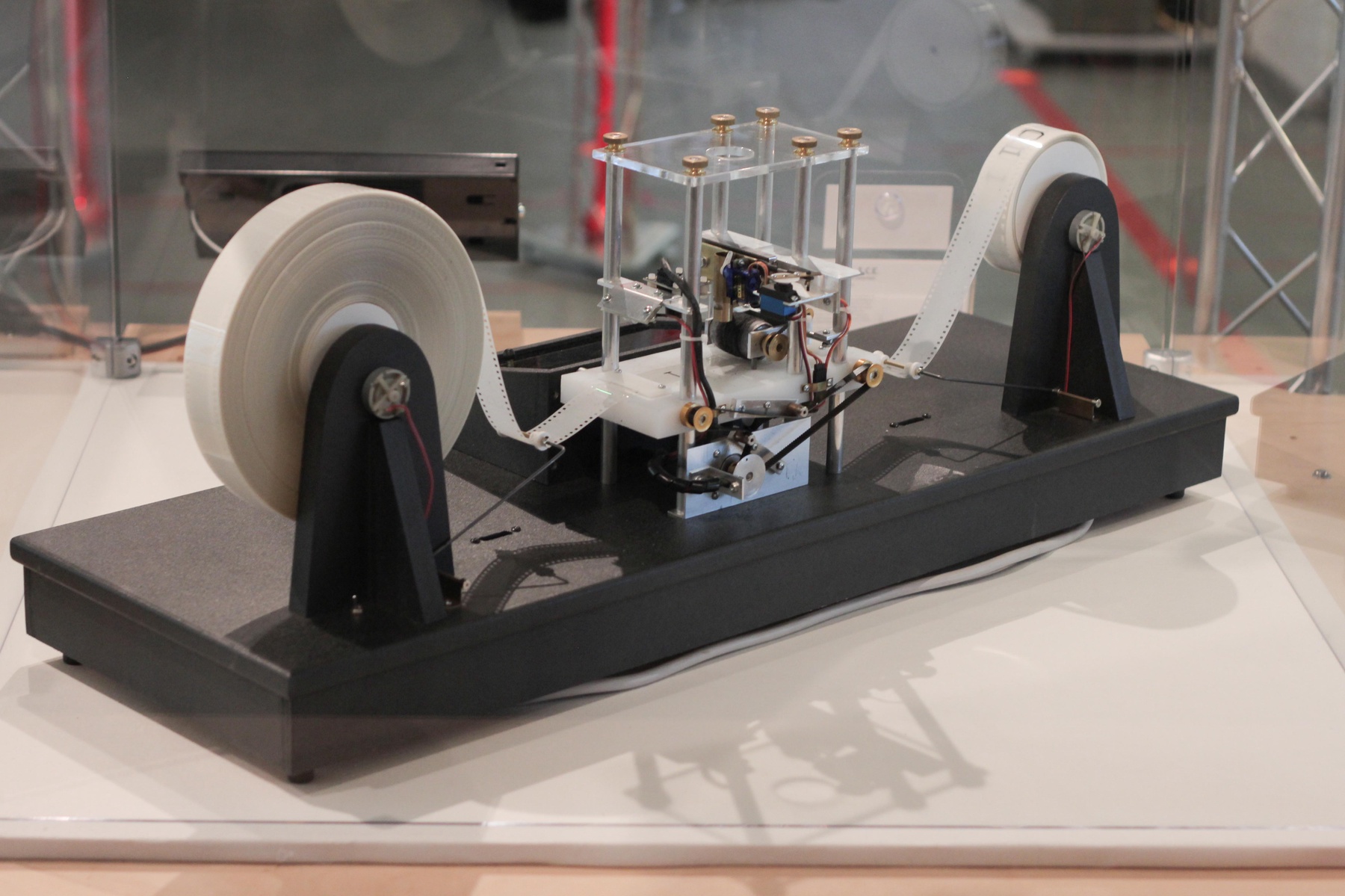
He said a raw model is like a Turing machine with a ticker tape, just reading and writing sequentially.
YuvalHOST
But a well-designed harness turns it into a Von Neumann computer.
AmitHOST
Exactly, because the harness adds persistent state, tools, and compute.
Ben BrubakerGUEST
But I think what I was trying to do was just understand, like, if you think about these more mathematical abstract sides of the field, fundamentally, like, you don't need computers to do that work, but how important is the existence of these machines to that side of the work, like conceptually? And one reason you might say, "Well, it's not really about computers," is that the people who first started to think about these questions from the theoretical side, in many cases, they weren't motivated by the possibility of building computing machines.
Ben BrubakerGUEST
Like Alan Turing, who came up with this famous model of computation called the Turing machine, was trying to think about how human mathematicians work.
Samir PatelHOST
Defining the human mathematician also as a computer-
Ben BrubakerGUEST
Right.

NunoHOST
Then, yeah, two games I don't have much to talk about.
NunoHOST
Turing Machine I got recently, and it's a game I have already...
NunoHOST
It's the only game I think I've learned digitally and played digitally before... having it and I think it's a blast it's a simple game that is really hard to get your head around it the first time because it's a logic game where you have some conditions and you're trying to figure out the code and just how the conditions work in the machine it's a bit it's a bit weird to get your end around and I totally remember that because I tried to teach it to my wife this past weekend and it went horribly wrong And I realized, yeah, I remembered, yeah, I was like playing six or 10 games of these in PGA, not understanding what was happening until I got it.
NunoHOST
And then it's simple.
29 MINS LATER
DaveHOST
Nice.
DaveHOST
Yeah, definitely we'll look into that one.
NunoHOST
And then going to the next, that I already talked about, Turing Machine, which the game doesn't really tell you much, just tells you that the game is based on an analog machine that Alan Turing invented to crack codes from the Nazis, but it doesn't really tell you more, but it made me go search.
NunoHOST
and find out some horrible things, that not only Alan Turing was responsible for ending the war, because he cracked the Enigma codes and they were able to listen on the Nazis, and that way that was really important to end the war, but also that Alan Turing was gay, and after the war was over, the British Empire castrated him, chemically.

Shriram KrishnamurthiGUEST
What you mean by I don't care how it's expressed is, I've got this medium that we've never really sat down and voted on, but we've just decided on.
Shriram KrishnamurthiGUEST
It's not quite the Turing machine either.
Shriram KrishnamurthiGUEST
Yeah, it's not the Lambda calculus, but it's not a Turing machine either.
Shriram KrishnamurthiGUEST
But we've just kind of agreed upon this.
Shriram KrishnamurthiGUEST
It's not even, in fact, most algorithms books are like first order, right? There's maybe a little higher orderness, like, oh, maybe sort will take up argument to like decide which way to sort.
6 MINS LATER
Shriram KrishnamurthiGUEST
I don't think, I don't, I'm not quite ready to say like, I mean, I don't, I haven't traced the full history here.
Shriram KrishnamurthiGUEST
I think it's certainly the case that if you go to complexity theory courses, there's very few people who tried to do complexity theory through like Lambda calculus.
Shriram KrishnamurthiGUEST
Most complexity theory courses are definitely done through Turing machines.

Angus MenugeGUEST
And of course, that view initially seems very naive because the machines of the time did one particular thing, like a sewing machine is just good for clothes.
Angus MenugeGUEST
So the thesis was really rather implausible until the development of the idea of the Turing machine, Alan Turing's idea of an ideal digital computer.
Angus MenugeGUEST
Because what's special about that is that now you have a multipurpose problem solver, a device that can be reprogrammed to do just about anything that can be reduced to a set of instructions.
Angus MenugeGUEST
And of course, that then makes you think, well, Could it be that a human being is essentially an organic realization of a Turing machine, right? The Turing machine seems versatile enough, maybe that's really all there is to us.
Angus MenugeGUEST
And in the background, the big target though is just any version of materialism that wants to say that we're nothing but an arrangement of physical parts.
Pat FlynnHOST
Great.

Dan SafferHOST
So I'm excited about that.
Dan SafferHOST
And I'm also giving a new talk called Tuning the Turing Machines as part of the Human-Centered Tooling Cluster of Talks.
Dan SafferHOST
My talk is going to be making the case that we should consider designing tools like instruments, like a cello, and having that be our design target so that people's capabilities compound with use instead of the AI absconding with it.
Dan SafferHOST
We judge tools by what they make.
25 MINS LATER
Dan SafferHOST
But when you're trying to work on a deadline and stuff like that, it could become annoying.
Dan SafferHOST
But you'd have to show what the value of it is.
Dan SafferHOST
You'd have to be able somehow to go back and review the ledger or the ledger actually helps the AI start to design better things because it's designing things like you would do them to talk about tuning the Turing machines, making the AI a little bit more like an instrument that you're playing versus something that is feeding you all the answers, that it's working back and forth with you.
Dan SafferHOST
I think... having to show the value of why you would be doing this is hard, I think, in this era and maybe in every era of going back and documenting things.

speaker_1HOST
Turing was trying to define what computation actually is.
speaker_1HOST
He invented the theoretical concept of a Turing machine, a machine that reads and writes symbols on an infinite tape according to a set of rules.
speaker_1HOST
This is the conceptual blueprint for every computer on Earth today.
speaker_0HOST
And Turing asked a fundamental question: Is there a universal algorithm, a master program that can look at any other computer program and predict whether that program will eventually finish running and halt, or if it will get stuck in an infinite loop forever?

Jason PadgettHOST
I was on my way to Lafayette to a job at a healthcare company.
Jason PadgettHOST
I listened to Republican talk radio and a red DJ started talking about this basically, uh, uh, Turing machine that was able to produce human tech and write social media stuff.
Jason PadgettHOST
And I was like, that is BS.
Jason PadgettHOST
Like, I cannot wait to get to work.

Gavin McCrackenGUEST
You gain this like super general, easy to, to code, you know, program.
Gavin McCrackenGUEST
But because of that, you have to flip bits, right? The, the Turing machine, it's all these bits and that's, that's why, you know, you end up needing all this memory and Micron stock's going up, right?
Brandon BeyloHOST
[laughs]
Gavin McCrackenGUEST
Um, because you know, they're, they're bottlenecked on basically, you know, to make things go faster, you can parallelize it and, and flip bits and, and it's a super general thing.
12 more episodes mention Turing machine.
Create an account to see the whole feed, search across every transcript, and follow the entities you care about.