Tunguska event
ExplosionWikipedia
100
MENTIONS
27
EPISODES
14
PODCASTS
Search complete. 100 mentions across 27 episodes found for "Tunguska event".
Oct 11, 2026

speaker_4HOST
Stress can do crazy things.
speaker_6HOST
But it can't explain the Tunguska event in 1908.
speaker_6HOST
A massive explosion in Siberia.
speaker_4HOST
A thousand times more powerful than Hiroshima.

TonyHOST
Welcome to the UFOs and Aliens podcast.
TonyHOST
Today we dive into the 1908 Tunguska event.
TonyHOST
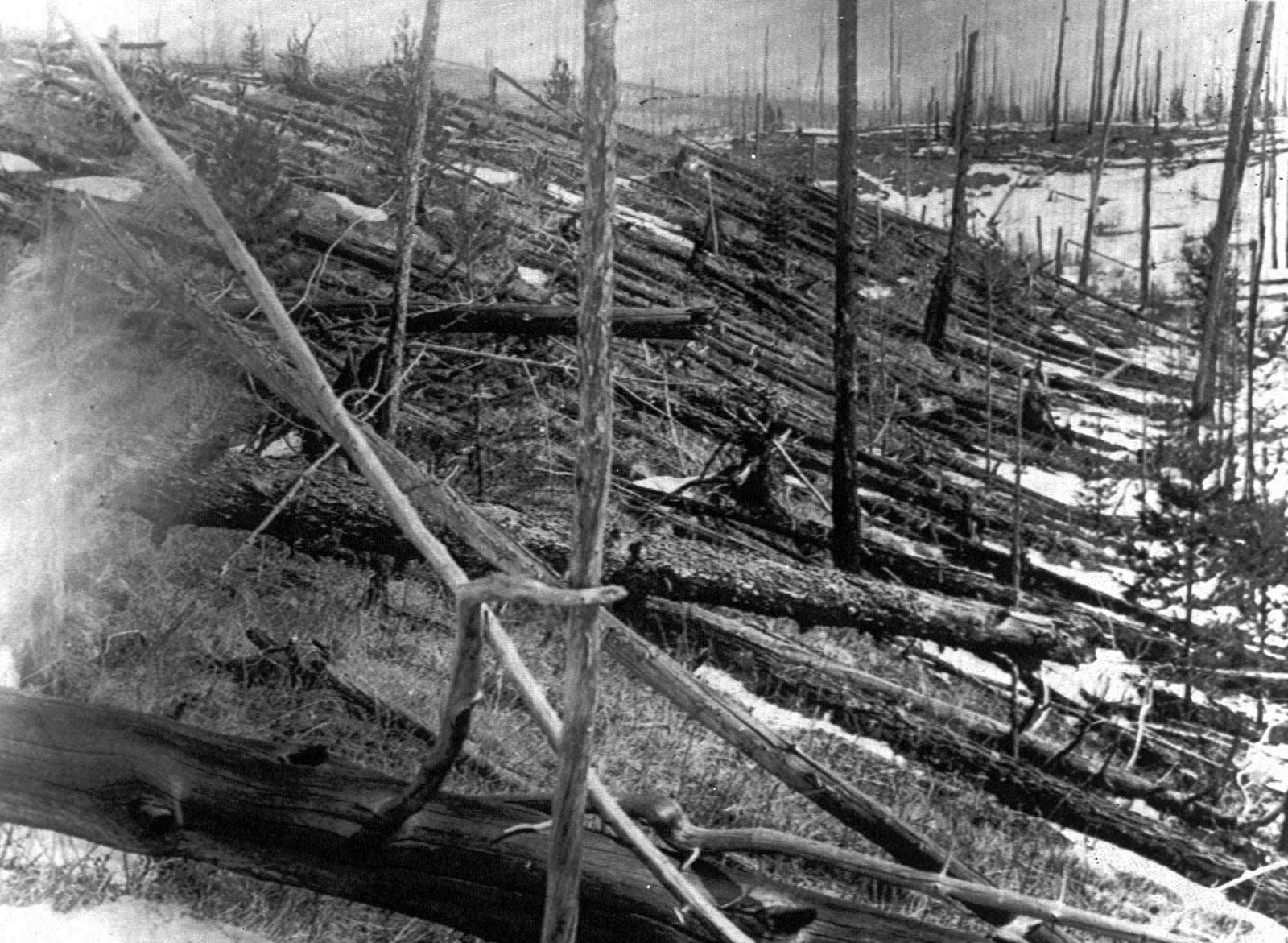
Was it a natural meteor burst or an alien encounter? On the morning of June 30, 1908, a silent explosion erupted over a remote patch of Siberian taiga near the Podkamanaya Tunguska River, flattening an estimated 2,000 square kilometers of forest, sending shockwaves that were felt in brachismographs in Europe as far away as Paris and London, producing phenomena observable for several days.
TonyHOST
Modern science now attributes this event to a meteor air burst, a rocky or heat bodies to a meteor air trance.
TonyHOST
Now our icy body disintegrating at alt of Tomis to releasing an energy comparable to 10 to 15 megatons TNT, and now to roughly 30 times of TNT bomb, which instead of enough to 30 times the Hiroshima bomb, which is more than enough to vaporize trees in a ringed pattern, seagull.
TonyHOST
Moreover, over the ensuing decades, witnesses, farmers in distant villages, military observers stationed on outpost airfields, and even a handful of local hunters recounted seeing a bright fireball or a disc-shaped object moving across the sky with a speed that defied the known ballistic trajectories of meteorites, reports that were later collected in archival newspapers but rarely given credence by mainstream journals.
TonyHOST
These accounts were archived in regional Soviet documents and occasionally resurfaced during the Cold War era, yet they were almost always dismissed by scientific committees as folklore or mass psychic misinterpretation, illustrating the tension between an objective record of atmospheric events and a cultural narrative that sometimes favors speculation over data.
TonyHOST
In 1991, Russian geophysicist Andrei Zlobin returned to Tunguska with an expedition team armed with modern sampling tools, asserting they had recovered tiny meteorite fragments that matched the spectral signature of Heinrich Kondrites, a claim that if confirmed would settle the debate in favor of a natural origin.
TonyHOST
[mysterious music] Welcome to the UFOs and Aliens podcast.
TonyHOST
In this episode, we revisit the nineteen oh eight Tunguska event that shook Siberia.
TonyHOST
Was it a natural meteor burst or an alien crash? When the Russian Steppes first erupted in a column of blue smoke on June thirtieth, nineteen oh eight, most people thought they were witnessing the heavens answering back.
TonyHOST
The blast leveled an area over two thousand square kilometers, an event that left even the quietest villages shaken to their core.
TonyHOST
Field searches through the last decade have turned up nothing but pine bark and charred soil, no evidence of engineered materials.
TonyHOST
The second hypothesis, that a nuclear weapon detonated over Siberia, often hinges on the resemblance to nuclear blast circles.
TonyHOST
Yet a modern forensic analysis of crater morphology from known atomic explosions shows features absent in Tunguska's radial devastation.
TonyHOST
Scientists argue that nuclear tests leave distinctive layers of ash and radiation traces, none detected at Tunguska's site.
TonyHOST
Welcome to the UFOs and Aliens podcast.
TonyHOST
In this episode, we revisit the 1908 Tunguska event, exploring why scientists say it was an atmospheric meteor burst while some still argue for alien spacecraft, and what new data might shift that debate.
TonyHOST
Now let's examine the evidence, testimony, and competing explanations behind today's case.
TonyHOST
It's easy to picture a massive, silent shockwave tearing through Siberian forest as the world watches an unseen fireball erupt over empty tundra, but the reality of that event is a lesson in how data and narrative collide.
TonyHOST
On the 30th of June 1908, a pulse of light erupted over the Podkhamenaya-Tunguska River, flattening roughly 2,000 square kilometers of forest within minutes.
TonyHOST
Witnesses reported the sound as if an explosion had detonated directly overhead, and seismic instruments in distant cities registered a tremor comparable to a magnitude-5 quake.
TonyHOST
Those immediate reports set the stage for an enduring mystery that would capture scientists' curiosity, conspiracy theorists' imaginations, and the public's fascination with the unknowns.
TonyHOST
Fast forward a century, modern seismology and satellite imagery have replicated that evidence by modeling an explosion between 5 and 10 kilometers high, consistent with a meteoroid disintegrating in air.
TonyHOST
Welcome to the UFOs and Aliens podcast.
TonyHOST
Today, we revisit the 1908 Tunguska event over Siberia, a fiery burst that left a scar of trees but no crater, sparking debate whether it was a comet airburst or an alien intervention.
TonyHOST
June 30, 1908, the world had never seen a fireball of this magnitude until that morning over Siberia.
TonyHOST
It flattened an area larger than any modern stadium and sent shockwaves through the Earth that were felt half a continent away.
6 MINS LATER
TonyHOST
Instead, it reinforces the need for empirical data, which the modern Chelyabinsk meteor gave us.
TonyHOST
We watched a similar airburst live on television and later examined fragments recovered on ground.
TonyHOST
When you compare Tunguska to Chelyabinsk, you see striking parallels in altitude, energy release, and pattern of damage, but also clear differences.
TonyHOST
Chelyabinsk had a visible crater at the impact point, whereas Tunguska left no obvious one.
TonyHOST
Welcome to the UFOs and Aliens podcast.
TonyHOST
Today we explore the 1908 Tunguska explosion.
TonyHOST
Did a meteor light up Siberia, or was an alien craft in our sky? The first thing you need to know about Tung, it happened on a crisp summer morning, June thirtieth in 1908, deep inside Siberian taiga.
TonyHOST
The region was almost as remote as any wilderness the world has seen before, with little human activity and very few records of that time.

Steve StocktonHOST
It tore wide open and screamed.
Steve StocktonHOST
If you want to talk about mysteries that make the hairs on the back of your neck stand at attention, then you have to talk about Tunguska.
Steve StocktonHOST
Because what happened out there in the middle of nowhere was a display of raw, apocalyptic power that, by all rights, should have left a scar on the earth so deep we'd still be digging into it today.
Steve StocktonHOST
Instead, it left nothing but a ghost story.
Steve StocktonHOST
And no amount of money or threats could make them step foot in the dead zone.
Steve StocktonHOST
They turned back, leaving Kulik and his scientists to push on alone.
Steve StocktonHOST
So, when Kulik finally reached the epicenter, standing on a ridge looking down into the Tunguska River Basin, the breath went right out of his lungs.
Steve StocktonHOST
Below him, an estimated 80 million trees had been flattened.

TravisHOST
The chemical theory takes the poisoning idea even further.
TravisHOST
Some have suggested the hikers accidentally encountered a military chemical agent, just like The Outlaw Pass, j- uh, just like Tunguska in a way.
PhilHOST
Mm-hmm.
TravisHOST
Um, but symptoms alone can't identify a chemical weapon, and many medical emergencies can produce overlapping symptoms.
9 MINS LATER
TravisHOST
I went from zero to my tummy's not happy very quick [laughs].
TravisHOST
But yeah, I, I, it's, I- i- it's...
TravisHOST
What makes it so odd is, is again, it's like this, Dyatlov Pass, Tunguska, all this shit that's happened in Russia.
TravisHOST
That's what makes it weird.

Darren MarlarHOST
Wild ideas speculated that it was a secret Stalin-era uranium mine that used gulag labor forces.
Darren MarlarHOST
Ancient astronaut theorists chimed that it was the landing site of an alien UFO Other popular theories include an underground uranium or natural gas explosion, a dust-sized meteorite that burrowed through the planet and left the crater as an exit wound, a cylindrical metallic object of unknown origin, and the Tunguska event.
Darren MarlarHOST
The uranium theory may sound unlikely, however, this area is known to be rich in naturally occurring radioactive elements.
Darren MarlarHOST
A precise series of events would need to take place in order to create the circumstances for an explosion, but it lies within the realm of possibility.
Darren MarlarHOST
However, the trees do not indicate large explosions from uranium or the Tunguska event, which would have leveled the conifers.
Darren MarlarHOST
By far, the theory most out of this world involves some kind of external or alien body that long ago embedded itself in the Patomskiy Crater, causing the unique shape.
Darren MarlarHOST
The unremarkable radiation levels seem to contradict this, though, as an object from space would leave far higher radioactive levels than the typical levels on Earth.
Steve StocktonHOST
So until a Rosetta Stone for the Voynich manuscript is found, it remains a silent witness to a forgotten mind, a 600-year-old secret that refuses to be told.
Steve StocktonHOST
Next, the Tunguska event.
Steve StocktonHOST
Now, the Tunguska event of 1908 is the largest impact event on Earth in recorded history, yet it left behind no crater, no fragments of a meteorite, and no definitive explanation that satisfies every branch of science.
Steve StocktonHOST
It's a ghost impact, a cataclysmic release of energy that reshaped a vast wilderness in seconds, leaving scientists to play detective with a crime scene that's over a century old.
Steve StocktonHOST
On June 30th, 1908, 7:17 AM local time was the morning the sky split.
Steve StocktonHOST
At the epicenter, a forest of trees stood perfectly upright, but they were entirely stripped of their bark and branches, looking like a forest of telephone poles.
Steve StocktonHOST
Radiating outward from the center for 30 kilometers in every direction, 80 million trees lay flat on the ground, pointing away from the center in a distinct butterfly pattern.
Steve StocktonHOST
Now, modern estimates place the energy released in the Tunguska event at 10 to 15 megatons of TNT.
17 more episodes mention Tunguska event.
Create an account to see the whole feed, search across every transcript, and follow the entities you care about.