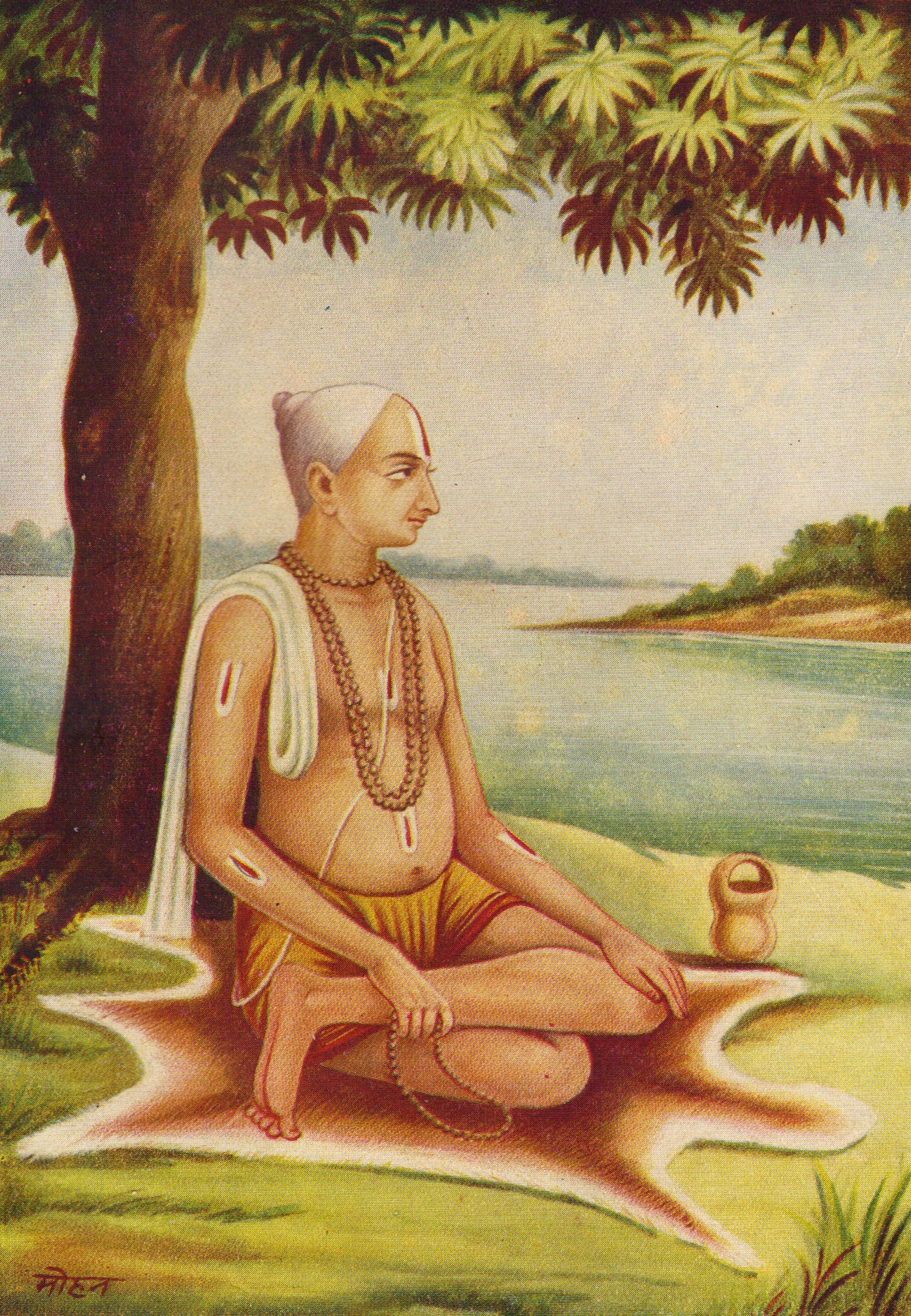
Tulsidas
PoetWikipedia
36
MENTIONS
15
EPISODES
8
PODCASTS
Search complete. 36 mentions across 15 episodes found for "Tulsidas".
Nov 3, 2026

Krishna's MercyHOST
It has since been described by poets across the ages.
Krishna's MercyHOST
There is the wonderful version in Hindi by Goswami Tulsidas.
Krishna's MercyHOST
He says that the previous participants resembled monkeys trying to open a coconut.
Krishna's MercyHOST
They had no idea what they were doing.
Krishna's MercyHOST
Quote, Out of compassion for them I, dwelling in their hearts, destroy with the shining lamp of knowledge the darkness born of ignorance.
Krishna's MercyHOST
Lord Krishna, Bhagavad Gita 10.11 Goswami Tulsidas makes the comparison to the quail and the eagle.
Krishna's MercyHOST
The baby eagle is sitting there, inferior to the quail.
Krishna's MercyHOST
In this case, the quail is envious.

speaker_0NARRATOR
Sushena crushed the herb and held it to Lakshmana's nostrils, and he stood up, healed.
speaker_0NARRATOR
In later tellings, especially in the Ramcharitmanas of Tulsidas, this second journey is the more famous one, and the herb is called the Sanjivani, the herb of life.
speaker_0NARRATOR
and the mountain Dranagiri, and more adventures are added along the way.
speaker_0NARRATOR
A demon called Kalanemi, sent by Ravana, who disguised himself as a sage and tried to delay Hanuman with false hospitality, until Hanuman saw through him and killed him, and, on the way back, Rama's own brother Bharata in Ayodhya, who saw a huge shape flying over the city at night and taking it for a demon, shot it down with an arrow, before learning who it was.
14 MINS LATER
speaker_0NARRATOR
and became friends, and it was then, some tellings say, that Hanuman agreed to sit on Arjuna's flag.
speaker_0NARRATOR
Other stories, from later centuries, tell of Hanuman appearing to saints and devotees in the forests and at the temples, in the form of an old monkey or a wandering stranger, who helped them and then vanished.
speaker_0NARRATOR
The most famous of these concerns, the poet Tulsidas.
speaker_0NARRATOR
Of all the poets who have told the story of Rama since Valmiki, the one who has done most to shape the way Hanuman is loved in northern India today is Tulsidas.
Krishna's MercyHOST
But Tulsi says when worshipping Sri Rama, both the day and the night are equally as good.
Krishna's MercyHOST
Dohavali 148 As Goswami Tulsidas reveals, worship of Rama is beneficial either in the day or the night.
Krishna's MercyHOST
It is not that any period of time necessarily becomes better or worse.
Krishna's MercyHOST
This applies to the glories of Sri Rama as well.
Krishna's MercyHOST
Moksha is the final release from the cycle of birth and death.
Krishna's MercyHOST
Goswami Tulsidas explains that these four rewards, while important, become of secondary concern once there is a firm connection in consciousness to the same Rama, who is always accompanied by the goddess of fortune, Sita.
Krishna's MercyHOST
Quote, Tulsi says that having pure love for Sita and Rama, without thinking of self-interest or supreme interest, is a reward superior to the four rewards of life.
Krishna's MercyHOST
That is my opinion.
Krishna's MercyHOST
Five Kinds of Dharma from Recent Times by Krishna's Mercy.
Krishna's MercyHOST
Tulsi says that having pure love for Sita and Rama, without thinking of self-interest or supreme interest, is a reward superior to the four rewards of life.
Krishna's MercyHOST
That is my opinion.
Krishna's MercyHOST
Dohavli 60
8 MINS LATER
Krishna's MercyHOST
The supreme occupation, Dharma, for all humanity is that by which men can attain to loving devotional service unto the transcendent Lord.
Krishna's MercyHOST
Such devotional service must be unmotivated and uninterrupted to completely satisfy the Self.
Krishna's MercyHOST
Srimad Bhagavatam 1.2.6 Goswami Tulsidas explains that this love of God is so powerful that the four rewards of life no longer become important.
Krishna's MercyHOST
Along with the four rewards, there are the concepts of Svartha and Paramartha.

Satish ManchikantiHOST
If you were to think of wishes that you would want to see for the nonprofit space, for the philanthropy space, what would be one that you would say, hey, I'd love to see this happen in the future for these two spaces?
Rishabh LalaniGUEST
I think both these spaces exist for, let me just talk in the context of India, because in the Ramcharitmanas, Tulsi Das talks about the world being our home, right? But if I were to just talk about our nation, I don't see philanthropy or nonprofits as different, right? And I think we are very, I would not want this Western driven connotation of a nonprofit and philanthropy.
Rishabh LalaniGUEST
I think our society is far more integrated.
Rishabh LalaniGUEST
And for whatever reason, the way this space has been structured over the last few decades, it's created separations that are not needed.
Krishna's MercyHOST
That was if they wanted any chance of winning.
Krishna's MercyHOST
From the information provided by Goswami Tulsidas, the mother of Sita received a reminder.
Krishna's MercyHOST
You see, she learned that this same Rama had recently defeated a wicked character named Subahu.
Krishna's MercyHOST
Unlike the contest of the bow, it was an unexpected encounter.

speaker_0NARRATOR
But first, I'm going to need to wash your feet.
speaker_0NARRATOR
This one comes from the Ramcharitmanas, Tulsidas' retelling of the Ramayana.
speaker_0NARRATOR
Ram has just left Ayodhya, sent into exile for 14 years with Sita and his brother Lakshman by his side.
speaker_0NARRATOR
And very early in that long journey, they come to the banks of the Ganga.

Anish ChaitanyaHOST
I have to connect you to the text first before I come to the actual conversation.
Anish ChaitanyaHOST
Ramcharitmanas is written by Goswami Tulsidas Ji.
Anish ChaitanyaHOST
Okay? He was a great saint in the northern of India, Uttar Pradesh, which now has become split into Uttar Pradesh and Uttarakhand.
Anish ChaitanyaHOST
So he was part of Uttar Pradesh.
Anish ChaitanyaHOST
But in the textbook, when you start, you will realize he says, "I am not the one who wrote the text." He says, "Shambhu Ki." This text is actually coming from Bhagwan Shiva.
Anish ChaitanyaHOST
He says, "I'm not the writer." This story of Bhagwan Ram was kept in the heart of Bhagwan Shiva for a long period of time.
Anish ChaitanyaHOST
When I was born, Goswami Tulsidas Ji was born, at that time, Bhagwan Shiva made him write the story which he had in his heart.
Anish ChaitanyaHOST
Since it was lying in the manas of Bhagwan Shiva, that is why it is called Ramcharitmanas.
5 more episodes mention Tulsidas.
Create an account to see the whole feed, search across every transcript, and follow the entities you care about.