Tsar Bomba
19
MENTIONS
13
EPISODES
10
PODCASTS
Search complete. 19 mentions across 13 episodes found for "Tsar Bomba".
Sep 10, 2026

RicoNARRATOR
Just like in 1994, when Schumacher-Levinin hit Jupiter.
RicoNARRATOR
However, only 5% of the energy of the Tsar Bomb was measured in its impacts.
RicoNARRATOR
The largest bomb ever ignited on Earth.
RicoNARRATOR
So the days of Jupiter should be counted with thousands of atomic bombs, right? Well, not quite.

Daven HiskeyHOST
While pure fission weapons are limited in the power they can achieve before they become infeasibly heavy and fuel inefficient, with the most powerful ever tested being the 500 kiloton Ivy King device detonated on November 16, 1952, by adding additional fusion stages to a thermonuclear device, a near unlimited yield can be achieved.
Daven HiskeyHOST
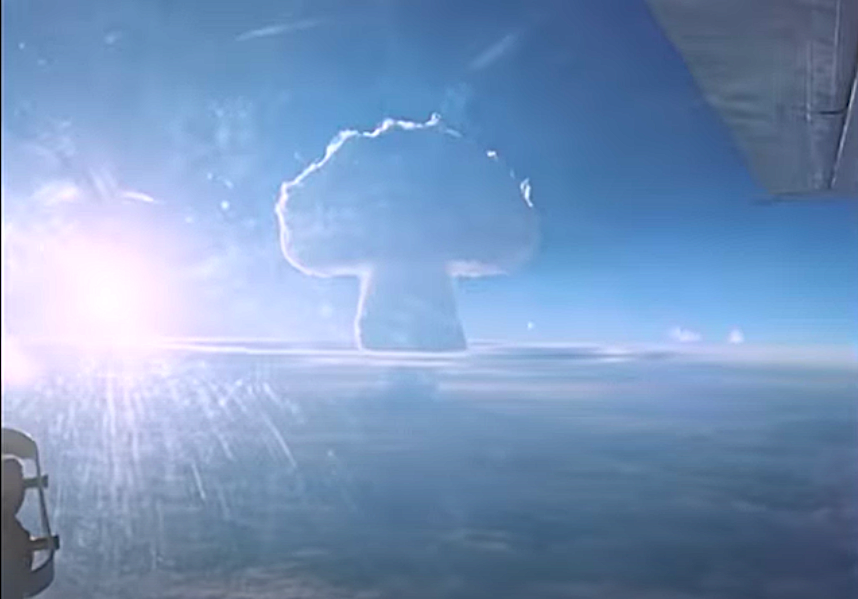
Indeed, thus far the most powerful nuclear weapon ever detonated was a three-stage Soviet Tsar Bomba, dropped on October 30, 1961.
Daven HiskeyHOST
Originally designed to have a yield of 100 million tons of TNT, to limit the spread of radioactive fallout, this was reduced at the last minute to only 50 megatons.
Daven HiskeyHOST
Nonetheless, the bomb produced a fireball a whopping 8 kilometers across, which was visible nearly 1,000 kilometers away, and nearly overtook the Tu-95 bomber that dropped it.

Saul PonsonHOST
There was the largest bomb ever-
MikeHOST
Tsar Bomba.
Saul PonsonHOST
Tsar Bomba, yeah.
Saul PonsonHOST
50 megatons of energy, and that was exploded in the '60s, but...
Saul PonsonHOST
And so for a while in the '60s, we had th- many of those things laying around.
Saul PonsonHOST
So yeah, the peak Cold War arsenal was mag 20 joules of energy, and now there are fewer bombs, but a lot fewer of the actual amount of energy in those bombs.
MikeHOST
Mm-hmm.
Saul PonsonHOST
So for reference, uh, yeah, Tsar Bomba was mag 17 joules, and, uh, Hiroshima was mag 14.

Type Three AudioNARRATOR
For matter-antimatter annihilation, the entire rest mass of the matter and antimatter can be converted into energy meaning it is capable of required energy densities.
Type Three AudioNARRATOR
To get a sense of scale, take a look at the Tsar Bomba explosion.
Type Three AudioNARRATOR
It had a yield of approximately 50 megatons of TNT, which corresponds to roughly 2.1 multiplied by 10 to the power of 17 J of energy, which is about 2.3 kilograms of mass converted into energy, equivalent to the annihilation of 1.15 kilograms of antimatter with 1.15 kilograms of ordinary matter under the ideal conditions.
Type Three AudioNARRATOR
An aircraft carrier-sized 100,000-ton interstellar spacecraft, with 60% of its mass as matter-antimatter fuel, 30,000 tons of antimatter and the corresponding 30,000 tons of matter, has about 25 million times the energy of the Tsar Bomba.
Type Three AudioNARRATOR
So, while energy density is, in theory, a solvable problem, it is worth understanding the scales of energy involved before they reach the real constraint.
Type Three AudioNARRATOR
Heat dissipation Heat Even with an arbitrarily good energy source, a rocket cannot turn all of its stored energy into useful directed propulsion.

BrianHOST
And the nerd in me, of course, spent some time this week researching nuclear fallout and 350 years of nuclear fallout.
BrianHOST
If it had even been, like, the Tsar Bomba, like the biggest nuclear bomb that has ever been made, if it had been detonated over Atlanta or, like, on the surface of Atlanta, like the half-life would have half-lifed, like, 12 times by this point.
BrianHOST
The efficacy of radiation would be like 2,000 times less than it would have been at the moment of detonation.
BrianHOST
It would be background radiation at this point.

PeterHOST
We've unleashed nukes as big as 50 megatons on our planet.
PeterHOST
That would be the notorious Tsar Bomba.
PeterHOST
It was 3,300 times more powerful than the bomb that struck Hiroshima.
PeterHOST
We've even nuked our own planet from space.
PeterHOST
Within a year of the Tsar Bomba explosion, the US lit up the sky over the Pacific with Operation Starfish Prime.
PeterHOST
This test detonated a 1.4 megaton nuke, flooding the upper atmosphere with radiation and knocking out power to most of Hawaii.
PeterHOST
If we set off modern nuclear weapons in that stretch today, we'd likely fry most of our electronics, destroy a huge chunk of our satellites, and make low Earth orbit a radioactive no-go zone for decades.
PeterHOST
Now, when we're not nuking ourselves, there have been some thought experiments put forward with the idea of nuking our red neighbor, Mars.
Simon WhistlerHOST
Due to its ominous connotations, the phrase soon became a popular diplomatic euphemism for the atomic bomb.
Simon WhistlerHOST
Indeed, the 50-megaton Tsar Bomba, the largest nuclear weapon ever detonated, was nicknamed Kuzma's mother by its designers.
Simon WhistlerHOST
Then there is the infamous shoe-banging incident.
Simon WhistlerHOST
During the meeting of the United Nations General Assembly on October 12, 1960, Lorenzo Sumulong, the head of the Filipino delegation, gave a speech denouncing the annexation and subjugation of Eastern European states by the Soviet Union.

Tommy CarriganGUEST
But it was made for, and I s- you can read it, the d- d- documents are there, to survive multiple, and I quote, "300 megaton airbursts"- Or multiple 100 megaton bunker busters.
Tommy CarriganGUEST
Think about Tsar Bomba is 57 megatons.
Tommy CarriganGUEST
And they decided not to do it, 'cause I guess Johnson said, like, it's a tomb, and that's what later led to the ARPANET so that these things could be, be, be connected.
Tommy CarriganGUEST
But they've been building this shit since the '50s and '60s, and I know this conspiracy people-
3 more episodes mention Tsar Bomba.
Create an account to see the whole feed, search across every transcript, and follow the entities you care about.