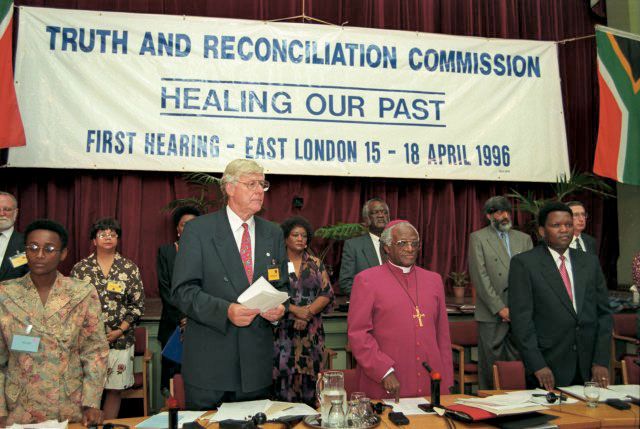
Truth and Reconciliation Commission
Truth commissionWikipedia
26
MENTIONS
16
EPISODES
13
PODCASTS
Search complete. 26 mentions across 16 episodes found for "Truth and Reconciliation Commission".
Oct 7, 2026

Nelson MandelaSOUNDBITE_SPEAKER
This is a moment of enormous significance in the history of our country.
Nelson MandelaSOUNDBITE_SPEAKER
Through the Truth and Reconciliation Commission, we can now deal with our past, establish the truth that has so long been denied us, and lay the basis for genuine reconciliation.
Nelson MandelaSOUNDBITE_SPEAKER
Because only by knowing the truth can we hope to heal the terrible open wounds that are the legacy of apartheid.
Nelson MandelaSOUNDBITE_SPEAKER
Only the truth can put the past to rest.
Nelson MandelaSOUNDBITE_SPEAKER
The Truth and Reconciliation Commission will now be set up to perform this momentous task.
Nelson MandelaSOUNDBITE_SPEAKER
It will do its work through three committees.
Nelson MandelaSOUNDBITE_SPEAKER
The first, the Amnesty Committee, will hear applications for amnesty on the basis of full disclosure.
Nelson MandelaSOUNDBITE_SPEAKER
The third committee, the Committee on Reparations, will look at ways to restore the dignity and self-respect of victims.
Mathews PhosaGUEST
And I'm going to say it again positively, which was in the media.
Mathews PhosaGUEST
He, when he opened the, uh, the TRC he says, you know, "Everybody is equal." I, I made a, as, as the head of legal, legal of the ANC, I made a s- a comment that says, "I cannot be equal to someone who wanted to kill me five times.
Mathews PhosaGUEST
How can we, can we be equal?"
Sakina KamwendoHOST
[clears throat]
Mathews PhosaGUEST
I was very blunt about it.
Mathews PhosaGUEST
And of course, they arranged a meeting at the airport.
Mathews PhosaGUEST
Sharo, Sharo was there, and then we shook hand and professed misunderstanding this way and that way to make peace, and the com- the TRC moved on.
Mathews PhosaGUEST
I always maintain a position on this matter, which I've not changed even today.

Patrick Scott ArmstrongHOST
But there's some other things that he brought up on Joe Rogan that I want to get to beforehand like this.
David GruschSOUNDBITE_SPEAKER
believe in amnesty but i i think we need to do it like a truth and reconciliation commission which was in post-apartheid south africa in the 90s where you had um you know some white farmer comes in it's like yeah i murdered a bunch of black people or whatever and it's like okay thank you for telling us that you're good you know don't do it again and move on i'm i mean i'm distilling it down but that's essentially what the trc in south africa was and i think something like that would be very additive and good because, I mean, I have friends that were on the program.
David GruschSOUNDBITE_SPEAKER
They're great guys.
David GruschSOUNDBITE_SPEAKER
They're bros and gals.

Kevin ChaplinGUEST
But the story didn't end there, Shay, because four boys went to jail for her death.
Kevin ChaplinGUEST
They were sentenced to 20 years, and in 1997, Nelson Mandela and Archbishop Desmond Tutu formed the Truth and Reconciliation Commission.
Kevin ChaplinGUEST
Very powerful, shall we say, process in the history of South Africa, where their intention was to bring the victim and the offender during apartheid together.
Kevin ChaplinGUEST
Young, young men just disappeared overnight, so mothers didn't know where their bo- where their sons had been killed, and brothers and daughters.

Ro KhannaGUEST
So I believe the people who doged us and took away food and medicine from the world's poorest, who fired hundreds of thousands of federal employees, including black women, the people who ordered fishermen boats to be bombed in the Caribbean, the people who shot Alex Prudy and Renee Good and other harmless immigrants, the people who lied us into the war in Iran and ordered killings of schools with children dead, that all of them need to be held accountable, that we need to be a nation of laws, and that the next Congress and administration need to do that.
Thom HartmannHOST
Congressman, I did a deep dive into the South African Truth and Reconciliation Commission and why it didn't quite work out.
Thom HartmannHOST
And it turns out that that law required anybody who didn't admit their crimes to go to prison, and nobody ever went to prison.
Thom HartmannHOST
In other words, they didn't fully enforce the law.

Mpho Tutu van FurthGUEST
Yeah.
Lisa LittlebirdHOST
That's what's so astounding to me about the Truth and Reconciliation Commission, that it was so ambitious to take on such a cavernous amount of pain at both the individual and the social level, and to not leave out any individual who needed that affirmation.
Lisa LittlebirdHOST
For somebody who's not familiar with it, could you give us just the overview?
Mpho Tutu van FurthGUEST
Um, in very broad brushstrokes at the end of, um, of the apartheid era, the, the two sides, the apartheid government.
Mpho Tutu van FurthGUEST
The liberation movement actually wanted something like Nuremberg trials.
Mpho Tutu van FurthGUEST
Neither side was strong enough to have... their desired method of being able to resolve conflicts and move on.
Mpho Tutu van FurthGUEST
And so what they came to was to decide on a Truth and Reconciliation Commission.
Mpho Tutu van FurthGUEST
And the Truth and Reconciliation Commission said, or the acts that created the Truth and Reconciliation Commission said, that in exchange for a full disclosure, those who had committed human rights abuses could be granted amnesty from prosecution.

Mark AdderleyHOST
No, absolutely.
Mark AdderleyHOST
I'm old enough to remember Hysteria Lane, Mandela and Tutu's Truth and Reconciliation Committee, every effort to avoid conflict and reconcile difference.
Mark AdderleyHOST
Where are they like today?
Nadia SawalhaHOST
Where are they?

Jeff RadebeSOUNDBITE_SPEAKER
But those formal talks between the regime and the ANC, I was never, ever invited to be party to those talks.
speaker_1UNKNOWN
So the evidence is that in relation to what one might refer to as post-TRC justice, the pursuit of prosecutions after the TRC, that those discussions mainly took place between 1998 and around 2003.
speaker_1UNKNOWN
So while in cabinet or as a member of the ANC executive working committee, did news of those discussions ever come to your attention?
Jeff RadebeSOUNDBITE_SPEAKER
So as a member of the NEC as well as the National Working Committee and Cabinet, I have never been made aware of these talks.
Aubrey MatshiqiGUEST
It is my view now that we should investigate the involvement of sections of the media in this rot.
Aubrey MatshiqiGUEST
It is my view now that when we look at, for instance, the work the TRC Commission is doing under very difficult circumstances-
Sizwe Mpofu-WalshHOST
Mm
Aubrey MatshiqiGUEST
...
Aubrey MatshiqiGUEST
it is my view now that the country needs an investigation into, first of all, the lies that are embedded in truth about the liberation struggle, including the position of the ANC and its leaders.
Aubrey MatshiqiGUEST
Now, when you look at the TRC Commission, it's clear to me that there's an extent to which this commission, the TRC Commission-
Sizwe Mpofu-WalshHOST
Mm
Aubrey MatshiqiGUEST
... um, will struggle to come to the bottom of the truth because of the positionality of the ANC when it comes to collusion with apartheid forces, for instance.
Thom HartmannHOST
All are still democracies, and it looks like the same process will soon play out in Hungary.
Thom HartmannHOST
Even South Africa's Truth and Reconciliation Commission, which people think of as a gentle alternative to criminal prosecution, wasn't designed to be gentle.
Thom HartmannHOST
People who failed to make full public confessions of their crimes were supposed to be imprisoned.
Thom HartmannHOST
The cautionary tale is that none were, which is a good part of why so many South Africans will tell you the wounds are still open.
6 more episodes mention Truth and Reconciliation Commission.
Create an account to see the whole feed, search across every transcript, and follow the entities you care about.