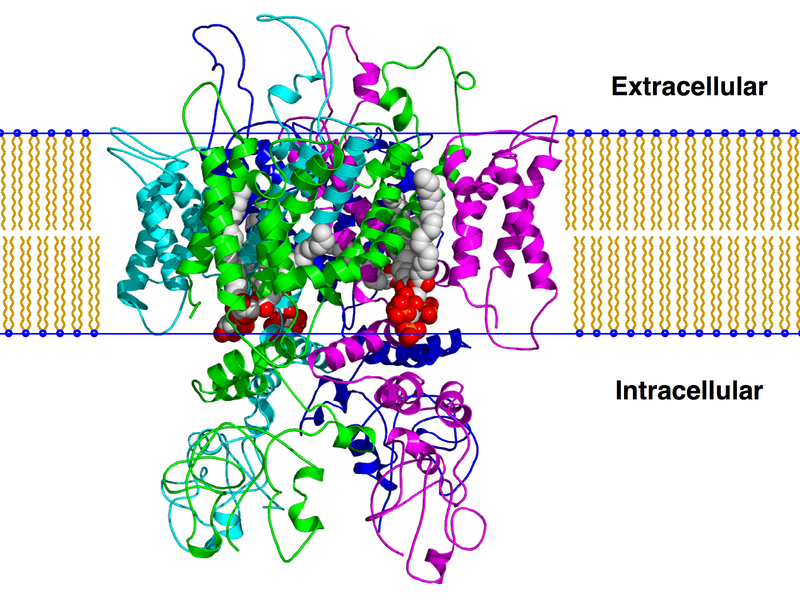
TRPV1
ProteinWikipedia
33
MENTIONS
18
EPISODES
17
PODCASTS
Search complete. 33 mentions across 18 episodes found for "TRPV1".
Nov 26, 2026

Mike DiamondsHOST
Capsaicin, the compound that gives chili pepper their heat, works in a pretty unique way compared to a lot of fat loss ingredients.
Mike DiamondsHOST
It activates a receptor in your body called TRPV1, basically your internal heat sensor.
Mike DiamondsHOST
And when that receptor is triggered, your body generates a mild thermogenic response, slightly increasing how many calories you burn throughout the day.
Mike DiamondsHOST
It's a small effect, but it's real.

Stasha WashburnHOST
Ginger helps turn down the volume on inflammation that causes your cramps.
Stasha WashburnHOST
Those shogols actually interact with a specific pain-sensing receptor called TRPV1.
Stasha WashburnHOST
It activates it first and then causes it to become desensitized, meaning it stops sending pain signals.
Stasha WashburnHOST
It's a similar mechanism to how chili peppers can eventually relieve pain.

Trisha PasrichaGUEST
It – It was a study that found that if you were to do biopsies of people who have irritable bowel syndrome, these are the surface-level biopsies that we would just do in a regular colonoscopy.
Trisha PasrichaGUEST
If you were to stain for something, which we normally never stain for, which is a process we do under the microscope, and we looked for something called TRPV1 receptors.
Trisha PasrichaGUEST
This is an important receptor for pain signaling.
Trisha PasrichaGUEST
People with irritable bowel syndrome express this TRPV1 pain signaling receptor at three times more than people who don't have it meaning the same thing that same amount of gas that goes through the same types of food they have a three times more higher chance of that getting stimulated and sending a signal up to the brain and then it's like you know imagine every time you're just kind of sitting with friends and you start to feel a gurgling in your stomach you say oh my god i wonder if this is it like this is going to be the thing that causes me pain and so like every time this happens it happens multiple times a of course you're going to become anxious of Of course, you're going to be a little nervous to eat and you're going to become a little paranoid about what's happening because you're experiencing really real signals.
Trisha PasrichaGUEST
But to the outside world, what it looks like is, yo, she can't eat anything.
Trisha PasrichaGUEST
And like she's just thinking about her symptoms all the time.

Trisha PasrichaGUEST
It was a study that found that if you were to do biopsies of people who have irritable bowel syndrome, these are the surface level biopsies that we would just do in a regular colonoscopy.
Trisha PasrichaGUEST
If you were to stain for something, which we normally never stain for, which is a process we do under the microscope, and we looked for something called TRPV1 receptors.
Trisha PasrichaGUEST
This is an important receptor for pain signaling.
Trisha PasrichaGUEST
People with irritable bowel syndrome express this TRPV1 pain signaling receptor three times more than people who don't have it.
Trisha PasrichaGUEST
the same thing that a same amount of gas that goes through the same types of food they have a three times more higher chance of that getting stimulated and sending a signal up to the brain and then it's like you know imagine every time you're just kind of sitting with friends and you start to feel a gurgling in your stomach you say oh my god I wonder if this is it like this is gonna be the thing that causes me pain and so like every time this happens it happens multiple times a of course you're gonna become anxious of course you're going to be a little nervous to eat and you're going to become a little paranoid about what's happening because you're experiencing really real signals but to the outside world what it looks like is yo she can't eat anything and like she's just thinking about her symptoms all the time thinking about it is what's causing them you know but it's but it's actually there's a real pathology which actually is accessible to us it's just not something we usually check for
Mark HymanHOST
You said this, just because we have the absence of evidence doesn't mean it's the evidence of absence.

Daven HiskeyHOST
Capsaicin binds with certain sensory neurons, which then more or less trick your brain into thinking that it is being burned, or at least experiencing excessive amounts of heat in the area that the capsaicin comes in contact with, even though no actual physical burning is taking place.
Daven HiskeyHOST
More technically, the capsaicin is binding to the VR1 receptor, which is a member of the superfamily TRP ion channel, and thus is referred to as TRPV1.
Daven HiskeyHOST
By binding to the VR1 receptor, the capsaicin molecule will produce the same sensation, or signal to the brain, that normal heat will produce when activating the TRP receptors.
Daven HiskeyHOST
Thus, spicy makes brain think burning.

Daven HiskeyHOST
Capsaicin binds with certain sensory neurons, which then more or less trick your brain into thinking that it is being burned, or at least experiencing excessive amounts of heat in the area that the capsaicin comes in contact with, even though no actual physical burning is taking place.
Daven HiskeyHOST
More technically, the capsaicin is binding to the VR1 receptor, which is a member of the superfamily TRP ion channel and thus is referred to as TRPV1.
Daven HiskeyHOST
By binding to the VR1 receptor, the capsaicin molecule will produce the same sensation, or signal to the brain, that normal heat will produce when activating the TRP receptors.
Daven HiskeyHOST
Thus, spicy makes brain think burning.

Jose Maria CarazoGUEST
I mean the information about how your structure was blurred, how your structure was degraded to start with, or at least an approximation to how your structure was degraded to start with.
Jose Maria CarazoGUEST
And well, you have here the same channel TRPV1 that it was before.
Jose Maria CarazoGUEST
It was sharpened with a number of algorithms and we made many measurements of quality and one of them that you have here is the EM ringer But really, the slide that I like the most is this one, in which you see how there are areas that normally correspond to loops in the structure.
Jose Maria CarazoGUEST
This is in the proteosome structure that really are not very well seen.

Dr. DrayHOST
All that skincare aside, what about your diet? Are there any foods that you should be eating or avoiding if you have rosacea? It's kind of challenging to say what foods you should be eating, but I will say when it comes to rosacea, there are actually several foods that can be a trigger for your rosacea.
Dr. DrayHOST
Certain spices I already alluded to can be problematic, and these include cinnamon, for example, because certain spices and certain foods contain compounds that are known to activate something called TRPV1 in the skin, which is contributory to the flares of rosacea.
Dr. DrayHOST
Now, if you're wondering what other foods might be problematic, I want you to watch my video on foods that cause facial redness, because this is gonna open your eyes as to potential triggers above and beyond that list that I showed you at the beginning of the video, food triggers that you might wanna avoid or try to avoid if you have rosacea.
Dr. DrayHOST
If you try avoiding them and it doesn't make a difference then by all means continue eating them because you don't need to eliminate foods just you know willy-nilly.

RichardHOST
There's another one.
RichardHOST
Capsaicin from chili peppers or camphor, I think they're the same thing, binds to another receptor that's called the TRPV1.
RichardHOST
So hang on.
RichardHOST
TRP.
RichardHOST
transient receptor potential channels.
speaker_1HOST
So that's allowing...
RichardHOST
TRPV1 receptor, the heat or pain receptor, triggering a burning signal.
RichardHOST
So it's both the ice pack and...

Shelly AnnHOST
Capsiocin is found in chili peppers, including varieties of cayenne, jalapeno, habanero, and our very own scotch bonnet.
Shelly AnnHOST
According to research, it interacts with a receptor in the body called TRPV1, and this is the shortened version.
Shelly AnnHOST
This receptor is involved in detecting it and certain types of pain.
Shelly AnnHOST
When capsaicin activates it, your nervous system receives signals similar to those produced by exposure to it.
8 more episodes mention TRPV1.
Create an account to see the whole feed, search across every transcript, and follow the entities you care about.