Triiodothyronine
HormoneWikipedia
1.2k
MENTIONS
220
EPISODES
166
PODCASTS
Search complete. 1240 mentions across 220 episodes found for "Triiodothyronine".
Oct 27, 2026

Elisha EdwardsHOST
And maybe you've even had, like I say, the blood tested and the thyroid tested.
Elisha EdwardsHOST
And some of you definitely send me those results, whether you get your T3 tested or their T4, and to see how all that's working.
Elisha EdwardsHOST
And sometimes it is.
Elisha EdwardsHOST
Sometimes the blood work says there's nothing wrong, but clearly there is something wrong.
Elisha EdwardsHOST
T4 is kind of like a log sitting beside the stove.
Elisha EdwardsHOST
It's fuel, but it isn't burning yet, right? It's the inactive form.
Elisha EdwardsHOST
So to get heat, T4 has to be converted into the other thyroid hormone, T3, and that's the active form.
Elisha EdwardsHOST
And most of that conversion doesn't happen in the thyroid at all.

Mindy PelzHOST
50% of women going through menopause are going to end up with a thyroid issue.
Mindy PelzHOST
Every cell in your body has a receptor site for T3, your bioactive version of your thyroid hormone.
Mindy PelzHOST
So one of the things that the thyroid needs is calorie.
Mindy PelzHOST
It's not that fasting tanks the thyroid.

Eric BergHOST
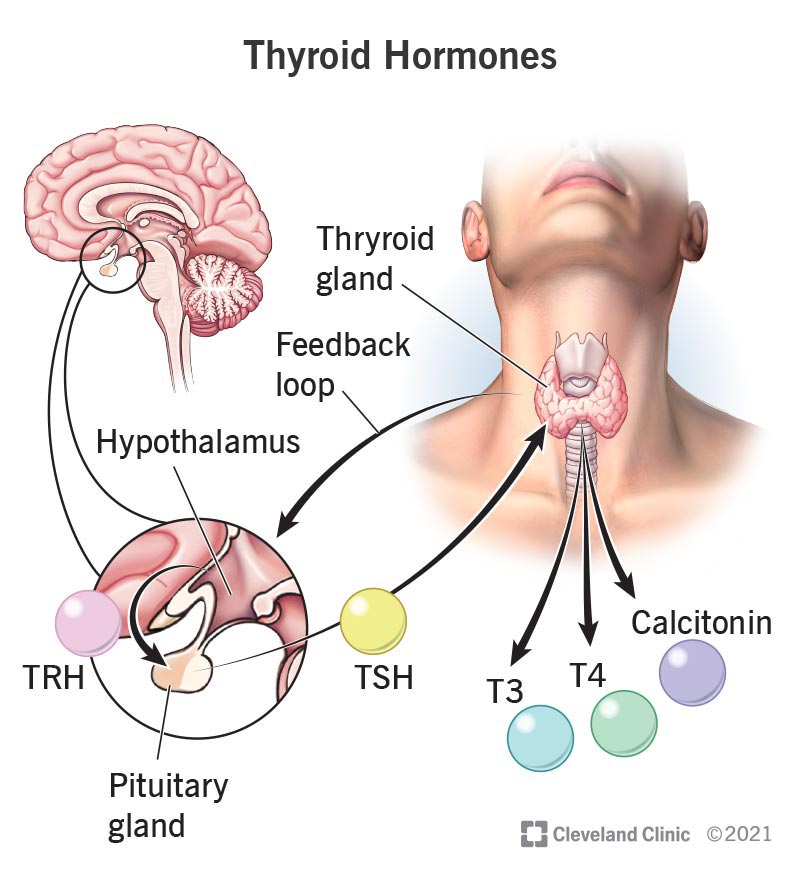
So the question is why... and how that relates to maybe a better option so this video mainly relates to those people who want to continue to do conventional care they don't want to do alternative care and or they're already on synthroid okay this is a really important video for those people you know a lot of times when you get hormone therapy whether it's estrogen therapy or even thyroid therapy you're given this one hormone but i have an interesting question if you're getting treatment for the thyroid okay with one hormone and the thyroid produces more than one hormone what's happening with these other hormones or let's say for example you get a thyroidectomy the complete thyroid removed, right? And then they treat it with one hormone, which is T4.
Eric BergHOST
So what about the other hormones? What about T3? What about T2? What about T1? That's right.
Eric BergHOST
And what about calcitonin, right? Calcitonin is another hormone in your body.
Eric BergHOST
And guess what? It's produced by the thyroid gland.
Eric BergHOST
So I think it's really important to understand that these glands make more than one hormone.
Eric BergHOST
And if you're going to get treated with Synthroid for some reason, I would bring up the argument for taking armor thyroid.
Eric BergHOST
It comes from a natural source, an animal source, but at least armor has T4, T3, T2, T1, and calcitonin.
Eric BergHOST
It was what they used before they developed Synthroid.

Nicola SchmitzHOST
It cannot really do its job in that form.
Nicola SchmitzHOST
Before your body can actually use it, before it can warm you, lift your mood, sharpen your mind, and drive your metabolism, the T4 has to be converted into a different active form that people call T3.
Nicola SchmitzHOST
T4 is the check.
Nicola SchmitzHOST
T3 is the cash.
Nicola SchmitzHOST
And you cannot spend the check.
Nicola SchmitzHOST
It has to be cashed first.
Nicola SchmitzHOST
So the test comes back normal because there genuinely is plenty of the storage form.
Nicola SchmitzHOST
But if that person's liver is congested and overworked, the conversion stalls.

Kela SmithHOST
And so we want to look at things like T4, which is your active thyroid hormone that's produced in the thyroid gland.
Kela SmithHOST
And that is converted into T3, which goes throughout the bloodstream to all the cells, the receptors for thyroid on your cells.
Kela SmithHOST
We also want to look at free T3, which means unbound thyroid hormone.
Kela SmithHOST
That's that thyroid hormone that's actually floating through your bloodstream.
Kela SmithHOST
It's not attached to proteins.
Kela SmithHOST
It can go into the cells and do its job.
Kela SmithHOST
We also need to look at reverse T3 and T4.
Kela SmithHOST
So looking at how that feedback loop is happening and going back up to the thyroid and impacting it.

Kimberly VaughnGUEST
Because, Ailey, you have a head full of hair, right? And I don't know the density of your hair because I've never examined it.
Kimberly VaughnGUEST
I have a lot of hair as well because I take T3 and T4 as well.
Kimberly VaughnGUEST
But I have very fine, thin hair.
Kimberly VaughnGUEST
So my hair is going to look different in a lost perspective than yours is going to.

Christiane NorthrupGUEST
One, most women need a little more iodine in their diet because it ameliorates excess estrogen.
Christiane NorthrupGUEST
And what is T3 and T4? That just refers to the molecules of iodine in thyroid hormone.
Christiane NorthrupGUEST
So T3 has three and T4 has four.
Christiane NorthrupGUEST
And you just do a little bit of that, and you'll find that very often your body and your thyroid just gets far better.
Christiane NorthrupGUEST
That's in short supply, iodine, and also as magnesium is.

TreyHOST
Yeah.
TreyHOST
Now, what do you guys think about thyroid? All the overdoing of the T3 prescriptions?
Austin StoutHOST
It's, it's weird to me because thyroid replacement is, is pretty easy.
Austin StoutHOST
You know, you know like it's not a hard so first off your tsh dropping some is normal right like to some degree because well now there's not as much need for thyroid stimulating hormone because you're taking this exogenous source like some of you know people like oh my god my tsh drop like that's fine now if it's a zero and you're having side effects like like jeff is mentioning that's yeah you're you're hyperthyroid and the range the range is fairly applicable to most people, but not everyone needs to be at the very top of the range.
Austin StoutHOST
The other thing is that we obviously need to look at total levels and free levels.
Austin StoutHOST
And we also have to think about, you know, I mean, there's conversion in there and there's all this other stuff, but we have to think about TSH is responding to the amount of basically free T3 in the blood or T3 in the blood, but it's also responding to, It's also responding like how much of that is actually binding actively and working.
Austin StoutHOST
So let's say you have like two people and they both have a free T3 of, I don't know, like 3.5. That seems pretty good.
Austin StoutHOST
You know, you'd be like, all right, that looks good.

Jamie DorleyHOST
And there's so many people on things like Synthroid, Levothyroxine, which is just a T4 hormone.
Jamie DorleyHOST
So it's the ingredients to make the active T3, but a lot of people don't convert well.
Jamie DorleyHOST
So we have some strategies to help those people too.
Kristine GenoveseHOST
Right.

Jarrod CooperGUEST
And I'll often see that iodine is low in many people.
Jarrod CooperGUEST
And I was saying for the thyroid, the T3 and the T4, which are your main thyroid hormones, the T3 is three molecules of iodine.
Jarrod CooperGUEST
The T4 is four molecules of iodine.
Jarrod CooperGUEST
So that's pretty much what your thyroid is made up of is iodine.
210 more episodes mention Triiodothyronine.
Create an account to see the whole feed, search across every transcript, and follow the entities you care about.