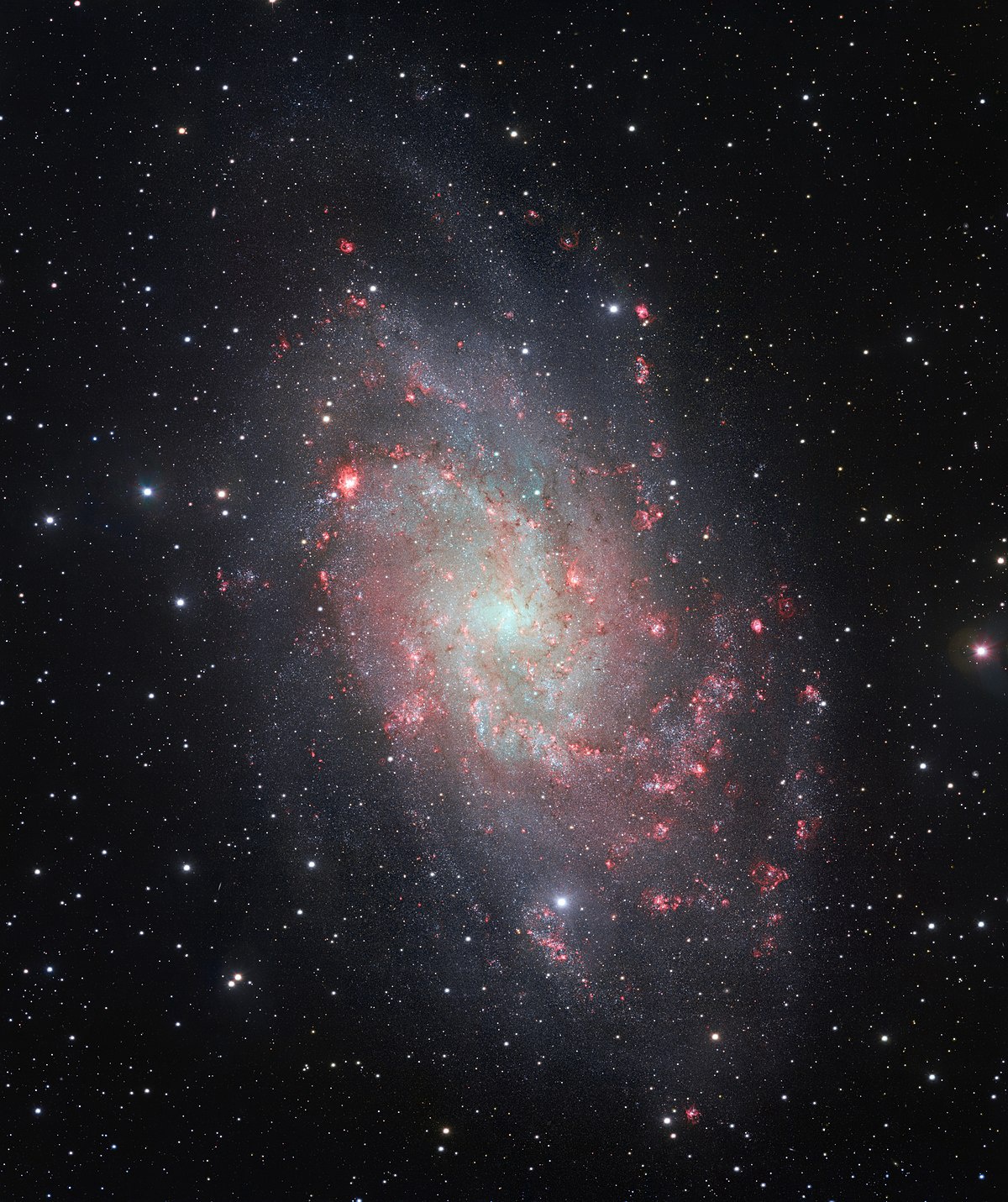
Triangulum Galaxy

Triangulum Galaxy

GalaxyWikipedia

Search complete. 30 mentions across 15 episodes found for "Triangulum Galaxy".

Sep 11, 2026

speaker_2HOST
1:30
It found five giant glowing pink and blue bubbles in a galaxy called NGC 604.
speaker_1HOST
1:37
Which is inside the M33 Triangulum Galaxy, right?
speaker_2HOST
1:40
You got it.
speaker_2HOST
1:40
And these aren't just regular bubbles.

Unknown podcast

The True Scale of the Universe Will MELT Your Mind

Sep 5 · 1 Mention

speaker_2NARRATOR
53:11
Most members are dwarf galaxies, faint, small collections of a few billion or even a few million stars each.
speaker_2NARRATOR
53:19
The Triangulum Galaxy, also called Messier 33, is the third largest member, containing about 40 billion stars and sitting roughly 3 million light years from the Milky Way.
speaker_2NARRATOR
53:30
Everything else in the Local Group is substantially smaller.
speaker_2NARRATOR
53:34
The Large Magellanic Cloud holds perhaps 30 billion stars.

Unknown podcast

The Distance Between Galaxies Is Worse Than You Think

Sep 4 · 4 Mentions

speaker_3NARRATOR
16:03
Many of them orbit the Milky Way or Andromeda as satellites, trapped in gravitational bondage like moons circling a planet.
speaker_3NARRATOR
16:11
The third largest member, the Triangulum Galaxy, contains roughly 40 billion stars and sits about 2.7 million light years from us.
speaker_3NARRATOR
16:22
Beyond these three dominant spirals, the Local Group is mostly populated by dim, small, easily overlooked structures scattered across a volume of space, roughly 10 million light years in diameter.
speaker_3NARRATOR
16:35
10 million light years.

1 HR 9 MINS LATER

speaker_3NARRATOR
85:26
divided into islands of matter surrounded by expanding voids that no technology can bridge.
speaker_3NARRATOR
85:32
The local group is our island.
speaker_3NARRATOR
85:34
The Milky Way, Andromeda, Triangulum, and approximately 130 smaller galaxies comprise our gravitationally bound family.
speaker_3NARRATOR
85:44
These galaxies are close enough and massive enough that their mutual gravitational attraction overcomes the cosmic expansion.

Unknown podcast

What_s Really Above And Below The Sun_

Sep 4 · 1 Mention

speaker_4NARRATOR
87:30
The Milky Way belongs to the Local Group, a collection of over 80 galaxies bound together by gravity within a volume roughly 10 million light years across.
speaker_4NARRATOR
87:39
The Local Group is dominated by two large spiral galaxies, the Milky Way and Andromeda, with the smaller Triangulum Galaxy as a distant third.
speaker_4NARRATOR
87:48
The remaining members are dwarf galaxies, scattered in three dimensions throughout the group's volume.
speaker_4NARRATOR
87:54
The Local Group has no preferred alignment with the Milky Way's disk.

Unknown podcast

The Distance Between Us and the Next Galaxy Is Far Worse Than You Think

Sep 3 · 5 Mentions

speaker_6NARRATOR
19:56
Most of them are dwarf galaxies, tiny systems containing only millions or a few billion stars, gravitationally bound to either the Milky Way or Andromeda.
speaker_6NARRATOR
20:05
The three major spirals, the Milky Way, Andromeda and the Triangulum Galaxy, dominate the group.
speaker_6NARRATOR
20:12
The entire structure spans roughly 10 million light years.
speaker_6NARRATOR
20:16
Within this volume, galaxies interact, orbit, and occasionally merge.

38 MINS LATER

speaker_6NARRATOR
58:34
The merger was treated as virtually certain, but in June of 2025, a study led by Til Sawala at the University of Helsinki, published in the journal Nature Astronomy, significantly revised this picture.
speaker_6NARRATOR
58:47
Sawala and his colleagues ran more than 100,000 simulations of the local group's future dynamics, using the latest data from both the Gaia spacecraft and the Hubble Space Telescope.
speaker_6NARRATOR
58:57
The team incorporated the gravitational influence of surrounding galaxies that earlier studies had neglected, particularly the Large Magellanic Cloud and the Triangulum Galaxy, designated M33.
speaker_6NARRATOR
59:09
The results were striking.

Unknown podcast

The Terrifying Size of the Largest Galaxy We_ve Ever Found

Sep 3 · 1 Mention

speaker_4NARRATOR
31:47
If IC 1101 were placed at the Milky Way's location, it would not merely dwarf our galaxy.
speaker_4NARRATOR
31:53
It would engulf Andromeda, the Large Magellanic Cloud, the Small Magellanic Cloud, the Triangulum Galaxy, and nearly every other galaxy in the local group.
speaker_4NARRATOR
32:04
a single galaxy occupying the space that our entire galactic neighbourhood currently fills.
speaker_4NARRATOR
32:10
Try to feel this in a different way.

Unknown podcast

Even If We Could Travel at Light Speed... It Still Wouldn_t Be Fast Enough

Sep 2 · 1 Mention

speaker_5NARRATOR
59:11
They are our closest independent galactic companions, the nearest islands in the intergalactic sea, and reaching either one of them at the speed of light requires a journey longer than our species has been alive.
speaker_5NARRATOR
59:23
The Triangulum Galaxy, the third largest member of our local group, lies roughly 2.7 million light years away, nearly as far as Andromeda, nearly as devastating to contemplate.
speaker_5NARRATOR
59:35
Now face the real test.
speaker_5NARRATOR
59:37
The Andromeda Galaxy, also known as M31, is the nearest large spiral galaxy to the Milky Way.

Unknown podcast

How Much of the Universe Could Humans Ever Reach

Sep 2 · 1 Mention

speaker_4NARRATOR
71:42
There is one further dimension of this problem worth naming, and it concerns the shrinking local group.
speaker_4NARRATOR
71:48
Our own gravitational neighbourhood, the local group of galaxies containing the Milky Way, Andromeda, Triangulum and dozens of smaller companions, is the one region of space where cosmic expansion has effectively already lost.
speaker_4NARRATOR
72:03
Gravity binds the Local Group together tightly enough that expansion cannot pull it apart, and the whole system behaves as a single gravitational island floating in an ocean of accelerating expansion.
speaker_4NARRATOR
72:15
Far into the future, when everything outside the Local Group has receded beyond the observable horizon, the Local Group will remain a single, connected, gravitationally bound structure.

Unknown podcast

Why the Universe is Far Bigger Than You Think

Sep 1 · 1 Mention

speaker_2NARRATOR
78:23
The great superclusters Laniakea, the Shapley Concentration, the sprawling filaments of the cosmic web will dissolve from view over similar timescales.
speaker_2NARRATOR
78:32
Within roughly 2 trillion years after the Big Bang, the only galaxies visible from our cosmic neighbourhood will be the few dozen members of the local group, the Milky Way, Andromeda, Triangulum.
speaker_2NARRATOR
78:44
and the small dwarfs gravitationally bound to them.
speaker_2NARRATOR
78:47
By that time, the Milky Way and Andromeda will have long since merged into a single elliptical galaxy, sometimes called Milkomeda.

Unknown podcast

The Strange Reason Why Everything Spins in the Universe

Sep 1 · 1 Mention

speaker_8NARRATOR
21:39
Andromeda rotates.
speaker_8NARRATOR
21:41
The Triangulum Galaxy rotates.
speaker_8NARRATOR
21:43
Distant spirals billions of light years away show the unmistakable signatures of rotation in their spectral lines.
speaker_8NARRATOR
21:50
One side of the galaxy is blue-shifted, its light compressed as it moves toward us.

5 more episodes mention Triangulum Galaxy.

Create an account to see the whole feed, search across every transcript, and follow the entities you care about.

We value your privacy

We use cookies to understand how you use our platform and to improve your experience. Click “Accept All” to consent, or “Decline non-essential” to opt out of non-essential cookies. Read our Privacy Policy.