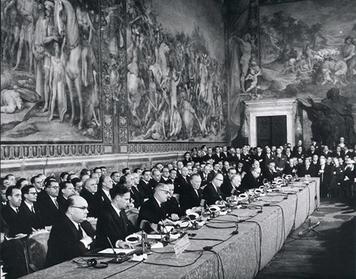
Treaty of Rome
8
MENTIONS
8
EPISODES
8
PODCASTS
Search complete. 8 mentions across 8 episodes found for "Treaty of Rome".
Oct 14, 2026

Tim StanleyHOST
...
Tim StanleyHOST
Emily Thornberry was on News Night and was saying, "Well, you wouldn't necessarily be a member of Schengen." And Nick Watt pointed out, "No, but you would be a signatory to the Treaty of Rome, and one of the essential freedoms is freedom of movement."
Camilla TomineyHOST
Yes.
Tim StanleyHOST
So you've, you've gotta have it.

Timothy Garton AshGUEST
And the same is true of history, right? We're not prisoners of history, but there are all these layers of legacies, and one of the most important is empires, starting of course with the ancient Roman Empire because, you know, in a way Europe is constantly trying to recreate the ancient Roman Empire, the Holy Roman Empire, Napoleon.
Timothy Garton AshGUEST
The treaty founding the European Union is called the Treaty of Rome, not an accident.
Timothy Garton AshGUEST
But then there are all these other empires, you know, the German, the Russian, the Austro-Hungarian, the Ottoman, and so on.
Timothy Garton AshGUEST
And, you know, as I travel a great deal, particularly around Central and Eastern Europe, and I can tell you to this day I know exactly when I've crossed one of the old im- imperial borders.

Bill O'KeefeGUEST
It's a food production policy.
Bill O'KeefeGUEST
It was invented after the Treaty of Rome in nineteen fifty-eight
Dennis DrennanGUEST
fifty-eightCAP began in the 1960s where, uh, there was a, a problem with food production in Europe.
Dennis DrennanGUEST
We weren't self-sustainable in food, and we're rapidly returning to that scenario too with the, with the demographics and the production levels all over Europe that are dropping.

Warren DockterHOST
So Churchill, I think, feels like he personally has to get the deal set with the U.S., Great Britain, and Russia to avoid this potential catastrophe because Eden really isn't up to that.
Richard ToyeHOST
And so in a way, kind of like by the time that Churchill retires in April 1955, the scene is set for the creation of the European Economic Community with the Treaty of Rome in 1957.
Richard ToyeHOST
And it's pretty clear that Britain is just going to be on the sidelines and isn't going to be sort of participating.
Richard ToyeHOST
And equally, I think it's worth saying that after Churchill's retirement and after the EEC countries, the six nations seem to be really performing economically well, then there's this new interest in Britain joining at a time where things seem to be kind of going wrong with the British economy.

Aidas PalubinskasHOST
For someone who has never encountered the committee before, how would you explain what the EESC – and I'm using the acronym because it will get really long if we keep saying it every time – What does it actually do and why it matters that employers, workers and civil society groups all sit together at the same table? Peter Van
Séamus BolandGUEST
Doren Well, first of all, it's in the Treaty of Rome since 1957 and it was felt – and the reason it's in the treaty is of course it brings balance to the various voices.
Séamus BolandGUEST
So the voices of civil society as you pointed out The trade unions, the workers, in other words, the employers, the organizations representing civil society, which are anything to do with older age, youth, women, a whole range of rights issues, the environmentalist, farmers, all of those underground organizations are now part of the voice in the EU policy making.
Séamus BolandGUEST
329 members from across the 27 countries.

David MooreGUEST
So in 1957...
David MooreGUEST
When the European Economic Community was formed with the Treaty of Rome, Paul Henry Spack, its architect, said this, and this is what he said, I think we have established the Roman Empire without a single shot being fired.
David MooreGUEST
Now that's the founder of the European Union.
David MooreGUEST
He's honored with buildings named after him in Brussels and in Strasbourg.

Matt d'AnconaHOST
And that was, frankly, a very successful project, because even in the Cold War, In the depths, the frostiest moments of the Cold War, you know, the Soviet bloc and the West agreed on one thing, which was Hitler was a bad thing.
Matt d'AnconaHOST
And, you know, the UN, NATO, the Treaty of Rome, codification of human rights, the foundation of Israel, and very important, exclusion of ethno-nationalism and racism from respectable politics.
Matt d'AnconaHOST
These were all the product of that.
Matt d'AnconaHOST
Yeah.

Dale GoldhawkSOUNDBITE_SPEAKER
Well, can you, without going through the whole treaty, which is impossible, I'm afraid, on the radio here, can you characterize a bit for us what is in the Maastricht Treaty so we'll have a better idea here in Canada what we're dealing with?
Daniel SingerSOUNDBITE_SPEAKER
Now, the Maastricht Treaty is the continuation of the European integration that has been going on for quite a time now on the basis of the Rome Treaty.
Daniel SingerSOUNDBITE_SPEAKER
And the main features of this treaty now is a further, let's say, economic and essentially monetary unification, integration.
Daniel SingerSOUNDBITE_SPEAKER
And in fact, the basic thing, and that's why really our debate is becoming now slightly theoretical, because the basic thing and the new thing in the treaty, all the other things were somewhat conditional, that in foreign policy, in social affairs, In other fields like defense, there are certain things where all these countries can do things in common.