Treaty of Lausanne
29
MENTIONS
15
EPISODES
12
PODCASTS
Search complete. 29 mentions across 15 episodes found for "Treaty of Lausanne".
Oct 9, 2026

EvanHOST
The Turkish, uh, war for independence occurs.
EvanHOST
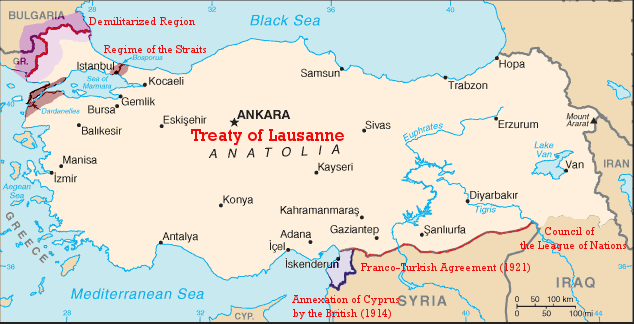
Atatürk's side wins, and he forces everybody back to the negotiating table with the Treaty of Lausanne and says, "Uh-uh, no." What is now the modern state of Turkey, and those borders will exist.
EvanHOST
Greece gets kicked out of Western Anatolia.
EvanHOST
There is no independent Kurdistan or Armenia.

Simon Sebag MontefioreGUEST
So he was, he was really a, um, he was really a sort of a fascinating character.
Simon Sebag MontefioreGUEST
And of course, you know, the creation of Turkey is such an important moment, and what one forgets about it now, and this is very relevant with President Erdoğan today, is that the, the Turks weren't delighted with what they got in 1923 in the Treaty of Lausanne.
Simon Sebag MontefioreGUEST
They, they really wanted half of Iraq too, and they wanted more of Syria, and they probably would've liked more of Europe, so ... on the European side too.
Simon Sebag MontefioreGUEST
Um, so they, um, they regard it as the best of a bad job.

speaker_0NARRATOR
The Ottoman Sultanate itself, its authority already hollowed out by three years of nationalist governance from Ankara and now stripped of any remaining claim to represent a nation that had won its own war of survival through its own arms, is formally abolished by the Grand National Assembly on the first of November, the last sultan departing Istanbul aboard a British warship within weeks, bringing to an end more than six centuries of Ottoman dynastic rule, an ending that arrives not through foreign conquest, but through the deliberate act of the very assembly that Mustafa Kemal had labored through those long, uncertain months in Ankara three years earlier to bring into being.
speaker_0NARRATOR
The peace that will formalize all of this, the Treaty of Lausanne, negotiated through the winter and spring of nineteen twenty-two and nineteen twenty-three and signed in July of the latter year, lies still ahead.
speaker_0NARRATOR
A long and difficult negotiation in its own right, fought with words and diplomatic leverage rather than rifles, but fought by many of the same men and toward the same essential goal: recognition by the powers that had once imagined dividing Anatolia among themselves of a sovereign and undivided Turkish state, bounded by borders that Turkish arms and not foreign committees had determined.
speaker_0NARRATOR
But that is a negotiation for another chapter in a different room at a different table.
19 MINS LATER
speaker_0NARRATOR
The conference breaks down once in February of nineteen twenty-three, delegates departing Lausanne without agreement, the entire process seemingly on the verge of failure.
speaker_0NARRATOR
But it resumes again in April, and this second phase moves with greater urgency toward resolution, both sides having taken the measure of the other's resolve during the interruption.
speaker_0NARRATOR
And finally, on the twenty-fourth of July, nineteen twenty-three, the Treaty of Lausanne is signed.
speaker_0NARRATOR
It is worth sitting with the significance of this document because it accomplishes something that very few defeated powers in the aftermath of the Great War managed to achieve.

speaker_2HOST
It happened in a diplomatic conference room in Switzerland.
speaker_2HOST
It was the Treaty of Lausanne in 1923.
speaker_3HOST
The treaty mandated a compulsory population exchange between Greece and Turkey to untangle the ethnic and religious borders after the war.
speaker_2HOST
Just uprooting everyone.

Feza RemziGUEST
I can pay my debt to my wife, I hope so, to being a good husband, to my son being a good father.
Feza RemziGUEST
But I can never pay my debt to Atatürk for somebody who brought the nation out of the disintegration to a culture of a man can get married with many women, the women had no rights and in a country that was at the puppet of the Western regimes and brought a secular state and kicked out all the invaders from Turkey and was able to sign the Lausanne Treaty.
Feza RemziGUEST
It's equivalent of the Paris Treaty for United States and established the modern secular Republic of Turkey that who gave a chance to my parents to become who they are that my mom was able to become a pediatrician a doctor and then we were able to become who we are so our generation engineer after even the current generation despite the unfortunate reality that's going on where turkey has become a major dictatorship as the way it is, that people are thrown into jail with nothing to be proven so they cannot be trained to the current regime, that I owe everything to Ataturk.
Feza RemziGUEST
So he is going to be the first one on that table.
Evan BuckHOST
We're giving the Kurds some autonomy," which they'll probably vote for independence too, "And we'll give some lands and islands to Greece and Italy as well." Essentially leaving the Ottomans a, uh, rump state in part of what is commonly referred to as Anatolia.
Evan BuckHOST
Well, in our timeline, uh, Ataturk was not a big fan of this, and a lot of the Turks were not f- fans of this at all, and they essentially led a rebellion, a revolution, Turkish war for independence, all that good stuff, and ended up forcing the allies into a treaty that was much more kind to them, and that was, in our timeline, what was known as the Treaty of Lausanne.
Evan BuckHOST
And this essentially restored the borders of what is now modern Türkiye for the most part, uh, took back the land that was given to Greece and, and Italy, or was set to be given to Greece and Italy, and, um, yeah, that's basically what happened in, in our timeline.
Evan BuckHOST
In the alternate timeline, which we started talking about in part one, we ended up m- putting the fork right at what if the Treaty of Sèvres was able to be implemented? Was able to be g- to, to be given the go-ahead, and Ataturk is not able to actually be successful in the Turkish war for independence.
9 MINS LATER
Chris CoppolaHOST
Mm-hmm.
Evan BuckHOST
So if we have that sort of similar situation fomenting in, in Turkey, you know, that's going to lead to some very interesting questions with regards to what's gonna happen in the lead-up to and this alternate timeline's version of World War II.
Evan BuckHOST
Because something very important to note, to compare and contrast, our timeline's version of Turkey, essentially because Ataturk got what he wanted, uh, in the Treaty of Lausanne, uh, was able to, to get back Armenian lands, have an independent Armenia and Turkey.
Evan BuckHOST
Well, what essentially happened was Armenia became a part of, the Russian part of Armenia became part of the Soviet Union.

Spyros EconomidesGUEST
It could make up the rules a bit, and this began to bring a bit of tension into the relationship between Greece and Turkey, who were slightly different in terms of their relationship with Washington because of strategic importance.
Spyros EconomidesGUEST
I think what happens, uh, in the 1960 or from the 1950s onwards, if you-- is you have as, as the beginnings of the unraveling, if you want, of the Treaty of Lausanne in many, in many respects because the minority, the Greek minority which still exists in Turkey, uh, and is provided for by the Treaty of Lausanne in 1923, starts coming under attack.
Spyros EconomidesGUEST
The emergence of the Cyprus question, that's what people normally refer to it as, uh, is an issue which starts, uh, make a lot of Greeks think about the protection of Hellenism beyond the borders of the Greek state.
Spyros EconomidesGUEST
And Cyprus is really Greece's near abroad to many Greeks.
8 MINS LATER
Spyros EconomidesGUEST
And people tend to forget that in the middle of the 1980s, under his prime ministership, uh, there was no backing down.
Spyros EconomidesGUEST
There was no backing down from what was seen as the Turkish challenge.
Spyros EconomidesGUEST
And the Aegean became this playground o-of, of, of, of, of military, almost military mishaps, uh, in the air and on the sea, converging on the idea that the territorial waters hadn't been properly, uh, um, delineated at the Treaty of Lausanne, that certain of the islands hadn't been demilitarized as provided by the Treaty of Lausanne.
Spyros EconomidesGUEST
There were claims as to the sovereignty of islands.
Chris CoppolaHOST
Number one, the initial Treaty of Sevres had allowed for the Ottoman Empire to hand over for prosecution, people that had been involved in the Armenian genocide.
Chris CoppolaHOST
And the Treaty of Lausanne does not.
Chris CoppolaHOST
The other thing the Treaty of Lausanne recognizes is Turkish control over Western Anatolia, all of these majority Greek areas that were literally currently being ethnically
Evan BuckHOST
cleansed of Greeks.
Evan BuckHOST
Exactly.
16 MINS LATER
Evan BuckHOST
And this is what we kind of see as one of the most important elements of helping to preserve Russia.
Evan BuckHOST
the Ottoman state for the longer run.
Evan BuckHOST
And Chris, I don't know if we fully flesh this out in the pre-podcast so we can do it now on the air, but as far as one of the biggest implications of this fork, you know, I put in my show notes that like at a Turk and the, you know, Turkish national movement aren't going to win, aren't going to force the, the terms of the treaty of Lausanne to happen.

Christina RiggsSOUNDBITE_SPEAKER
We're still in the aftermath of the First World War, right? So First World War ends November 1918, but the resolution of that war takes years.
Christina RiggsSOUNDBITE_SPEAKER
And in fact, Tutankhamen, the discovery of the tomb that winter of 1922 to 1923, literally is sharing headlines with the story of the Treaty of Lausanne, which determines what happens to the country that we now know as Turkey.
Christina RiggsSOUNDBITE_SPEAKER
which had been the Ottoman Empire, one of the losing parties in the First World War.
Christina RiggsSOUNDBITE_SPEAKER
And so it's that breakup of the former Ottoman lands, which had included Egypt up until 1914, that is part of an ongoing story.
5 more episodes mention Treaty of Lausanne.
Create an account to see the whole feed, search across every transcript, and follow the entities you care about.