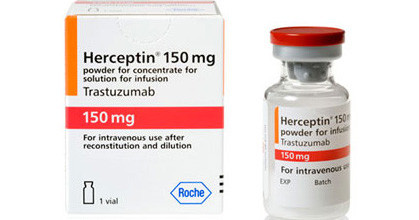
Trastuzumab
MedicationWikipedia
77
MENTIONS
35
EPISODES
32
PODCASTS
Search complete. 77 mentions across 35 episodes found for "Trastuzumab".
Sep 19, 2026

Robert CykiertHOST
Now, walk a patient or a family through the old first line playbook.
Robert CykiertHOST
It was chemo, then Herceptin, then immunotherapy.
Robert CykiertHOST
What worked and where did it fall short?
Geoffrey KuGUEST
Yeah, so historically, I mean, all we had until 2010 was chemotherapy.
Geoffrey KuGUEST
And I mean, I guess that was not so long ago.
Geoffrey KuGUEST
So, you know, the first landmark study, you know, in the space was a study called TOGA, which found that trastudumab or Herceptin, you know, so which is kind of the, you know, original... antibody that binds HER2.
Geoffrey KuGUEST
So basically binds and negates HER2.
Geoffrey KuGUEST
So TOGA established that adding trastuzumab to HER2-positive cancers in the first-line setting, adding it to chemotherapy, improved outcomes.

Anita RaniHOST
... who need it, but how does it actually work? Wh- why is it so effective?
Simon VincentGUEST
So Enhertu is based on an existing drug called Trastuzumab Herceptin.
Simon VincentGUEST
Uh, many women and men who are diagnosed with HER2 positive breast cancer will, will have that drug.
Simon VincentGUEST
Um, and what Enhertu does is it adds onto that some molecules of chemotherapy.

William WilliamsGUEST
I'm a physician by training, but I had also done a postdoc in Mark Green's lab at Penn.
William WilliamsGUEST
He, of course, is the man who developed the technology that led to Herceptin and a lot of other targeted cancer treatments, antibody-based cancer treatments.
William WilliamsGUEST
So after being at University of Pennsylvania for a number of years, I saw a lot of people who were leaving academia, starting biotech companies, doing good science, but they had no idea how to develop a drug.
William WilliamsGUEST
So I decided to take a different path.

Dawn MussallemGUEST
It's so much harder because 10 years ago, 15 years ago, we didn't have quite the treatments we do today.
Dawn MussallemGUEST
But the Herceptin, the Progetta, it's the hardest chemo women go through.
Dawn MussallemGUEST
The TCHP chemo is the hardest chemo that I see my patients go through because there's a lot of symptoms, GI symptoms for a full year that are hard.
Dawn MussallemGUEST
But then once you're free, these are my miracle cases that I see.

Ming Hei ThaiHOST
And this followed on zongurtinib, which also has an accelerated approval indication in this space.
Ming Hei ThaiHOST
So the first thing I want to talk about is the press release of FAM, Trastuzumab, Durex, TKN.
Ming Hei ThaiHOST
This press release says that the percentage of HER2 mutant lung cancer is 2 to 4%.
Ming Hei ThaiHOST
But if you look closer at the press release, they're really only referring to lung adenocarcinoma.
Ming Hei ThaiHOST
HER2 also has an extracellular and intracellular domain, and mutations can happen in either domain.
Ming Hei ThaiHOST
The most common mutations happen in the intracellular domain, and these are the exon 20 insertions, and these are what are targeted by our HER2 DKIs, as well as fam-trastuzumab-derx-tcan.
Ming Hei ThaiHOST
The rest of the mutations are extracellular, and these are only targeted by FAM, Trastuzumab, DERX, TKAN.
Ming Hei ThaiHOST
And I only mention this because I will not be focusing on the extracellular domain here because these patients can only be targeted with FAM, Trastuzumab, DERX, TKAN.

Tiffany Troso-SandovalHOST
And so, you know, just for people in the audience that can think of clinical trials as a phase three, for example, when we looked at in triple negative breast cancers, adding immunotherapy to the chemotherapy, that had to be tested out and shown to be better than just chemo alone.
Tiffany Troso-SandovalHOST
Same thing with Herceptin for HER2 positive breast cancers.
Tiffany Troso-SandovalHOST
Now, we've had that on the market for years and years, but it re- it initially started as a clinical trial, and it now changes the entire algorithm of how we treat women with HER2 positive breast cancers.
Tiffany Troso-SandovalHOST
And those are just two simple, um, examples, but I thought it was worth pausing here just to explain for anybody who might not know.

Lindsay PetersonHOST
I think most of us think about, you know, trastuzumab deruxtecan.
Lindsay PetersonHOST
We think about, you know, tukainib combinations.
Lindsay PetersonHOST
You know, when, when I was in fellowship, I think we had capecitabine and intrathecal methotrexate, and then we were starting to do some intrathecal Herceptin.
Lindsay PetersonHOST
So where do you sort of place all of those options, and does it depend somewhat on how much non-CNS disease they have? I know this is, you know, this is in coordination with medical oncology, but, but so what's your practice there, and what do you see being used most often, and what's driving the decision for one CNS regimen over another?
Barbara O'BrienGUEST
Well, if we're talking LMD, I will say I do far less intrathecal chemo than I, than I used to.
12 MINS LATER
Lindsay PetersonHOST
I remember in fellowship, you know, quoting people six to eight weeks and, and seeing that, you know, on a routine basis, so.
Lindsay PetersonHOST
Do you have any, like, success stories that really stick in your mind? I have a patient that I always think about when I'm talking to patients about prognosis, and she had HER2 positive disease.
Lindsay PetersonHOST
It was, you know, biopsy-proven recurrence outside the CNS, was treated and had a resolution of all of her disease, and then had a, a brain met pop up that was resected that was HER2 positive, and then was maintained on Herceptin for, I wanna say, close to five years.

Robert CarlsonGUEST
You know, i-in that long am-amount of time, it's been quite varied.
Robert CarlsonGUEST
I started as a scientist doing really oncology diagnostics development in breast and prostate, again, through the tools enabling kind of discovery of biomarkers through that, including biosensors and flow cytometry, to even working at Dako, where we launched the very first companion diagnostic test, which in fact was with breast cancer and, uh, HERCEP Test and Herceptin.
Robert CarlsonGUEST
You know, I've spent a bunch of time in the hemonc space as well as in the molecular space when it comes to that, and also quite a bit of time in gastroenterology.
David FilbyHOST
Hmm.

Roy HerbstGUEST
No, it's a very nice result.
Roy HerbstGUEST
HER2 has been known for a while, and years ago, Herceptin was tried in this setting, a naked antibody, and that didn't really work much.
Roy HerbstGUEST
So I think using the ADCs make a lot of sense, and it's very impressive, and I think it gives us a new option for our patients.
Roy HerbstGUEST
I wonder if we can get even more specific someday by looking at the specific mutation and whether the receptor is internalized or not, and I think that probably makes a difference as well.

Samantha HarrisHOST
Very interesting.
Samantha HarrisHOST
Interestingly, when I question my personal medical oncologist, who actually wrote the foreword to my book and is at the top of the top of the top, he is the father of Herceptin, which saves so many women now who are her two positive cancer patients.
Samantha HarrisHOST
And when I asked him about Dr. Blooming and Estrogen Matters, and he said, look, I know him, he's wonderful, but I have my own thoughts specifically for me, right? Especially with the recurrence.
Samantha HarrisHOST
And so that's where that conversation with your oncologist, with your team, with your other doctors is very important because the general rule is, you know what, systemic, So we're talking about the transdermal patch or oral.
25 more episodes mention Trastuzumab.
Create an account to see the whole feed, search across every transcript, and follow the entities you care about.