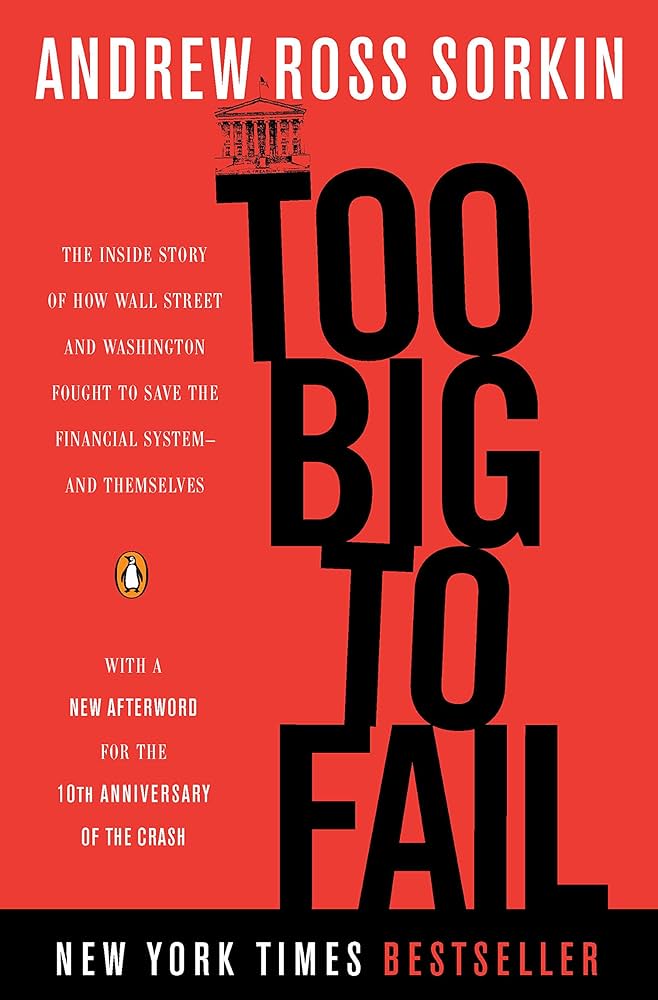
Too Big to Fail
Book by Andrew Ross SorkinWikipedia
35
MENTIONS
6
EPISODES
6
PODCASTS
Search complete. 35 mentions across 6 episodes found for "Too Big to Fail".
Sep 14, 2026

David KellyGUEST
And so we've got some great books, starting with The Great Crash, 1929, by John Kenneth Galbraith.
David KellyGUEST
And ending with Too Big to Fail by Andrew Ross Sorkin, just looking at the story of how these crises came up and then how they sort of evolved over time and then how they ultimately resolved and any lessons that we can learn from them.
Gabriela SantosHOST
And speaking of in terms of these five crises, were there any commonalities between them and what led up to them?
David KellyGUEST
I think in all cases, there was a degree of investor enthusiasm or optimism that you can't really squash that out in America.
6 MINS LATER
David KellyGUEST
People invest in crypto today because it really should be, in my personal opinion, should be regulated out of existence.
David KellyGUEST
But if not, it should be very heavily regulated.
David KellyGUEST
I remember after the 2008 crisis, people talked about moral hazard and how nothing should ever be too big to fail and drawing lines in the sand and being tough.
David KellyGUEST
You don't need to be tough in a crisis.

Sara RoccisanoGUEST
And so there were pictures of various people.
Sara RoccisanoGUEST
It's really the grandfather of Too Big to Fail, the other book that's huge, that was written by a Cornellian, Andrew Ross Sorkin.
Sara RoccisanoGUEST
And he wrote about the financial crisis of 2008.
Sara RoccisanoGUEST
So it's the same sort of story on repeat.

Jack SweeneyHOST
I don't know, something that interests you or a resource even, whether it's something streaming.
Jonathan MaGUEST
Yeah, I actually just recently reread Too Big to Fail.
Jonathan MaGUEST
I actually moved to New York in September of 2008.
Jonathan MaGUEST
So when I first moved there, I actually saw the financial industry go through all the challenges it was going through.

Andrew Ross SorkinGUEST
I didn't tell anybody I was working on it, in large part because I didn't know if I'd ever finish it and I didn't know if it would ever be any good.
Andrew Ross SorkinGUEST
You know, I had written Too Big to Fail after the financial crisis in 2008.
Andrew Ross SorkinGUEST
And people used to ask me all the time about how 2008 compared.
Andrew Ross SorkinGUEST
to 1929.
Andrew Ross SorkinGUEST
A lot of them were written, there was a couple of books written in the late 30s, 40s.
Andrew Ross SorkinGUEST
The Galbraith book was in the 1950s.
Andrew Ross SorkinGUEST
And so there really wasn't the kind of writing, you know, the Barbarians at the Gate, Den of Thieves style, Michael Lewis style book, or even what I thought it was too big to fail.
Andrew Ross SorkinGUEST
So I thought...

John RamseyHOST
[laughs]
Ronan RyanHOST
I stole Too Big to Fail, which-
John RamseyHOST
Oh, yeah
Ronan RyanHOST
... painted not the best picture-

Andrew Ross SorkinGUEST
What, what are you? You're a, you're a multi-hyphenate.
Oprah WinfreyHOST
Well, you know what? I don't know finance the way you do, and I will have to say this, that when I saw your book, 1929: Inside the Greatest Crash in Wall Street History and How It Shattered a Nation, so when I saw that this, um, you know, immediately went to number one on The New York Times bestseller, I was so happy for you.
Andrew Ross SorkinGUEST
Thank you.
Oprah WinfreyHOST
Really, so happy for you.
Oprah WinfreyHOST
And I thought, "Yeah, I'm really happy for him, but I don't know if I can read that book."
speaker_2UNKNOWN
[laughs]
Oprah WinfreyHOST
[laughs] "I don't know." And then I got the book, and I thought [laughs] it's like over 500 pages.
speaker_2UNKNOWN
[laughs]