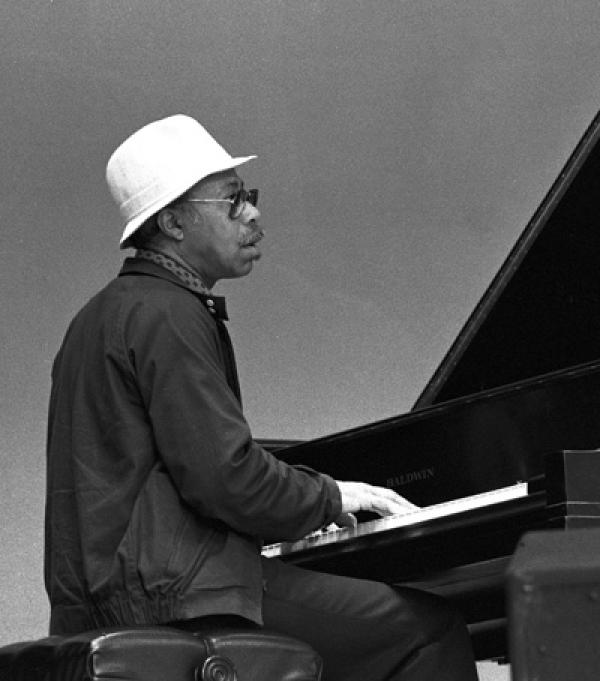
Tommy Flanagan
American jazz pianist and composerWikipedia
16
MENTIONS
13
EPISODES
13
PODCASTS
Search complete. 16 mentions across 13 episodes found for "Tommy Flanagan".
Oct 17, 2026

Kevin LawrenceHOST
Music from the classic 1960 album, Giant Steps.
Kevin LawrenceHOST
You heard the title track, and the personnel on that cut: John Coltrane, tenor sax, Tommy Flanagan, piano, Paul Chambers, bass, Art Taylor on drums.
Kevin LawrenceHOST
And John Coltrane, this guy was a member of the first great Miles Davis Quintet.
Kevin LawrenceHOST
We dug up some cuts from the jazz vaults.

Ari LehmanGUEST
And so I pursued that, and I got a scholarship, and then I went to New York University, and I literally... could go and watch the greatest jazz piano players of all time for the price of a beer.
Ari LehmanGUEST
I would just go downstairs on University Place and I could see Hank Jones and Tommy Flanagan and Soros and McCoy Tyner.
Ari LehmanGUEST
Oh my God, George Coleman played the saxophone and oh my god it was incredible and then at that time too you know punk was happening and metal was happening and i met oh just some amazing players and so so like i don't know uh the lead singer for reagan youth which was a great punk band and he would bring me over to cbgb's to see the bad brains and dead kennedys and oh i even saw this guy With his band, and they were called White Zombie at the time.
Ari LehmanGUEST
Yeah, yeah.

Allan SlutskyGUEST
And, uh, Motown's studio band had a, a deep jazz background.
Allan SlutskyGUEST
Uh, Earl Van Dyke was the, basically the unofficial band leader, and he had been schooled unofficially by Hank Jones and, um, Tommy Flanagan.
Allan SlutskyGUEST
All the, all the Detroit jazz musicians, you know, they kind of took him under their wing.
Allan SlutskyGUEST
And, uh, then you had Joe Messina, the guitar player from the Funk Brothers.

Peter BernsteinGUEST
And then when I got into jazz, when I first, you know, I heard Kenny Burrell, Wes Montgomery around the same time, got some records, and I was like, "What are they doing? I don't know.
Peter BernsteinGUEST
I hear the blues." You know, my ears were limited to a certain thing, and I just had to expand what I was able to hear, and hearing Wes Montgomery and Kenny Burrell play the blues, I was like, "Okay, I gotta figure out what those other, other notes are too." But, but fr- from the first time I heard Wes and, and Kenny Burrell, the other people on the record, the Kenny Burrell record had Coltrane and Tommy Flanagan.
Peter BernsteinGUEST
It was that stuff, so.
Peter BernsteinGUEST
Then I heard Wes with Wynton Kelly, and I was like, "That's serious piano playing." Just the feeling of the music, the drums, the bass.

Steve DavisGUEST
for decades, but he just seemed like the perfect fit for this.
Steve DavisGUEST
And, and he was, you know, he just, and so I kind of approached the session as if I was going to hear them play duo at Bradley's piano bar in the village, which is, you know, hasn't been there for 30 years, but I used to go and, and hear Hank Jones there or, or, Tommy Flanagan or Cedar Walton or Kenny Barron or Larry Willis or, you know, any of the great pianists, usually in piano bass duo configuration quite often.
Steve DavisGUEST
So yeah, that was the idea.
Steve DavisGUEST
And that could, could I just sort of get in the flow on slush pump and not mess it all
23 MINS LATER
MikeHOST
you know,
Steve DavisGUEST
red Garland, you know, just keep going.
Steve DavisGUEST
Tommy Flanagan, uh, Barry Harris.
Steve DavisGUEST
I mean, Cedar, I guess I mentioned him and, but you know, I, I used to tell people if, if you really want to know what I'm trying to do on the trombone, yes, JJ Johnson, Curtis Fuller, slide Hampton, of course, you know, all day long and many others, but, uh, it's really piano trios.

Larry SeidmanHOST
Rollins' mother would sing it to him as a child, but independently, pianist Randy Weston, who was fascinated with African culture, discovered the same tune, and he recorded it a year before Sonny Rollins, but under the name of Fire Down There.
Larry SeidmanHOST
I think I'll play the whole six and a half minute Sonny Rollins version from his Saxophone Colossus album of 1956 with Tommy Flanagan piano, Doug Watkins bass, Max Roach drums, and Sonny Rollins on tenor saxophone.
Larry SeidmanHOST
St. Thomas.
Larry SeidmanHOST
? ? ?

speaker_0NARRATOR
Improvising over the progression in Giant Steps at that tempo is still the hardest test in jazz.
speaker_0NARRATOR
Tommy Flanagan, who played piano on the 1959 session, picked his way through a halting solo, was haunted enough to try it again and recorded the tune 23 years later.
speaker_0NARRATOR
Modal jazz is almost the opposite challenge, how to discover a new sound while the harmonic space remains steady.
speaker_0NARRATOR
The chordal coltrane was looking for more powerful, difficult and in-your-face harmonic structures.

Mike AllemanaGUEST
No.
Mike AllemanaGUEST
So, so Check Please, their theme song was from the Kenny Burrell-John Coltrane album, right? Uh, it's the, uh, uh, Tommy Flanagan tune, uh, um, [singing] I forget the name of it.
Mike AllemanaGUEST
Uh, [laughs] sorry, brain cramp.
Mike AllemanaGUEST
But Jimmy Cobb's the drummer on that.

Kevin WhiteheadCORRESPONDENT
The saxophonist played a lot of notes while trumpeter Miles played famously few, and they tugged the music in opposite directions.
Kevin WhiteheadCORRESPONDENT
Coltrane's next boss, pianist Thelonious Monk, played even fewer notes than Miles, but in this case, opposites attract.
Kevin WhiteheadCORRESPONDENT
Monk and Coltrane sound like they approach the same musical problems from opposite directions.
Kevin WhiteheadCORRESPONDENT
This is Monk's 1957 Trinkle Tinkle.
Kevin WhiteheadCORRESPONDENT
On his famous test piece Giant Steps, the chords change on every beat while bouncing around three distantly related keys.
Kevin WhiteheadCORRESPONDENT
Coltrane had practiced it thoroughly, but not with his band.
Kevin WhiteheadCORRESPONDENT
In the studio, the great pianist Tommy Flanagan could barely keep up.
Kevin WhiteheadCORRESPONDENT
[jazz music] Miles Davis then advised Coltrane, "When you squeeze in a whole bunch of chords like that, don't make the rhythm section track your every move.

Joey BaronGUEST
And so they closed the club, and it was a private party.
Joey BaronGUEST
And Elvin Jones and Tommy Flanagan and the bassist, uh, who was with Red and Ira at the time, Mike Formanek, they got up and played, you know.
Joey BaronGUEST
And of course, Elvin sat at my drum set 'cause it's-- I'm there all week, you know.
Joey BaronGUEST
And they were his drums.
3 more episodes mention Tommy Flanagan.
Create an account to see the whole feed, search across every transcript, and follow the entities you care about.