Toll-like receptor
17
MENTIONS
6
EPISODES
6
PODCASTS
Search complete. 17 mentions across 6 episodes found for "Toll-like receptor".
Sep 15, 2026

Jeff GreensteinHOST
That's the thing.
Jeff GreensteinHOST
Those TLRs like that and the Yashica mat.
Jeff GreensteinHOST
Yep.
Jeff GreensteinHOST
The Minolta auto cord.

Rebecca SappHOST
So are the ILCs primarily in the mucosal surfaces and other epithelial surfaces? How do they interact with the environment like that?
Taylor DohertyGUEST
So it mainly is thought to be due to indirect alarm and recognition or say neuropeptide stimulation or inhibition as well as from other immune cells that can provide signals like I mentioned say with the lipids and so there are cases where ILC2s have been shown especially in vitro to directly respond to something say like a TLR signal from a pathogen but in general sitting at these barriers as sentinels they really do rely on the entire input from the milieu from other cell types whether it's cytokines lipids or other potential mediators that And we should be a little careful here because the field's evolved enough to where when an ILC2 is quote-unquote activated, there are many different fates of where that daughter population can end up.
Taylor DohertyGUEST
And so it actually really speaks in the human ILC2 world.
Taylor DohertyGUEST
that there's so much heterogeneity even within these populations.

LiamHOST
Yes.
LiamHOST
So in the preseason, our top defenders were Zippy Fish, Maddie Gay, TLR, Maeve Champlin, Tani White, and Serene Watson.
LiamHOST
And then currently the top six for average are Zippy Fish, Maddie Gay, Charlie Thomas, Becky Webster, Erica Roche, and then Emma O'Driscoll.
LiamHOST
So those bottom four weren't present in our top six prediction in the preseason.
LiamHOST
I would somewhat even say famous for saying just that.
WillowHOST
Yeah, just
LiamHOST
like a back in TLR to accumulate in defence for the rest of the year.
LiamHOST
The track record is there for them.

Sam SmithHOST
And I'll do this, number one, to illustrate how complex these pathways are, and number two, to point out a few of the effects that these pathways can have on cells.
Sam SmithHOST
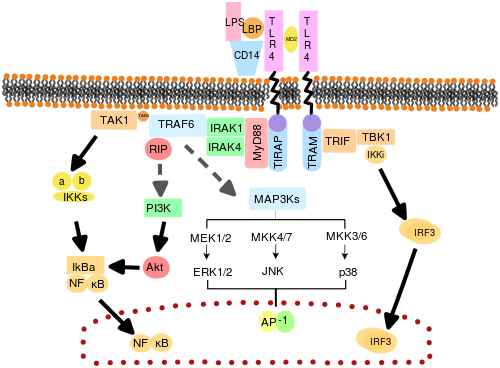
So toll-like receptors, or TLRs, are a major pattern recognition receptor for immune cells, and these toll-like receptors set off a very specific intracellular pathway.
Sam SmithHOST
And so what they first do, obviously, is they recognize some kind of pathogen or antigen.
Sam SmithHOST
In our case, again, this is a few of the proteins from a salmonella flagella.

Jill CarnahanHOST
Mm-hmm.
Isaac MelamedGUEST
Which we evaluate, it's called toll-like receptor, that we look at the signaling of toll-like receptor, and we see that the TLR is actually low in the patient with infection.
Isaac MelamedGUEST
And as it is being low, what happen is the immune system is producing Pro-inflammatory mononuclear cells.
Jill CarnahanHOST
Mm-hmm.

Cindy LeiferHOST
Um, Department of Rheumatology at Shanghai Jiao Tong University School of Medicine, Institute of Translational Medicine in Hangzhou, uh, School of Basic Medical Sciences in Fudan in Shanghai, and Institute of Pharmacology and Toxicology in, in, uh, Beijing.
Cindy LeiferHOST
Um, so, so it's a bunch of Chinese, uh, people who worked on this particular study, and I was interested in it because, uh, again, I am interested in TLRs, especially nucleic acid sensing TLRs, which there are primarily TLR3, which sees double-stranded RNA, seven and eight which see single-stranded RNA, and nine which sees DNA.
Cindy LeiferHOST
And then there are many different, many different cytoplasmic sensors that can see nucleic acids.
Cindy LeiferHOST
Um, cGAS is one particular one that gets a lot of attention, and it recognizes DNA.
5 MINS LATER
Cindy LeiferHOST
So one of those players is TREX or TREX.
Cindy LeiferHOST
Um, so that one, um, is really important, and if you mutate that one, and that will come up in the paper, if you mutate that or you lack that gene, that allows nucleic acids to accumulate, and when they accumulate, they make it into those endosomes, and then they trigger the response.
Cindy LeiferHOST
And the interesting thing is that these nucleic acid sensing TLRs are expressed on B cells.
Cindy LeiferHOST
So what happens is if you have an anti-DNA, anti-RNA B cell, uh, it will bind to nucleic acid.