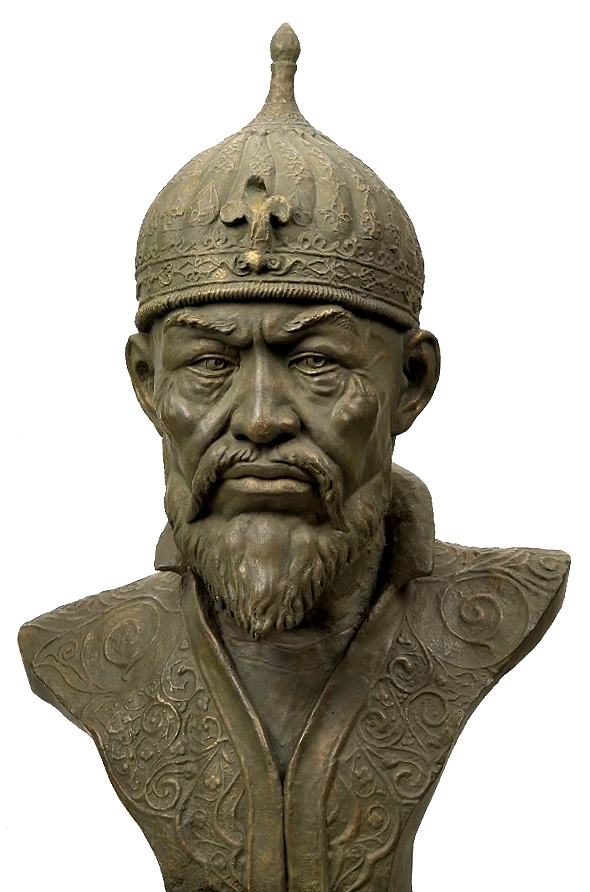
Timur
Military leader and former Amir of the Timurid EmpireWikipedia
382
MENTIONS
45
EPISODES
34
PODCASTS
Search complete. 382 mentions across 45 episodes found for "Timur".
Oct 27, 2026

Chris HaslerHOST
Particularly notable was Nicopolis, where a European crusader army catastrophically failed to defeat the Ottomans.
Chris HaslerHOST
European momentum was curbed, at the beginning of the 15th century by Tamerlane who defeated an Ottoman army at Ankara and captured the Ottoman Sultan who died in captivity.
Chris HaslerHOST
This plunged the Ottoman Empire into civil war before the rise of Mehmed I reunified the empire.
Chris HaslerHOST
So although this period was a setback for the Ottomans it proved only to be temporary.

Julie ToméHOST
He was a sultan, but he was also an astronomer and a mathematician.
Julie ToméHOST
He was the grandson of the conqueror and King Timur and the eldest son of Shah Rukh.
Julie ToméHOST
His mother was Guhar Shah, who was a noble woman.
Julie ToméHOST
He was born in Sultaniye during Timur's invasion of Persia and given the name Mirza Muhammad Targay, but is better known as Ulugbeg, which loosely translates to great ruler.
Julie ToméHOST
He spent his childhood moving around the Middle East and India as Timur expanded the empire.
Julie ToméHOST
And after Timur's death, Shahrukh moved the capital of the empire from Samarkand to Herat.
Julie ToméHOST
And Herat is in Afghanistan.
Julie ToméHOST
Uluqbaik became the governor of Samarkand at age 16 in 1409.

Ebrahim JosephGUEST
But if we look to Marlow, then we see a much more sustained engagement with Persia.
Ebrahim JosephGUEST
So in the Tamerlane plays, we have very strong echoes of the Syropaedia.
Ebrahim JosephGUEST
So the Tamerlane plays follow a Scythian shepherd who becomes an apparently unstoppable conqueror.
Ebrahim JosephGUEST
And this model of kingship that Tamerlane employs is one that's very familiar to readers of the Syropedia.
Ebrahim JosephGUEST
So he is brutal on the one hand, but he is extraordinarily eloquent, which is another of Cyrus's key traits.
Ebrahim JosephGUEST
He is charismatic.
Ebrahim JosephGUEST
He has this band of brothers following him.
Ebrahim JosephGUEST
But when he reaches the apotheosis of his power.

Pete QuiñonesHOST
But the Kara- Karaim, a Jewish sect that does not follow the Talmud, and Jewish residents of the Crimean did not go over to the Muslim faith.
Pete QuiñonesHOST
The Khazars were finally conquered by Tamerlane, much later by Tamerlane or Timur, the fourteenth-century conqueror.
Pete QuiñonesHOST
A few researchers, however, hypothe- hypothesize-
Matthew Raphael JohnsonGUEST
Okay, well, there's so much here.

speaker_0NARRATOR
The problem was approaching from the east, and Bayezid was not paying it sufficient attention.
speaker_0NARRATOR
Timur, known to European history as Tamerlane, was one of those figures who appears in the historical record like a force of nature rather than a person.
speaker_0NARRATOR
He had emerged from the region around Samarkand in Central Asia in the 1360s and spent the following decades building an empire through a combination of military genius and systematic, deliberate terror.
speaker_0NARRATOR
He conquered Persia.
speaker_0NARRATOR
He invaded northern India, sacked Delhi, and departed having killed so many people that contemporary accounts become almost too large to process.
speaker_0NARRATOR
He was not a Mongol by direct descent, but he deliberately modelled himself on Genghis Khan's legacy and pursued conquest with a similar organisational ruthlessness.
speaker_0NARRATOR
By the late 1390s, Timur's attention had turned westward toward Anatolia and the friction with Bayezid had a specific, traceable cause.
speaker_0NARRATOR
Several of the Anatolian Beylik rulers that Bayezid had deposed or subjugated had fled east and sought refuge with Timur.

Pamela NagamiNARRATOR
there was no bastille here and no letters to cachet by which titled pensioners or royal idlers could send their untitled foes to gaol without cause and without trial here were thirty religions and not one priest here was the boldest sect of all the quakers who astonished all christendom by behaving like christians voltaire never to the end of his life ceased to wonder at them in the dictionnaire philosophique he makes one of them say our god who has bidden us love our enemies and suffer evil without complaint assuredly has no mind that we should cross the sea to go and cut the throats of our brothers because murderers in red clothes and hats two feet high enlist citizens by making a noise with two sticks on an ass's skin it was in england too that throbbed with a virile intellectual activity bacon's name was still in the air and the inductive mode of approach was triumphing in every field hobbes fifteen eighty eight to sixteen seventy nine had carried out the sceptical spirit of the renaissance and the practical spirit of his master into so complete and outspoken a materialism as would have won him in france the honour of martyrdom for a fallacy locke sixteen thirty two to seventeen o four had written a masterpiece of inductive psychological analysis the essay on the human understanding sixteen eighty nine without so much as mentioning the soul collins tyndall and other deists were reaffirming their faith in god while calling into question every other doctrine of the established church Newton had just died, Voltaire attended the funeral, and spoke repeatedly of the impression made upon him by the national honors awarded to this modest Englishman.
Pamela NagamiNARRATOR
Not long ago, he writes, a distinguished company were discussing the trite and frivolous question who was the greatest man, Caesar, Alexander, Tamerlane, or Cromwell.
Pamela NagamiNARRATOR
Someone answered that without doubt it was Isaac Newton, and rightly, for it is to him who masters our minds by the force of truth and not to those who enslave them by violence that we owe our reverence voltaire became a patient and thorough student of newton's works and was later the chief protagonist of newton's views in france one must marvel at the quickness with which voltaire absorbed almost all that england had to teach him its literature its science and its philosophy he took all these varied elements passed them through the fire of french culture and the french spirit and transmuted them into the gold of gallic wit and eloquence he recorded his impressions in letters on the english which he circulated in manuscript among his friends he did not dare to print them for they praised perfidious albion too highly to suit the taste of the royal censor they contrasted english political liberty and intellectual independence with french tyranny and bondage they condemned the idle aristocracy and the titheabsorbing clergy of france with their perpetual recourse to the bastille as the answer to every question and every doubt they urged the middle classes to rise to their proper place in the state
speaker_2ADVERTISER
With VrboCare, help is always ready before, during, and after your stay.

Dave FarinaHOST
Manuel traveled to Europe to ask for help from Italy, France, and England, but he came back empty-handed.
Dave FarinaHOST
In the end, it was the Mongols, led by Timur or Tamerlane, who had just invaded Asia Minor, that forced the Ottoman army to withdraw.
Dave FarinaHOST
This crisis was followed by a period of cooperation between Byzantines and Turks, which ended in 1421, when a new emperor, John VIII, came to power around the same time as a new Sultan, Murad II.
Dave FarinaHOST
Both men decided to pursue a more aggressive policy, and after John backed a rebellion against the Sultan, Murad attacked Constantinople.

Pete QuiñonesHOST
But the Karai- Karaim, a Jewish sect that does not follow the Talmud, and Jewish residents of the Crimean did not go over to the Muslim faith.
Pete QuiñonesHOST
The Khazars were finally conquered by Tamerlane, much later, by Tamerlane or Timur, the 14th century conqueror.
Pete QuiñonesHOST
A few researchers, however, hypot- hypothesize-
Matthew Raphael JohnsonGUEST
Okay, well, there's so much here.

EnochNARRATOR
The Bayids came to dominate Baghdad, the heart of the caliphate.
EnochNARRATOR
Then came the Seljuks, followed by the devastating Mongol invasions of Genghis Khan and later the campaigns of Tamerlane.
EnochNARRATOR
It was as if Persia had become a vast chessboard, where power constantly shifted from one hand to another.
EnochNARRATOR
Yet in the midst of this whirlwind of wars and conquests, something new began to take shape.

DanteHOST
And Bill's name also echoes that title.
DanteHOST
Tamerlane is the title of one of Edgar Allan Poe's poems.
DanteHOST
And then you also have, and this plays into the next episode, Maury or Morella and Lenore, they are watching the 1961 Vincent Price film, The Pit and the Pendulum.
DanteHOST
Which basically kind of foreshadows Freddy's death to some degree.
35 more episodes mention Timur.
Create an account to see the whole feed, search across every transcript, and follow the entities you care about.