Tiktaalik
AnimalWikipedia
45
MENTIONS
14
EPISODES
13
PODCASTS
Search complete. 45 mentions across 14 episodes found for "Tiktaalik".
Oct 22, 2026

GregHOST
We have Eustonopteron, circa around 385 million years ago, a fully aquatic lobed fin fish featuring internal fin bones, homologous to modern land limbs, a single upper bone, humerus, two lower bones, the radius and ulna, and early wrist elements.
GregHOST
Then, in 375 million years ago, we have Tiktaalik rose, discovered in 2004 on Ellesmere Island in the Canadian Arctic.
GregHOST
And Tiktaalik is the ultimate fishapod.
GregHOST
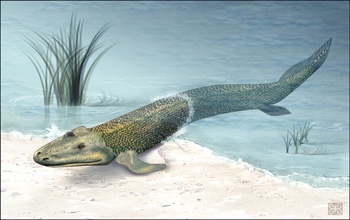
It combined fish-like scales and fin rays with a flattened crocodile-like skull, functional wrist joints capable of bearing weight, and the loss of gill-covered bones, giving it a flexible, movable neck to strike at prey in shallow water.
GregHOST
Then we have Acanthostega around 365 million years ago and Ichthyostega 360 million years ago.
1 HR 46 MINS LATER
GregHOST
And up next, let's take a look at the mechanical integration of the creature from the Black Lagoon.
GregHOST
Players must maneuver a boat token along a color-coded sequence track on the monster's mat through water spaces to locate the creature's lair, spending items to drive them off, and this recreates 20th century Amazonian riverboat expeditions aboard ships like the Rita.
GregHOST
It ties directly to the fossil record of early lobefin fish like Tiktaalik that we learn about, making the Devonian evolutionary transition to land, and the creature uses aquatic terrain to stalk victims from the depths, forcing the heroes to embark on an uncharted river voyage to flush them out of his steep lagoon.

speaker_11NARRATOR
In fact, the Devonian period got its name from the fossils of lobefins found in Devon, England.
speaker_11NARRATOR
In 2004, a lobefin fossil was found in the Canadian Arctic, known as the Tiktaalik, which is considered to be the species between fish and land-dwelling tetrapod.
speaker_11NARRATOR
It had a crocodile-like head, bony fins, sharp teeth, and a flat body almost three meters long.
speaker_11NARRATOR
Its fins had partial wrists, allowing it to crawl on land.
speaker_11NARRATOR
So if I were you, I would quickly hide if I saw a Tiktaalik coming my way.
speaker_11NARRATOR
The other dominant species were cartilaginous fish with skeletons covered in, you guessed it, cartilage.
speaker_11NARRATOR
These are the ancestors of sharks and rays, but you don't have to worry about sharks.

Andy AmanGUEST
That's right, right? Like, having bony, pointy things grow into the oral cavity and become, like, the masticatable organ or something, that would've been huge, right? And our lineage had pre-evolved that before it was necessary in the mouth.
Andy AmanGUEST
And then talk about our immediate tetrapod ancestor, right? Like, again, harking back to Neil Shubin, like the Tiktaalik, right? So...
Andy AmanGUEST
Or Tiktaalik.
Andy AmanGUEST
Tiktaalik is a wonderful-- Do you guys like to call him a fish, or do you like to call him a land animal?
JoshHOST
Ask Christine.
JoshHOST
I don't know.
JoshHOST
[laughs]
ChristineHOST
Sorry, I got excited when I saw that you had put Tiktaalik in, so-

RicoNARRATOR
The Devon period got its name because of the fossils of the fleas, which were found in Devon, England.
RicoNARRATOR
In 2004, in the Canadian Arctic, one found fossils of a carnivore known as a Tiktaalik and seen as a bond between fish and tetrapods.
RicoNARRATOR
It had a crocodile-like head, knotted fins, sharp teeth and a flat, almost three-meter-long body.
RicoNARRATOR
Some of its fins had wristbands with which it could crawl on land.
RicoNARRATOR
If a Tiktaalik approaches you, better hide.
RicoNARRATOR
The other prevailing species were codfish, whose skeleton was covered with codfish.
RicoNARRATOR
They are the ancestors of sharks and sharks.
PeterHOST
375 million years ago, just inches away from my wrist, something incredible happened.
PeterHOST
The creature Tiktaalik dragged itself out of the water, becoming the first creature to walk on land.
PeterHOST
To a fish, going on land wasn't an adventure to the unknown, it was a refuge from the giant armored predators in the water.
PeterHOST
And they walked around the first true forests with real trees.
30 MINS LATER
PeterHOST
they may not look so special but, believe it or not, this fellow is DigiPeter's ancestor, and yours.
PeterHOST
It's an interesting time to be alive.
PeterHOST
Within a few million years, another lobed-finned fish, a relative of the one DigiPeter just caught called Tiktaalik, evolves the ability to crawl onto land.
PeterHOST
[feet pattering] That's the first creature to set foot, or fin, out of the sea.

Dave FarinaHOST
That is because all tetrapods share common ancestry with the last common ancestor of all tetrapods dating back to about four hundred million years ago.
Dave FarinaHOST
There are many fossil forms that illustrate the evolution from obligate water-dwelling species into terrestrial forms, but at least one extinct species of great importance is Tiktaalik, an extinct lobe-finned fish from the late Devonian.
Dave FarinaHOST
Though technically a fish, it had a large flattened head with eyes on top instead of along the sides and fins that were closer morphologically to tetrapod limbs.
Dave FarinaHOST
It is an important transitional fossil in the evolution of vertebrates from water to land, which has provided important insights into the evolutionary history of vertebrates and has helped scientists better understand how fish gradually adapted to life on land.
Dave FarinaHOST
It's important to remember that ancient lobe-finned fish were not the first organisms to colonize the land.
Dave FarinaHOST
Bacteria, fungi, plants, and even other animals like the arthropods and gastropods had already been living on land for millions of years before Tiktaalik.
Dave FarinaHOST
Also, Tiktaalik and its kin didn't just flop onto land.
Dave FarinaHOST
They still needed the water to survive, so they couldn't migrate too far away.

Megan WetherellHOST
Yeah
Amy AtwaterHOST
... really popular coelacanth meme and a Tiktaalik me- anyway, and I'm just like, "Cool."
Megan WetherellHOST
Yeah.
Amy AtwaterHOST
"Ugh, hello fellow kids." So.

Grayson HawkGUEST
the predictions of evolution that are about things that will happen in the future are about what kind of fossil anatomies we will discover that are unlike anything that we know of today.
Grayson HawkGUEST
For example, the specific anatomical features for Tiktaalik were that it would have a flat head, with wrist bones and a neck, which no lungfish on Earth or before has ever been observed.
Grayson HawkGUEST
And they predicted this unique, non-arbitrary anatomy, and then they found it exactly in the location.
Grayson HawkGUEST
That's not arbitrary.
Grayson HawkGUEST
You couldn't do that.
Jim BobGUEST
Okay, I understand.
Jim BobGUEST
So then if you found that same exact thing, a Tiktaalik, right? If you found it with all the same data, the neck, the wrist, and everything, can you tell me, given all the same data is the same, nothing else changes, the similarities change, the neck is the same, the fins are the same, and you're like, holy shit, that's like exactly what we wanted to predict here.
Jim BobGUEST
Can you tell me with all the data being the same, how you would determine it wasn't the common ancestor?

Megan WetherellHOST
Yeah
Amy AtwaterHOST
... really popular coelacanth meme and a Tiktaalik me- anyway, and I'm just like, "Cool."
Megan WetherellHOST
Yeah.
Amy AtwaterHOST
"Ugh, hello fellow kids." So.

speaker_1HOST
Oh, absolutely.
speaker_1HOST
One of the greatest validations of this was the discovery of Tiktaalik in the Canadian Arctic in two thousand six.
speaker_3HOST
What was the prediction there?
speaker_1HOST
Well, paleontologists knew there had to be an evolutionary transition between ancient lobe-finned fish and the very first four-limbed animals to walk on land.
speaker_1HOST
They used the dating methods we just discussed to identify sedimentary rocks of the exact right age, about three hundred and seventy-five million years old, that were also formed in the right environment, an ancient shallow stream system.
speaker_3HOST
Okay.
speaker_1HOST
They mounted an expedition to those specific rocks, and they found Tiktaalik.
speaker_1HOST
It is technically a fish with gills and scales, but it has distinctly limb-like bone structures inside its fins, including a wrist.
4 more episodes mention Tiktaalik.
Create an account to see the whole feed, search across every transcript, and follow the entities you care about.