Tikal
National park in Tikal, GuatemalaWikipedia
149
MENTIONS
30
EPISODES
25
PODCASTS
Search complete. 149 mentions across 30 episodes found for "Tikal".
Sep 11, 2026

speaker_0NARRATOR
A living city packed with people thick with smoke and noise and color, functioning at the height of its power.
speaker_0NARRATOR
Take Tikal, in the lowland jungle of what is now northern Guatemala.
speaker_0NARRATOR
At its height, around 700 AD, Tikal was home to somewhere between 60,000 and 100,000 people.
speaker_0NARRATOR
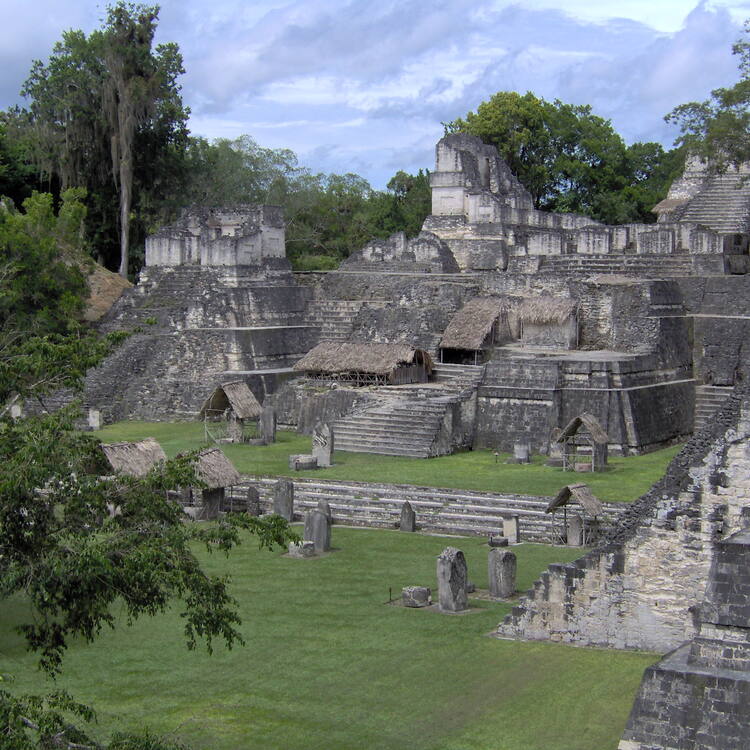
The city sprawled across more than 60 square kilometers of jungle, and at its center, great pyramids rose above the canopy.
speaker_0NARRATOR
The tallest, Temple 4, stood nearly 70 meters high, its limestone bulk climbing above the treetop so that from its summit you could see nothing but green in every direction.
49 MINS LATER
speaker_0NARRATOR
It spanned a geographic area the size of modern Germany, lasted for more than two thousand years, and encompassed hundreds of independent polities with their own traditions, their own politics, and their own relationships with violence and the sacred.
speaker_0NARRATOR
To speak of Maya sacrifice as a single, uniform practice is to flatten a civilization's complexity into a stereotype, and that flattening has served colonial narratives far more than it has served historical understanding.
speaker_0NARRATOR
Think about what it would have been like to stand on top of a pyramid at Tikal on a clear night.

ChaseHOST
We also see isolated buildings, such as the Knap of Hower, preserved under the Scottish turf, a farm more than 5,000 years old.
ChaseHOST
So, even after five to ten thousand years, our work would still exist, but it would be buried, like the temples of Tikal, the great Mayan temples abandoned to the jungle, more than a thousand years ago.
ChaseHOST
When they were rediscovered, the buildings had been completely taken over by the jungle, only the ends of the calcareous of the Mayan pyramids appearing on the hills of the dense forest.
ChaseHOST
But under the ground, the buildings and burial sites were still noticeably intact after a thousand years, and the steps could still be climbed.

speaker_2NARRATOR
And that's not all, because 700 kilometers away, a terrible drought struck the Maya plains.
speaker_2NARRATOR
Tikal, Caracol, and Palenque, large cities with tens of thousands of inhabitants experienced a mass exodus.
speaker_2NARRATOR
Their all-powerful leaders couldn't soothe the anger of the gods.
speaker_14GUEST
What we are understanding in archeology is that communities, cities, villages are not forever.
44 MINS LATER
speaker_2NARRATOR
An extraordinary city that marked the zenith of a 4,000-year-old civilization.
speaker_2NARRATOR
One that continues to leave archaeologists wondering.
speaker_2NARRATOR
Who knows what secrets the ancient Mayas buried in the city's depths? Who hasn't dreamed of these pre-Columbian temples? Of these faraway lands filled with legends? Who hasn't wanted to wander, guided by the sun, through the heart of Maya country? Tikal, Guatemala.
speaker_2NARRATOR
This city, a genuine treasure of mankind for over 2,000 years, has been captivating visitors ever since it was rediscovered in the 19th century.
speaker_0NARRATOR
Judging by the craftsmanship of the stone, the city it was taken from was a spectacular place.
speaker_0NARRATOR
perhaps rivaling even Tikal, the greatest capital of the Maya.
speaker_0NARRATOR
For want of a name, they call this most lost of lost cities Site Q. Explorers have been trying to find it for over 30 years without success.
speaker_0NARRATOR
It's somewhere in the jungle that stretches for hundreds of miles beyond the temples of Tikal.
Neil BrodieGUEST
There could be hundreds of sites in this jungle.
Neil BrodieGUEST
And how would you know where to look? How would you know even where to start to look? From what we know of Site Q, it's been very badly looted.
speaker_0NARRATOR
The museum director is willing to allow a chip to be cut from his collection's greatest treasure, but only if Neil Brodie's team can bring back stone samples from a plausible location for Site Q.
speaker_0NARRATOR
Then, scientific analysis might be able to show where the panel came from.

Mario PinedaNARRATOR
Chapter 2 The Maya Civilization Part 1 the wonderful culture of the mayan indians to which we will now turn our attention was developed in the humid lowlands of central america and especially in the yucatan peninsula artists are everywhere of the opinion that the sculptures and other products of the mayas deserve to rank among the highest art products of the world and astronomers are amazed at the progress made by these people in the measuring of time by the observed movements of the heavenly bodies moreover they invented a remarkable system of hieroglyphic writing by which they were able to record facts and events and they built great cities of stone that attest a degree of wealth and splendor beyond anything seen elsewhere in the new world the mayan culture was made possible by the agricultural conquest of the rich lowlands where the exuberance of nature can only be held in check by organized effort on the highlands the preparation of the land is comparatively easy owing to scanty natural vegetation and a control vested in irrigation on the lowlands however great trees have to be felled and fast-growing bushes kept down by untiring energy but when nature is truly tamed she returns recompense manifold to the daring farmer moreover there is reason to believe that the removal of the forest cover over large areas affects favorably the conditions of life which under the canopy of leaves are hard indeed the principal crops of the mayas were probably much the same as on the highlands with maize as the great staple varieties favorable to a humid environment had doubtless been developed from the highland stock by selective breeding as agriculture worked its way down into the lowlands archaic art appears along the edges of the mayan area in the state of vera cruz mexico and in the ulloa valley honduras in both these regions are also found clay figurines that mark the transition in style between the archaic and the mayan as well as finished examples of the latter there can be no doubt then that the archaic art of mexico marks an earlier horizon than the mayan whether or not it was once laid entirely across the mayan area cannot be decided on present data but it seems unlikely we have already seen that this first art was distributed primarily across arid and open territory with their calendarial system already in working order the mayas appear on the threshold of history six hundred years before the christian era according to a correlation with european chronology that will be explained later the first great cities were tical in northern guatemala and copan in western honduras both of which had a long and glorious existence many others sprang into prominence at a somewhat later date for example palenque yaxchilan or menche piedras negras ceibal naranjo and the most brilliant period was from three hundred to six hundred a d after which all these cities appear to have been abandoned to the forests that soon closed over them the population moved to northern yucatan where it no longer reacted strongly upon the other nations of central america and where it enjoyed a second period of brilliancy several hundred years later architecture the idea of a civic center is admirably illustrated in maya cities particularly those of the first brelian period the principal structures are built across courts or plazas and there is usually an artificial acropolis which is a great terraced mound serving as a common base or platform from which the individual pyramidal bases of several temples rise at some sites this acropolis is a natural hill which has been trimmed down or added to but at other sites it is entirely artificial at copan there is an especially fine example of artificial platform mound rising from one end of the great plaza and affording space for several temples as well as for sunken courts with stepped sides that may have been theatres the river washing against one side of this great mound has removed perhaps a third of it and made a vertical section that shows the method of construction it is apparent that the mound was enlarged and all walls and floors buried mayan buildings are of two principal kinds one is a temple pure and simple and the other has been called a palace the temple is a rectangular structure crowned in a rather high pyramid that rises in several steps or terraces as a rule the temple has a single front with one or more doorways and is approached by a broad stairway the pyramid is an ordinarily solid mass of rubble and earth faced with cement or cut stone and rarely contains compartments some temples have but a single chamber while others have two or more chambers the central or innermost one being specially developed into a sanctuary the so-called palaces are clusters of rooms on low and often irregular platforms these palaces might have been habitations of the priests and nobility the common people doubtless lived in palm-thatched huts similar to those used to-day in the same region the typical mayan construction is effaced concrete the limestone which abounds in nearly all parts of the mayan area was burned into lime this was then slaked to make mortar and applied to a mass of broken limestone the facing stones were smoothed on the outside and left rough hewn and pointed on the inside it is likely that these facing stones were held in place between forms and the lime mortar and rubble filled in between the resulting wall was essentially monolithic the rooms of mayan buildings are characteristically vaulted but the roof is not a true arch with a keystone the vault like the walls is a solid mass of concrete that grips the cut stone veneer and that must have been held in place by a false work-form while it was hardening the so-called corbelled arch of overstepping stones was doubtless known to the mayan builders but was little used taking the single rectangular room as the unit of construction the width was limited to the span of the vault which seldom exceeded twelve feet while the length was indeterminate the first variation from the temple with one rectangular room was the two-roomed structure with one chamber directly behind the other in this case there were two vaulted compartments separated from each other by a common supporting wall pierced by one or more doorways the inner room was naturally more dimly lighted than the outer one and as a result was modified into a sanctuary or holy of holies enhanced by sculptures and paintings while the outer room developed gradually into a portico the outer wall was cut by doorways till only pier-like sections remained and finally the spheres were replaced by square or round columns the development of the mayan temple may be traced through a thousand years of change and adjustment much attention was paid by mayan builders to the question of stability which was accomplished directly by keeping the centre of gravity of the principal masses within the supporting walls rather than by the use of binding stones the cross-section of a two-roomed temple of late date will illustrate how this was done there are three principal masses one over the front wall one over the medial partition and one over the back wall the roof where these sections join is of no great thickness the central mass is symmetrical and if the mortar has the proper cohesiveness very stable for the front and back masses the projection of the upper or free zone tends to counterbalance the overhang of half the vault in the earlier temples the upper zone of the faade often slopes backward so that the balance is not so perfect so far we have given brief space to the question of elevations taken vertically there are three parts to the mayan building first the substructure or pyramidal base second the structure proper third the superstructure in the case of temples the structure proper is one story in height two and three stories are rather common in palaces but the upper stories are in most cases built directly over a solid core and not over the rooms of the lower story the upper stories therefore recede so that the building presents a terraced or pyramidal profile one building at tigal is five stories in height in three receding planes the three uppermost stories being one above the other in a tower at malenque we have an example of four stories but this is unusual on top of the building proper especially if it is a temple we frequently find a superstructure this is a sort of crest or roof wall usually pierced by windows When this wall rises from the center line of the roof, it is called the roof comb or roof crest, and when it rises from the front wall, it is called the flying facade.
Mario PinedaNARRATOR
The highest temples in the Mayan area are those of Tikal that attain a total height of about 175 feet, counting pyramids and superstructure.
Mario PinedaNARRATOR
Massive Sculptural Art The decoration of Mayan buildings may be considered under three heads.
Mario PinedaNARRATOR
First, interior decoration.
Mario PinedaNARRATOR
Second, façade decoration.
Mario PinedaNARRATOR
Third, supplementary monuments.
Mario PinedaNARRATOR
In many temples at Yaxchilan, Tikal, etc., are found splendidly sculptured lintels of stone or wood.
Mario PinedaNARRATOR
At Copan we see wall sculptures that adorn the entrance to the sanctuary and at Palenque finely sculptured tablets let into the rear wall of the sanctuary.

Mike SiegelHOST
But no, I haven't really given it a full.
Mike SiegelHOST
I would love to get down to those Tikal, the ruins and everything like that.
Mike SiegelHOST
It's got to be really
Ryando SmithmanGUEST
cool.

speaker_3HOST
Yes, it's a great transition.
speaker_2HOST
Because if Mohenjo-Daro was a civilization that engineered water for abundance and sanitation, Tikal in Guatemala was a civilization that had to engineer water out of sheer desperate necessity.
speaker_3HOST
That is a crucial distinction.
speaker_3HOST
We are moving from the Indus Valley to the Pitin region of northern Guatemala.
speaker_2HOST
Okay.
speaker_3HOST
Tikal was a massive political, economic, and military center for the Maya world.
speaker_2HOST
Huge place.
speaker_3HOST
The ceremonial heart featured palaces, public squares, and temples, with the traces of residential homes spreading far out into the surrounding jungle.

Cliff DunningHOST
It goes beyond just the fields to actual pyramids.
Cliff DunningHOST
We know there's Maya pyramids at Tikal.
Cliff DunningHOST
that sat on telluric fields and that produced energy and somehow was distributed through these pyramids.
Cliff DunningHOST
So this is a field that needs to be enhanced.

speaker_0HOST
And that leaves us with a final thought I want you to really mull over.
speaker_0HOST
There's a fascinating detail in the research regarding the ancient Maya city of Tikal, located in modern-day Guatemala.
speaker_1HOST
Beautiful site.
speaker_0HOST
In the 1990s, pseudo-archaeological claims and television specials arguing that ancient aliens had carved the magnificent stones in Tikal caused a massive boom in international tourism.
speaker_0HOST
The public attention was huge.
speaker_0HOST
People flocked to the site.

Chuck YatesHOST
Here you go, Petavesa.
Chuck YatesHOST
Kind of reminds me of when I went to Guatemala in college and we were trying to figure out how to go see certain ruins, Tikal.
Chuck YatesHOST
And everyone we talked to, we would like ask, hey, you know, how do we get there? Who do we talk to? What do we do? They all said, let me give you some advice.
Chuck YatesHOST
And they always ended with, and I would like a commission.
20 more episodes mention Tikal.
Create an account to see the whole feed, search across every transcript, and follow the entities you care about.