Tidal locking
Orbit typeWikipedia
3
MENTIONS
1
EPISODES
1
PODCASTS
Search complete. 3 mentions across 1 episode found for "Tidal locking".
Aug 31, 2026
P
Unknown podcast
Why Living on Proxima b Would Be Worse Than You Think
Aug 31 · 3 Mentions
S
35:37speaker_1NARRATOR
The Sun would rise once and then never move again.
S
35:40speaker_1NARRATOR
This is the scenario astronomers call synchronous rotation or tidal locking and it flows directly from that intimate orbit.
S
35:48speaker_1NARRATOR
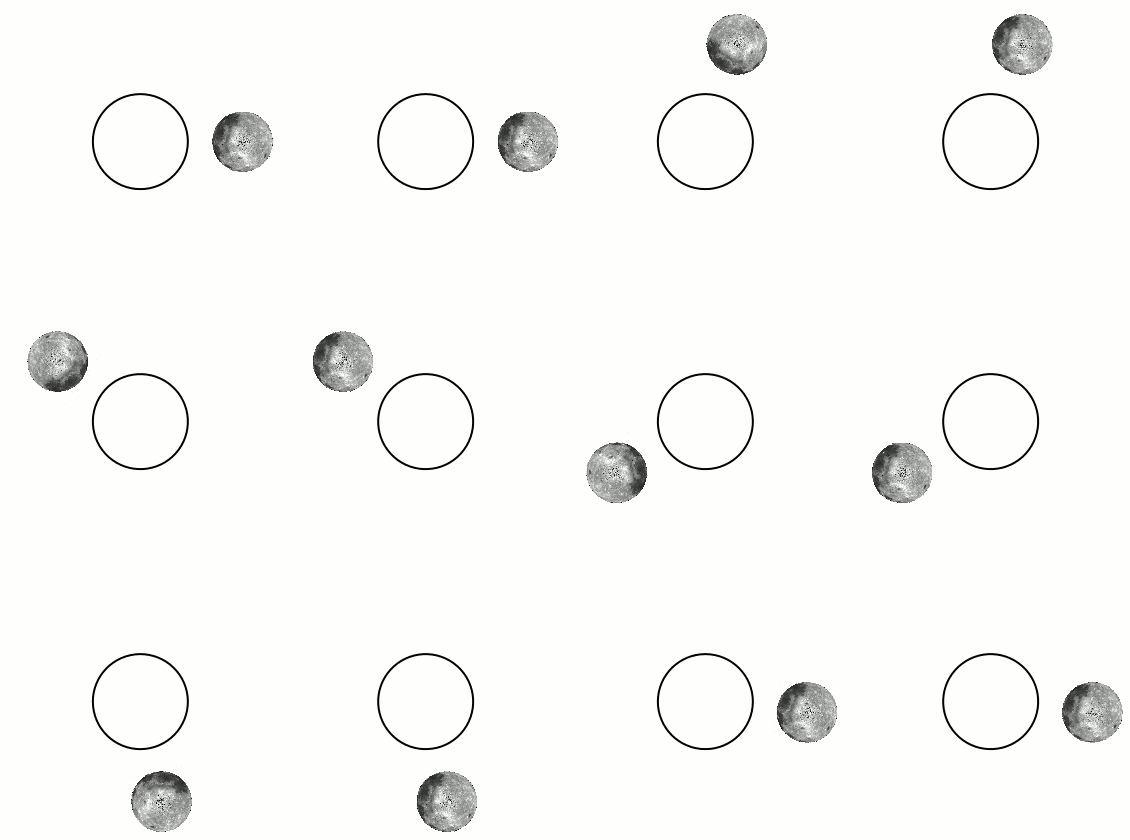
A planet pressed this close to its star is gripped by enormous tidal forces, the same kind of gravitational tug that keeps our Moon showing only one face to Earth.
S
35:59speaker_1NARRATOR
Over time, those forces can slow a planet's spin until it turns exactly once for every orbit, a one-to-one match between its day and its year and when a planet's day equals its year something profound happens to its sky the star stops moving one hemisphere is left facing the star forever and the other is turned away into permanent dark and the change from one to the other never comes there is no sunrise there is no sunset There is no tomorrow in the sense you mean it, because there is no night to separate today from the next day.
7 MINS LATER
S
43:18speaker_1NARRATOR
It is a subtle motion, but on a world where the sun is otherwise frozen, that gentle rocking might be the only clock the sky ever offers.
S
43:26speaker_1NARRATOR
Now change the scenario, because we owe it to the evidence to admit we do not actually know how this planet spins.
S
43:33speaker_1NARRATOR
Tidal locking is the most likely outcome, but it is not the only one.
S
43:37speaker_1NARRATOR
If Proxima B's orbit is stretched enough, if its eccentricity climbs past a modest threshold, the planet might have been captured instead into a different rhythm.