Thromboelastography
Diagnostic testWikipedia
66
MENTIONS
8
EPISODES
6
PODCASTS
Search complete. 66 mentions across 8 episodes found for "Thromboelastography".
Oct 30, 2026

speaker_0HOST
So the two most common ones are TAG thromboelastogram and Rotem, which stands for rotational something.
speaker_0HOST
But yeah, Teg and Rotem are the two most common viscoelastic testing.
speaker_0HOST
We won't belabor what that is in this episode.
speaker_0HOST
Just check out the episode we have dedicated to that.
speaker_0HOST
But these are much better ways to test the actual coagulation cascade than just sending something like an INR.
speaker_0HOST
Remember, cirrhotics are often deficient in fibrinogen.
speaker_0HOST
So certainly check the fibrinogen if you're not going to do a Teg or Rotem because this is something that we commonly will see low in patients with cirrhosis.
speaker_0HOST
Excuse us, I had to wet the whistle.

Trauma BayHOST
In this article, both TAG and Rotem will be reviewed with attention to their clinical uses in the initial resuscitation of the severely injured patient.
Trauma BayHOST
a systematic search was undertaken to find peer-reviewed literature describing TEG and Rotem employed for resuscitation of trauma patients.
Trauma BayHOST
Patent descriptions, animal studies, non-clinical in vitro, and elective surgical studies were excluded.
Trauma BayHOST
Only full-text articles available in the English language were reviewed.
Trauma BayHOST
Conventional coagulation tests also take time.
Trauma BayHOST
As an example, a multicenter prospective study including actively bleeding patients during major surgical procedures reported a median turnaround time of 88 minutes with a range that extended up to 235 minutes.
Trauma BayHOST
Viscoelastic testing, which includes TEG and BRTM, have been shown to identify trauma-induced coagulopathy with increased sensitivity and decreased time to interpretation compared to conventional coagulation tests.
Trauma BayHOST
In a large prospective cohort, rapid TEG predicted substantial bleeding and red blood cell transfusion requirements better than PT or PTT.

Ofer SadanGUEST
Later, we saw the development of D-dimer, that is more of a nonspecific marker for DAC, and so on.
Ofer SadanGUEST
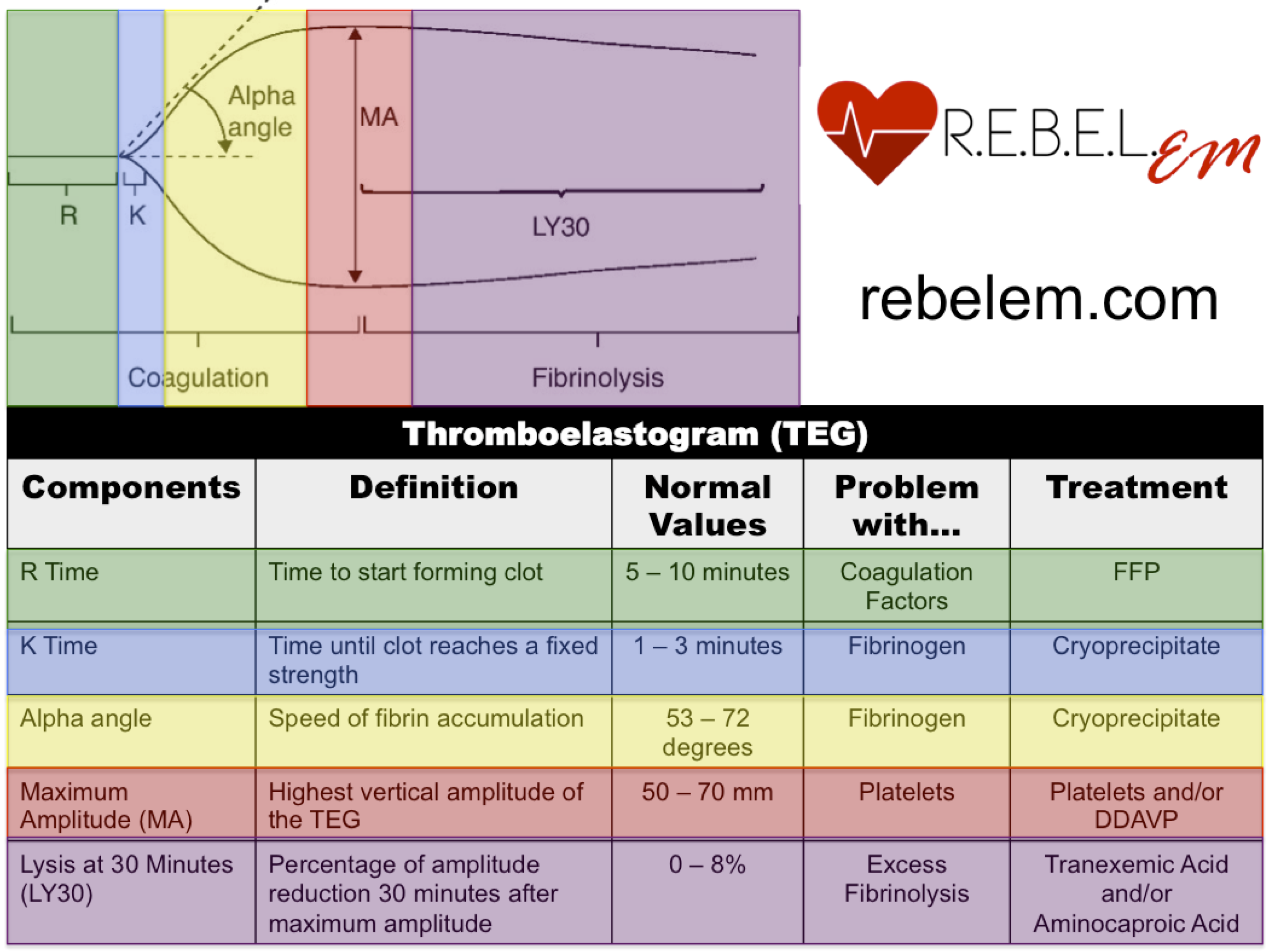
Now, the one test that try to look at that process as a whole is the TEG, the thromboelastography.
Ofer SadanGUEST
Now, I must admit that I had to do some reading to prepare for this podcast, and I always thought that TEG is relatively new, because I don't remember studying about it in med school.
Ofer SadanGUEST
But in fact, it was introduced in 1948. and it wasn't really adopted until the 1990s, and only then people have started kind of paying attention to it more and trying to understand the coagulation process as a whole.
Ofer SadanGUEST
Now, the way TEG works, pretty nice idea.
Ofer SadanGUEST
You take a cup and you have a pin and you throw in the blood, whole blood into it, and the cup spins or rotates a little bit.
Ofer SadanGUEST
And then naturally the clot forms around the pill.

MHOST
I will say more of our tertiary centers tend to have it, um, the nicer hospitals, but the majority of obstetric care is in community facilities and many don't have it, but I do think it should be standard.
MHOST
And so I would love for you to talk about, first of all, do you have a preference between TEG and Rotem? And just tell me your thoughts on it and how we should best be using it.
Beverly HuntGUEST
Okay.
Beverly HuntGUEST
One thing we haven't discussed is thromboelastography in maternal hemorrhage.

Rhea TemmermandHOST
Usually a trigger is about 500 mLs of chest tube output in a single hour or more than 200 per hour that just keeps going.
Rhea TemmermandHOST
Now, before you blame the surgeon for anything related to bleeding, make sure that your heparin is fully reversed, the patient is warm, and then you're going to use your VSCO elastic testing like Teg or Rotem to guide the types of products that you're going to give.
Rhea TemmermandHOST
I had seen a case one time done by a resident who didn't realize that all the stopcocks were off to the patient and on to the floor.
Rhea TemmermandHOST
So all the protamine that was given went to the floor and not to the patient.
Trauma BayHOST
I'm your host, Trauma Bae.
Trauma BayHOST
This episode is an introduction to TEG and ROTEM.
Trauma BayHOST
And in order to even understand the basics of viscoelastic testing, we first have to review the coagulation cascade.
Trauma BayHOST
And the clotting cascade is a fundamental principle in trauma.
7 MINS LATER
Trauma BayHOST
PT and INR are elevated first with synthetic liver dysfunction due to factor VII having the shortest half-life.
Trauma BayHOST
Okay, let's move on to the technology of Teg and Rotem.
Trauma BayHOST
TEG is thromboelastography and Rotem is rotational thromboelastometry.
Trauma BayHOST
Both are viscoelastic tests of hemostasis in whole blood.