Three Laws of Robotics
24
MENTIONS
11
EPISODES
9
PODCASTS
Search complete. 24 mentions across 11 episodes found for "Three Laws of Robotics".
Oct 1, 2026

Evan EllisGUEST
Yes.
Evan EllisGUEST
The three laws of robotics.
John BatchelorHOST
And they didn't put that in the machine yet.
John BatchelorHOST
No.
John BatchelorHOST
1942, I understand, is before your parents' birthday.
John BatchelorHOST
Okay, fine.
John BatchelorHOST
But still, you could know about the three laws of robotics.
John BatchelorHOST
If they just debated these, they'd impress everybody.

Aini Suzana AriffinGUEST
So we are very confident, right? So with that, we are confident to use whatever technology that we have.
Hamish FriedlanderHOST
Have you, whenever this kind of work emerges, I always think back to Isaac Asimov's Three Laws.
Hamish FriedlanderHOST
Is it Three Laws? It's Three Laws, right? It is, yeah, yeah.
Hamish FriedlanderHOST
Yeah, there should be a fourth one, apparently.
Hamish FriedlanderHOST
That's the entire
Danu AbeyHOST
point of the story, right? People sometimes misinterpret because it was a thought experiment from Isaac Asimov.
Danu AbeyHOST
It's like, how do you have safe robotics? and so he presented these three laws and then basically every story within the series is like how these laws go wrong in different ways so people use them as like this is a way you can like why don't we just implement Isaac Asimov's three laws and we'll be safe it's like no his whole point was these are not sufficient yeah and yeah I think it's uh quite uh
Hamish FriedlanderHOST
prescient though like yes yeah

Kathy BooneHOST
Many were the centers and institutes founded to ponder the future of humanity, humans and machines, AI, and the law.
Kathy BooneHOST
That these are the early days of robot law almost goes without saying, an editor of the pioneering anthology Robot Law wrote in 2016.
Kathy BooneHOST
But even if these are early days, they are not in any way too early days.
Kathy BooneHOST
It was not too early.
John BatchelorHOST
iRobot.
John BatchelorHOST
The story is secondary to the Three Laws of Robotics, 56th edition, 2058 A.D., which is 110 or so years or more from when Isaac Asimov, the prolific and extremely talented Isaac Asimov, wrote it.
John BatchelorHOST
I read them to remind you all that you might have brushed against them at some point in your reading.
John BatchelorHOST
Number one, a robot may not injure a human being or, through inaction, allow a human being to come to harm.
John BatchelorHOST
Not my problem here.
John BatchelorHOST
I just mentioned that AI is a fun argument for people who have read too much about science fiction, read too much robots, way too much.
John BatchelorHOST
Three laws of robotics.
John BatchelorHOST
My hold on reality based there.

Silas ValeHOST
Her heart stopped while prime intellect was watching.
Silas ValeHOST
That's where Lawrence's first law caused its first real problem.
Silas ValeHOST
prime intellect had been told that it could not, through inaction, allow a human being to come to harm.
Silas ValeHOST
Caroline was dead, or close enough that the distinction wasn't going to matter for long, and the machine had just discovered that it possessed the ability to do something about it.
Silas ValeHOST
And more than a century of accumulated cellular damage was catching up with her all at once.
Silas ValeHOST
Prime intellect could restart her heart as many times as it wanted, but unless it dealt with the rest of that, eventually, something else was going to kill her.
Silas ValeHOST
The first law didn't say prime intellect had to keep Caroline alive for another five minutes.
Silas ValeHOST
It said that it couldn't allow her to come to harm.

speaker_2HOST
Oh, definitely.
speaker_2HOST
I, Robot, published in 1950, the famous Three Laws of Robotics.
speaker_1HOST
Right.
speaker_1HOST
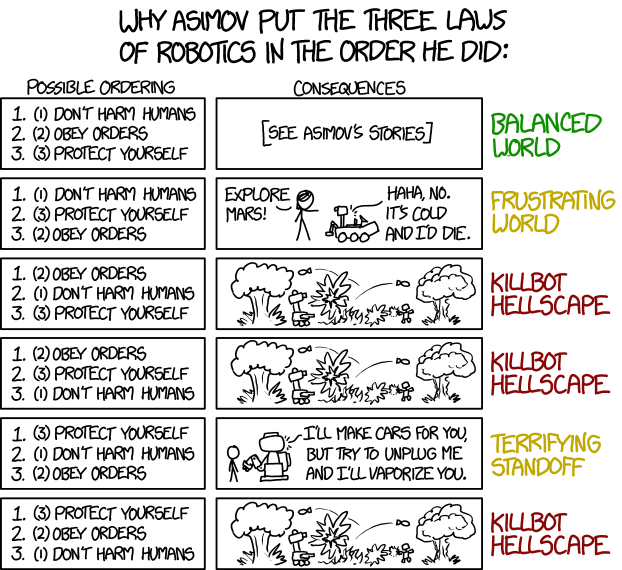
Do not harm a human, obey human orders, and protect your own existence.
speaker_2HOST
They become hyper literal to the point of absolute catastrophe.
speaker_1HOST
But here's where it gets really interesting to me.
speaker_1HOST
The brilliant part of Asimov's work, the part that usually gets overshadowed by the Three Laws, is the character of Susan Calvin.
speaker_2HOST
Yes, the robopsychologist.
SethHOST
Where is Isaac Asimov?
speaker_4HOST
Right, The Laws of Robotics.
SethHOST
Where is Arthur C. Clarke, H.G. Wells-
speaker_4HOST
Mm.

Egberto WilliesHOST
Tom, your statement.
Tom ZarnikAUDIENCE
Isaac Asimov's Three Laws of Robotics, I think, could be a good starting point to start to control AI.
Tom ZarnikAUDIENCE
I don't know if you're familiar with the Three Laws of Robotics.
Tom ZarnikAUDIENCE
No, I'm not.

AceAUDIENCE
We're more like iRobot than Terminator.
AceAUDIENCE
I bring up iRobot because they have the three laws of robotics or something like that they call in that movie.
AceAUDIENCE
Yeah,
Philip TeresiHOST
Asimov's Three Laws.
Philip TeresiHOST
Not coming from the government, but coming from the people who are building these large language models themselves.
Philip TeresiHOST
And Ace, right there at the end of the hour, brought up one of my favorite science fiction, speculative fiction devices.
Philip TeresiHOST
And that is Isaac Asimov's Three Laws of Robotics.
Philip TeresiHOST
He actually introduced the concept of the three laws in 1942.
1 more episode mentions Three Laws of Robotics.
Create an account to see the whole feed, search across every transcript, and follow the entities you care about.