Three Horizons
15
MENTIONS
5
EPISODES
5
PODCASTS
Search complete. 15 mentions across 5 episodes found for "Three Horizons".
Nov 4, 2026

Dimitri AxelrodHOST
It doesn't make sense to try to win it.
Dimitri AxelrodHOST
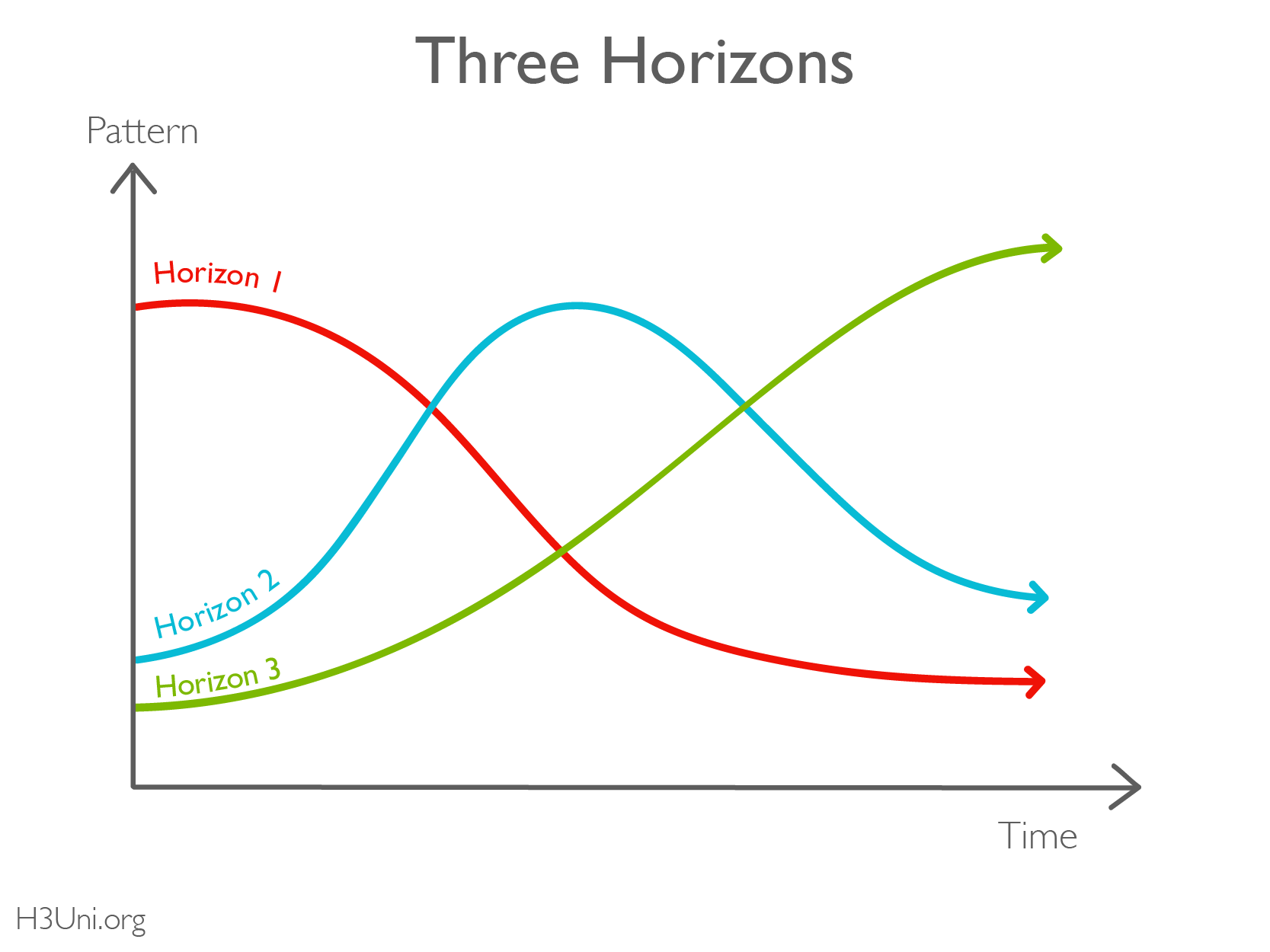
And I guess one of those arguments is when I follow, for instance, Jonathan Rosen's argumentation, where he speaks of these three horizons, right? Horizon 1 is business as usual, continue doing the stuff, right? But then Horizon 2, which says, well, let's try to change the system from within through a disruptive innovation.
Dimitri AxelrodHOST
But then this innovation ends up being captured back again and absorbed into the system, which he calls H2 minus vortex, right? So everyone who's trying to win the system from the inside is just going to be devoured and is just going to strengthen H2.
Dimitri AxelrodHOST
the the super organism because we're trying to the

Charmian LoveGUEST
And to transform something, we need to find new ways of doing things.
Charmian LoveGUEST
And this is where the Three Horizons framework is one that I really embrace.
Charmian LoveGUEST
Here's where we want to be, this regenerative future.
Charmian LoveGUEST
Here's where we are today, Horizon 1.
Charmian LoveGUEST
And there's a whole lot of experiments we need to do in Horizon 2 in order to figure out that bridge.
Charmian LoveGUEST
And that brings me to the second part about the title of this course, which was know how to so and and and we wanted to really help provide really practical tools because we know a lot of this stuff can be like philosophically interesting and you know challenging um but in some ways sometimes it's abstract like so what do we need to do at a really practical and tactical level um within business to think about how can we can we embrace some of these these pieces so again the course was regenerative and circular economy how to do business in a climate emergency.
30 MINS LATER
Charmian LoveGUEST
And we have to scale those things up.
Charmian LoveGUEST
Like, this is not just an Atura thing, which is why one of the things we're focused on, how do we help build greater demand? How do we open up these relationships we have with these cooperatives in the Amazon to others so that they can engage in this? So I like to, like, I don't want to...

Victoria MulliganHOST
So he has spent decades helping organizations, including Shell, navigate complexity and long-term change.
Victoria MulliganHOST
He's a founding member of the International Futures Forum and helped develop the Three Horizons Framework with Bill Sharp.
Victoria MulliganHOST
You might remember that from one of our earlier episodes.
Victoria MulliganHOST
Tony also founded H3Uni, a really special open resource library of practical tools for thinking about the future.
Anthony HodgsonGUEST
So he was particularly interested in the resolution of value systems occurs very strongly in futures work, as you know, because nobody can agree about much.
Anthony HodgsonGUEST
And so he introduced me to his dilemma method, and then we collaborated to create a more powerful way of facilitating it.
Anthony HodgsonGUEST
And since then, working with a colleague, Bill Sharp, who is a joint author with me of the Three Horizons Method, we took it a deal further and really from dilemma resolution to dilemma navigation.
Anthony HodgsonGUEST
We can explain that a bit later.

Kyla AvisHOST
It's a complete barrier to innovation and improvement.
Kyla AvisHOST
In this conversation, we use the Three Horizons models to walk through her book.
Kyla AvisHOST
The hero leadership model that's losing its fit for purpose, the future she calls distributed abundance, and the messy middle in between.
Kyla AvisHOST
I love this conversation and I think you will too.
9 MINS LATER
Kyla AvisHOST
times.
Kyla AvisHOST
Okay.
Kyla AvisHOST
So I thought it would be cool to kind of tie your thinking to the Three Horizons contract, which is a Bill Sharp model that I love.
Kyla AvisHOST
And for viewers or listeners who haven't, who don't know anything about the Three Horizons model, I recommend you going back to my early, early podcasts of listening to Andy Wilkins.

Chad McAllisterHOST
And then support products, which are largely correcting for problems that have come up and making things more stable and work better, so improvements there.
Chad McAllisterHOST
There's other approaches as well, such as Three Horizons, who are working on the core, the adjacent, the transformative kind of work or a timeline, but the timeline tends to get used less commonly these days.
Chad McAllisterHOST
And you may have a portfolio that's mapped to your organizational structure or distribution, like maybe geographically or product lines and the like.
Chad McAllisterHOST
But understanding that structure is helpful, and then the criteria that are used for what might get selected into one of those buckets helps there to be transparency to know what you need to prepare to get your idea selected as well, and hopefully have a better view of things a- at least appearing to be fair as projects get selected.