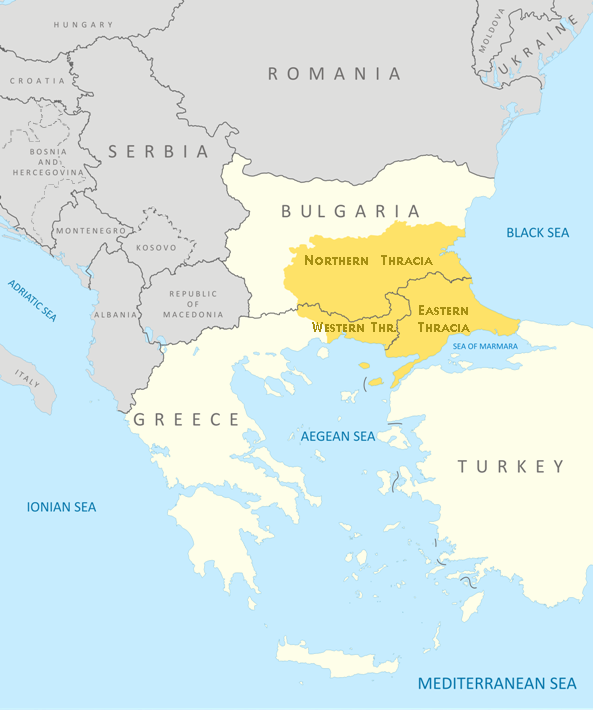
Thrace
RegionWikipedia
489
MENTIONS
159
EPISODES
132
PODCASTS
Search complete. 489 mentions across 159 episodes found for "Thrace".
Sep 25, 2026

Georgia HoweHOST
Lifestyle reporter Lauren Baer has the story.
Lauren BairCORRESPONDENT
The falsified labels were discovered after people noticed that the establishment date was egregiously wrong, reading, quote, "Established 1363", which would put the Department of Agriculture's founding more than 400 years before the United States was formed, right alongside historic events such as the expansion of the Ottoman Empire in Thrace or the Battle of Lake Poyang in China before the Ming dynasty.
Lauren BairCORRESPONDENT
The USDA was actually established in 1862 under Abraham Lincoln.
Lauren BairCORRESPONDENT
North Carolina-based Star Meat Delivery shipped roughly 168,000 pounds of meat to a Georgia distributor, which sent the products to retailers and restaurants nationwide.

Bruce KatchuckNARRATOR
Lines Written for the Opening of a Hall Devoted to Music, Oratory, Social Functions, and the Drama by Lewis V. F. Randolph.
Bruce KatchuckNARRATOR
Read for LibriVox.org. 'Tis many a league across the seas to Thrace, And many an age has run its reckless race Since at the sacred sweet Castalian spring On Mount Parnassus, mortals sought to bring Their votive offerings to the glorious Nine, The Muses, both by birth and deeds divine, Daughters of Zeus and fair Mnemosyne, Patrons of history and poesy— Clio, Euterpe, and their sisters seven, Who brought the thoughts of gods to earth from heaven.
Bruce KatchuckNARRATOR
At feasts of great immortals when they sang, Apollo played, and grand Olympus rang With wave on wave of high majestic song, And then with rapturous plaudits loud and long.
Bruce KatchuckNARRATOR
They sing the story of creation fair, And all the dreadful perils heroes dare; For Cadmus, at his nuptials, they rejoice, Or erst lament Achilles' death with voice So mournful and with tones of such distress That gods and men mixed tears of tenderness.

speaker_7NARRATOR
Then the chase became more furious.
speaker_7NARRATOR
They came to Thrace, where Typhon fought with whole peaks of the Hamas mountains, and when these were hurled back on him by the Thunderer, his blood gushed out over them so that these are called the Bloody Mountains to this day.
speaker_7NARRATOR
End of chapter 1
speaker_13NARRATOR
The Legend of Don Juan Manuel by Thomas Albon Henver This is a Libby Box recording.
8 MINS LATER
speaker_15NARRATOR
it is the custom nowadays for scientists and for other scholarly people to take hold of the old myths to take them to pieces and to find some deep hidden meaning in each part of the story so you will find that some will tell you that orpheus is the personification of the winds which tear up trees as they course along chanting their wild music and the eurydice is the morning with its short-lived beauty others say that orpheus is the mythological expression of the delight which music gives to the primitive races while yet others accept without hesitation the idea that Orpheus is the sun that, when day is done, plunges into the black abyss of night, in the vain hope of overtaking his lost bride, Eurydice, the rosy dawn.
speaker_15NARRATOR
And whether they be right or wrong, it would seem that the sadness that comes to us sometimes as the day dies and the last of the sun's rays vanish to leave the hills and valleys dark and cold, The sorrowful feeling that we cannot understand when in country places we hear music coming from far away, or listen to the plaintive song of the bird, are things that very specially belong to the story of Orpheus.
speaker_15NARRATOR
In the country of Thrace, surrounded by all the best gifts of the gods, Orpheus was born.
speaker_15NARRATOR
His father was Apollo, the god of music and of song, and his mother the muse Calliope.

Bill BorstNARRATOR
And when the summer was well nigh come again, the work was finished, and the old man Anchises commanded that they should tarry no longer, whereupon they sailed, taking also their gods with them.
Bill BorstNARRATOR
There was a certain land of Thrace, which the god Mars loved beyond all other lands, whereof in time past the fierce Lycurgus, who would have slain Bacchus, was king.
Bill BorstNARRATOR
Here, therefore, for the men of the land were friendly, or at the least had been before evil days came upon Troy, Aeneas builded him a city, and called it after his own name.
Bill BorstNARRATOR
But after a while, as he did sacrifice on a certain day to his mother, even Venus, that he might have a blessing on his work, slaying also a white bull to Jupiter, there befell a certain horrible thing.
Bill BorstNARRATOR
Fly, for the land is cruel, and the shore greedy of gain.
Bill BorstNARRATOR
I am Polydorus.
Bill BorstNARRATOR
Here was I pierced through with spears, which have grown into these wands that thou seest.' But Aeneas when he heard the voice was sore dismayed, and he remembered him how King Priam, thinking that it might fare ill with him and the great city of Troy, had sent his son Polydorus by stealth, and much gold with him, to Polymestor, who was king of Thrace; and how the king, when Troy had now perished, slew the boy and took the gold to himself.
Bill BorstNARRATOR
For of a truth the love of gold is the root of all evil.

Michael Shane Craig LambertNARRATOR
This too they signified to Constantius, who also had ordered the council to be held.
Michael Shane Craig LambertNARRATOR
But those who had been deposed at Ariminum went off to Constantius, and caused the others who had expressed their mind against them to be insulted, and to be threatened that they should not return to their diocese, and to suffer violence in Thrace in the same winter, so that they might submit to the new decisions made by them.
Michael Shane Craig LambertNARRATOR
If then any persons mention Ariminum, let them first bring forward the deposition of the above-named, and what the bishops wrote, saying that no one ought to seek for anything more than the decisions made by the fathers at Nicaea, nor mention any other council but that one.
Michael Shane Craig LambertNARRATOR
But these things they conceal, which they put forward what was done by violence in Thrace, whereby they show that they undertake to represent the Arian heresy, and are alien from the sound faith.
Michael Shane Craig LambertNARRATOR
And if anyone chooses to examine, side by side, that great council itself and those which they have originated, he will find how orthodox was the one, how senseless the others.
Michael Shane Craig LambertNARRATOR
Those who met at Nicaea were not deposed before they met, but confessed the Son to be from the essence of the Father.
20 MINS LATER
Michael Shane Craig LambertNARRATOR
Being then thus disposed, since it happened that we all met, we have written also to our beloved Damasus, bishop of Great Rome, concerning Auxentius, who invaded the church of Milan, and have narrated his proceedings, that he is not only a sharer in the Arian heresy, but is also chargeable with many misdeeds, which he perpetrated in conjunction with Gregory, the partaker of his impiety.
Michael Shane Craig LambertNARRATOR
And we have expressed our wonder that, up to this time, he has not been deposed and cast out of the church, and we have returned thanks to the piety of Damasus and of those who assembled in Great Rome, inasmuch as by casting out Ursacius and Valens and those who thought with them, they preserved the unanimity of the Catholic Church.

ExpatriateNARRATOR
They had a child named Troar, whom we call Thor.
ExpatriateNARRATOR
He was fostered in Thrace by a certain war duke called Loricus, but when he was ten winters old he took unto him the weapons of his father.
ExpatriateNARRATOR
He was as goodly to look upon when he came among other men as the ivory that is inlaid in oak.
ExpatriateNARRATOR
His hair was fairer than gold.
ExpatriateNARRATOR
When he was twelve winters old he had his full measure of strength.
ExpatriateNARRATOR
Then he lifted clear of the earth ten bearskins all at one time.
ExpatriateNARRATOR
And then he slew Duke Loricus, his foster father, and with him his wife Lora or Glora, and took into his own hands the realm of Thrace, which we call Trudheim.
ExpatriateNARRATOR
Then he went forth far and wide over the lands and sought out every quarter of the earth, overcoming alone all berserks and giants and one dragon, greatest of all dragons and many beasts.

George BanfieldNARRATOR
pleased by the sight of his mother's favorite shrub he began to pluck the green shoots but the twigs were more than usually tough and seemed to resist his efforts like living things and when at last one was torn away he saw it dripping with a red fluid like blood he wrenched off another and the same crimson liquor was seen oozing from the wound determined to explore the meaning of this strange portent he grasped the trunk of the bleeding myrtle tree and tugged with all his might seeking to tear it up by the roots when a dismal voice struck upon his ears and he heard these words spoken from the centre of the mound forbear aeneas forbear rend not my heart and defile not thy pious hands with a kinsman's blood it is i polydorus whom thou art torturing here i lie murdered by the hand of my host here i fell pierced by a hundred javelins which have grown into a leafy tree fly fly from this accursed shore this land of cruelty and greed Aeneas stood motionless and speechless, appalled by that strange message from the tomb and the tale of treachery and crime which it revealed.
George BanfieldNARRATOR
This Polydorus was Priam's youngest son, committed by his father with a great treasure to the charge of Polymester, king of Thrace.
George BanfieldNARRATOR
The ruffian king, when he saw that Priam's star was on the wane, murdered his youthful guest and took possession of his gold.
George BanfieldNARRATOR
Full of sad thoughts, Aeneas sought counsel of Anchiasus and other Trojan elders and told them that dark story of lawless outrage and broken faith.

Michael ArmentaNARRATOR
Life of Aesop The life and history of Aesop is involved, like that of Homer, the most famous of Greek poets, in much obscurity.
Michael ArmentaNARRATOR
Sardis, the capital of Lydia, Samos, a Greek island, Mesembria, an ancient colony in Thrace, and Cotium, the chief city of the province of Phrygia, contend for the distinction of being the birthplace of Aesop.
Michael ArmentaNARRATOR
Although the honor thus claimed cannot be definitely assigned to any one of these places, yet there are few incidents now generally accepted by scholars as established facts relating to the birth, life, and death of Aesop.
Michael ArmentaNARRATOR
He is, by an almost universal consent, allowed to have been born about the year 1620 B.C., and to have been by birth a slave.

George BanfieldVOICE_ACTOR
Aeneas stood motionless and speechless, appalled by that strange message from the tomb and the tale of treachery and crime which it revealed.
George BanfieldVOICE_ACTOR
This Polydorus was Priam's youngest son, committed by his father with a great treasure to the charge of Polymester, king of Thrace.
George BanfieldVOICE_ACTOR
The ruffian king, when he saw that Priam's star was on the wane, murdered his youthful guest and took possession of his gold.
George BanfieldVOICE_ACTOR
Full of sad thoughts, Aeneas sought counsel of Anchiasus and other Trojan elders and told them that dark story of lawless outrage and broken faith.
149 more episodes mention Thrace.
Create an account to see the whole feed, search across every transcript, and follow the entities you care about.