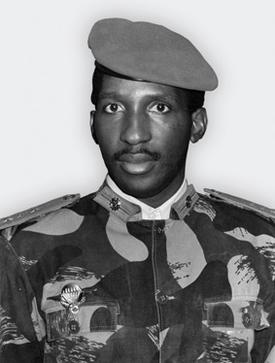
Thomas Sankara
Revolutionary and former President of Burkina FasoWikipedia
45
MENTIONS
25
EPISODES
20
PODCASTS
Search complete. 45 mentions across 25 episodes found for "Thomas Sankara".
Oct 2, 2026

Keidi AwaduGUEST
And this book is a chronological timeline of the African century, the century ahead of us.
Keidi AwaduGUEST
And I began this timeline in 1983 with the phenomenal event that took place in Burkina Faso, which is now we see the outcome of Thomas Sankara rising to the presidency, is impacting, influencing Ibrahim Ta'ore.
Keidi AwaduGUEST
And we can see the...
Keidi AwaduGUEST
The timeline in Burkina Faso from 1983 is an example of the global timeline for African people going into, through, and beyond the so-called African century.
Keidi AwaduGUEST
If we are seeing the world moving towards renewable energy for the century ahead, then they're going to absolutely need access to African materials and minerals to build the batteries and the technology for the green century ahead.
Keidi AwaduGUEST
So we should be very proud of that.
Keidi AwaduGUEST
Burkina Faso gives us a workable model step-by-step model and we see that transformation is not even close to complete but has made such progress since 1983 and that is of course the rise of Thomas Sankara the brilliant visionary who I hope all of us have Thomas Sankara deeply embedded in our psyche in our awareness of who we are and the work of our ancestors that we are committed to continue in our generation.
Carl NelsonHOST
All right.

Amin TMKHOST
things, again, where I just feel like people want to simplify geopolitics, and it's actually a lot of moving pieces, a lot of interests and those interests can change.
Amin TMKHOST
And I think that, you know, often we get these leaders like Ibrahim Traore, where we think that they are built with this spirit of Thomas Sankara and this revolutionary leftist socialist spirit.
Amin TMKHOST
But, you know, that that's usually not the case.
Amin TMKHOST
And that is that means that things become a lot more complicated, not to say that the Sahel is not full of complexity.

Victoria BrittainGUEST
Now there was something else.
Victoria BrittainGUEST
And of course, the assassinations of both Maurice Bishop and then Thomas Sankara and Burkina.
Victoria BrittainGUEST
And they were actually my, they'd become my friends.
Victoria BrittainGUEST
And I think it was because, um, Because when I was back in London in The Guardian, I had this very special privilege of this whole page called Third World Review, of which the whole point of it was it wasn't written by Western journalists.

speaker_0NARRATOR
From the heart of the Global South, we bring to you stories, voices, and ideas driving change across Africa and beyond.
Aliyu BelloHOST
There's a famous saying from the leader of Bokeh Nafaso, Thomas Sankara, where he said, we must dare to invent the future.
Aliyu BelloHOST
And perhaps the interesting question today is not whether Africa can invent that future.
Aliyu BelloHOST
It is whether the world is paying enough attention when Africans do.

speaker_2HOST
Mahama says, Africa seeks equal partnership, not charity.
speaker_2HOST
And President Mahama unveils new deal with global philanthropy and the economics of Thomas Sankara, the eighth Pan-African newsletter of 2026.
speaker_2HOST
All on the front page of the Inside Newspaper.
speaker_3HOST
Let me take you through the Daily Graphic newspaper, the front page.

Alex KrainerGUEST
And as it turns out, you know, the, uh, Bur- the...
Alex KrainerGUEST
In Burkina Faso, this is now being applied, and it comes from the same source because, uh, Ibrahim Traoré today is trying to apply the same model that was, uh, that, that his predecessor Thomas Sankara tried to.
Alex KrainerGUEST
And Thomas Sankara, uh, was, was mentored in economic governance by a French, uh, econo- economist.
Alex KrainerGUEST
Uh, his name was, um, Jacques Cheminade.

Breht O'SheaGUEST
but to work on your relationship with it so that it can inform and, and make more, more robust your, your life.
Breht O'SheaGUEST
And, and the last thing I'll say is every revolutionary or most of the revolutionaries that we really look up to, Thomas Sankara, Malcolm X, Rosa Luxemburg, Che Guevara, I could go on and on and on, they knew [chuckles] that death was probable, if not inevitable, that they knew that, that, that, you know, when the Freikorps smashed down Rosa's door, um, you know, when, when Malcolm X talked about walking around as a dead man walking, um, you know, as Che Guevara flees into the jungles of Bolivia instead of sits comfortably at a Cuban, you know, government office.
Breht O'SheaGUEST
They know that, that, that they have faced what death means and that they have, they have come to a choice that living their life in this authentic way is worth the possibility that they will die for it, and they did, and they live on because of it.
HugoHOST
B-beautifully delivered.

Pascal RobertPANELIST
So oftentimes when I hear people make those critiques, they use Marx's interrogation of the plight of the industrial proletariat as a means to state that this socialist stuff has nothing for us.
Pascal RobertPANELIST
But as we know, Some of the countries that use socialism more effectively to liberate themselves have been peasant economies in the African subcontinent and the Asian subcontinent went on from China to Vietnam, to Angola, to Guinea-Bissau, you know, Thomas Sankara, Emilio Cabral, and variety of others, Fidel Castro.
Pascal RobertPANELIST
who use Marxism, particularly Marxism and Leninism, as a means to change the material conditions of black and brown, but particularly black people in their countries.
Pascal RobertPANELIST
So I've always found that attempt to paint socialism as a Eurocentric phenomenon really a kind of cheap shot that doesn't really hit the mark.

David HundeyinGUEST
It's basically this concept.
David HundeyinGUEST
I believe the concept was actually pioneered by Thomas Sankara, but has been taken to another level by the Ibram Chouhary government.
David HundeyinGUEST
They figured that the old model for building infrastructure, which involves awarding contracts to a private businessman, and then based on how this businessman handles that tender, the infrastructure may or may not get constructed.
David HundeyinGUEST
It might take forever to get constructed.

BrehtGUEST
Not become morbidly obsessed with death necessarily, but to work on your relationship with it so that it can inform and make more robust your life.
BrehtGUEST
And the last thing I'll say is every revolutionary or most of the revolutionaries that we really look up to, Thomas Sankara, Malcolm X, Rosa Luxemburg, Che Guevara.
BrehtGUEST
I could go on and on and on.
BrehtGUEST
They knew that death was probable, if not inevitable, that they knew that that that, you know, when the fry corpse smashed down Rosa's door, you know, when Malcolm X talked about walking around as a dead man walking, you know, as Che Guevara flees into the jungles of Bolivia instead of sits comfortably at a Cuban government office.
15 more episodes mention Thomas Sankara.
Create an account to see the whole feed, search across every transcript, and follow the entities you care about.