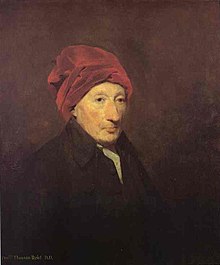
Thomas Reid
Scottish philosopherWikipedia
10
MENTIONS
6
EPISODES
6
PODCASTS
Search complete. 10 mentions across 6 episodes found for "Thomas Reid".
Oct 22, 2026

Jeffrey RosenHOST
It is Thomas Reed and the common sense school that said, it's absurd to claim that we don't know what color the podium is or basic truths about human nature.
Jeffrey RosenHOST
They're a matter of common sense and judgment that allowed Jefferson to root his claim in the common sense philosophy of Thomas Reid, who he learned through his admired Scottish law professor, William Small.
Jeffrey RosenHOST
It's not clear Jefferson It's not clear whether or not it was Jefferson who made the edit from sacred and undeniable to self-evident.
Jeffrey RosenHOST
Ted Widmer, who's here today, has well debunked the claim that it was Franklin, which Walter Isaacson embraces, who got it from Hume.

speaker_1NARRATOR
Dugald Stewart traces much of the elegance observable in the style of some of Hume's opponents to the careful and minute study which their desire to refute his views caused them to bestow upon his works, and there can be no question that his influence in this respect has been both great and beneficial.
speaker_1NARRATOR
Of the contemporaries of Hume, the two who stand next to him in the measure of their importance are undoubtedly Adam Smith and Thomas Reid.
speaker_1NARRATOR
The one is the acknowledged founder of political economy as a distinct branch of knowledge, the other is the recognised head of the Scottish school in philosophy.
speaker_1NARRATOR
But even as regards these distinguished men, a pre-eminence must be assigned to Hume, for apart from his influence, probably neither of the two would have written as he did.
1 HR 41 MINS LATER
speaker_7NARRATOR
I would therefore wish for the future, whenever my good fortune throws me in your way, that these topics should be foreborne between us.
speaker_7NARRATOR
I have long since done with all inquiries on such subjects, and am become incapable of instruction, though I own that no one is more capable of conveying it than yourself.
speaker_7NARRATOR
Two years later, 1763, Hume was brought into communication again through Dr. Blair with another and more formidable opponent, Dr. Thomas Reid.
speaker_7NARRATOR
Reid was at the time preparing his inquiry into the human mind in confutation of Hume's principles.

speaker_2NARRATOR
Other philosophers, as I have said, maintain that, quote, things which have a real existence are the very things we perceive, unquote.
speaker_2NARRATOR
It is Thomas Reid who has upheld, in some passages of his writings at all events, the theory of instantaneous perception or intuition.
speaker_2NARRATOR
It has also been defended by Hamilton in a more explicit manner.
speaker_2NARRATOR
It has been taken up again in recent years by a profound and subtle philosopher, M. Bergson, who, unable to admit that the nervous system is a substratum of knowledge and serves us as a percipient, takes it to be solely a motor organ, and urges that the sensory parts of the system, that is to say, the centripetal, optic, acoustic, etc., nerves, do not call forth, when excited, any kind of sensation, their sole purpose being to convey disturbances from periphery to periphery, or, say, from external objects to the muscles of the body.
21 MINS LATER
speaker_4NARRATOR
The impression on which the act of cognition operates, that impression, which is directly produced by the excitant of the nervous system, seems to me, without any doubt, to be of an entirely physical nature.
speaker_4NARRATOR
This opinion, which I make mine own, has only been upheld by very few philosophers.
speaker_4NARRATOR
Thomas Reid perhaps, and William Hamilton for certain.
speaker_4NARRATOR
But neither has perceived its deep-lying consequences.

Jesse WegmanGUEST
It's our term for it today, this unbelievable explosion of thought and philosophy around all of the issues that are concerning the, both the Scots, obviously, but, but Americans, too.
Jesse WegmanGUEST
You know, um, the, the n- the, the idea of independence, what it means to, uh, be a self-governing people, what it means to l- uh, live in a modern society, right? All of these things, from David Hume through Francis Hutcheson to Thomas Reid to Adam Smith, all of these thinkers are defining still what today I think are, are many of the terms that we still work with for the modern world.
Jesse WegmanGUEST
[laughs] And Wilson, alone among the American Founders, studies with them directly.
Jesse WegmanGUEST
He studies with Thomas Reid.
Jesse WegmanGUEST
He studies with Adam Smith.
Jesse WegmanGUEST
So other Founders knew these guys, and they were influenced, of course.
13 MINS LATER
speaker_8ADVERTISER
Availability and coverage vary by state and insurance plan.
Jesse WegmanGUEST
Many, uh, thoughtful scholars have put on their psychologist hat and, um, there's some wonderful writing about sort of how Wilson came to all of this, and I think we can boil it down to a few things.

BrianHOST
It's as if simply recognizing a truth is enough without taking the next step to actually act on it.
BrianHOST
Thomas Reid, the 18th century Scottish philosopher and founder of Scottish Common Sense Realism, believe that when the core evidence of reality is clear, our role isn't endless philosophical doubt, but thoughtful, confident action.
BrianHOST
In any truly valid faith, faith isn't about blindly jumping into the dark.
BrianHOST
It's about the soul's smart and brave reasoning, like modus ponens.

Ted LinhartNARRATOR
Locke speaks everywhere of the mind perceiving the idea rather than the thing, and has thus confused his realistic philosophy and made knowledge consist in the discovery of the conformity of our ideas to one another, and not their conformity to things.
Ted LinhartNARRATOR
And so the question was raised and has been much discussed by Thomas Reid, Sir William Hamilton, and the Scottish School of Philosophy as to whether it is necessary to suppose that there is anything coming between the perceiving mind and the thing perceived.
Ted LinhartNARRATOR
To allege that there is such a middle agent is at best a hypothesis of which there can be no positive proof.
Ted LinhartNARRATOR
As a hypothesis it explains nothing, but rather perplexes everything by bringing in agents of the existence of which we have no proof, and which, if they did exist,