Thomas Piketty
French economist and professorWikipedia
74
MENTIONS
58
EPISODES
55
PODCASTS
Search complete. 74 mentions across 58 episodes found for "Thomas Piketty".
Sep 15, 2026

Maxime Desmarais-TremblayGUEST
Again, in the other paper, Marian and I discuss the echo of those debates from the 1950s in the 2020 period.
Maxime Desmarais-TremblayGUEST
between Thomas Piketty, Emmanuel Saez, and Gabriel Zucman, on the one hand, and Gerald Alton and David Splinter, on the other hand, who really have technical debates about the evolution of economic inequality in the United States that really echo already these debates from the 1950s, we think.
François AllissonHOST
Excellent.
François AllissonHOST
Thank you, Maxime.

CornHOST
The wealth gap was real and enormous.
CornHOST
Piketty's data has the top 1% holding, about 51% of wealth in 1890, rising to nearly 59% by 1900, over 60% by 1910.
CornHOST
The top 10% reached 71%.
CornHOST
That's not a gap.
7 MINS LATER
Herman PoppleberryHOST
The Gilded Age frame is the default vocabulary for modern inequality debates because we never actually settled the original argument.
CornHOST
Let's talk about the numbers for a second.
CornHOST
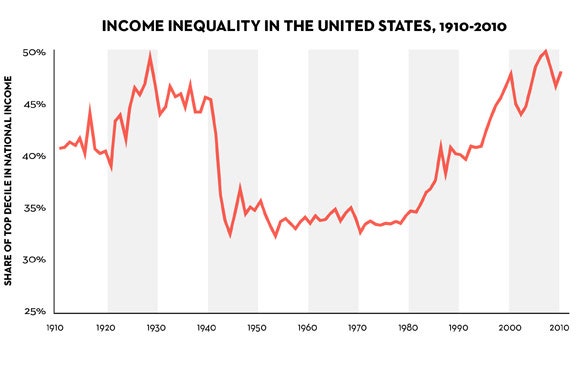
Piketty's data shows the top 1% share rising through the Gilded Age and peaking around 1910 at over 60%.
CornHOST
Then it falls through the mid-century and rises again.

Phillip W. MagnessGUEST
And it's a triumvirate of economists.
Phillip W. MagnessGUEST
They're all French economists around the most famous name is Thomas Piketty.
Phillip W. MagnessGUEST
And Piketty wrote this book in the early 2010s called Capital in the 21st Century that kind of broke under the bestseller list and made him a famous pundit.
Phillip W. MagnessGUEST
A lot of

Eric ZwickGUEST
Yeah, so I think there's this really famous graph in economics, the top 1% income share over time.
Eric ZwickGUEST
It comes from Piketty and Saez's work on income inequality.
Eric ZwickGUEST
One of the big questions at the time that we were starting to do this work, what's driving income inequality? What factors are responsible? Is it policy? Is it globalization? Who is at the top of the income distribution? And while that initial work was sort of pointing towards this class of people, it didn't really tell us that much about what they were up to.
Eric ZwickGUEST
You know, are they working? Are they just have passive portfolios that generate interest and dividends that they sort of hang out on the beach and just the bank accounts get fuller? What's going on there? We don't really know.

Pali LehohlaGUEST
The King of Bhutan comes up with a gross national happiness to try and understand how a world that is different to the one we have, like a world of Trump, should change.
Pali LehohlaGUEST
And Piketty looks at how accumulation is growing at a higher rate to the extent that only 10% or the top 1% or is it 10% own 65% of the income of the country.
Pali LehohlaGUEST
Now, all these streams As the image, the question of Muthuomi of five principles.
Pali LehohlaGUEST
The first one be know yourself and know the people who govern.

Brivael Le PogamGUEST
Basically, you said it, like, because there is, I think there is like big, big, the connection, like, like, like deep between the academia and the reality.
Brivael Le PogamGUEST
And that's why, for example, Thomas Piketty just took some like wrong action and And he wrote like, if you take that to the intellectual prism, it's valid.
Brivael Le PogamGUEST
But the assumption at the beginning, the roots, is completely false.
Brivael Le PogamGUEST
And I think it's the problem right now.

Daniel LacalleGUEST
What you get is stagnation.
Daniel LacalleGUEST
And that's why people like Stiglitz, people like Piketty, say, oh, high debt is not a problem.
Daniel LacalleGUEST
High debt is not a problem as long as you borrow at a cheap rate that is something that you can continue to add forever.
Daniel LacalleGUEST
No, no, it is a problem because once governments have exceeded the economic limit, the fiscal limit, and the inflationary limit, What happens is that the economy, the entire economy, moves upside down.

Joe RagazzoHOST
Realizing that.
Joe RagazzoHOST
The Piketty book, when I read Capital, that was a huge factor in it.
Joe RagazzoHOST
A huge factor in it was the Piketty book.
Joe RagazzoHOST
So whenever that came out, I might have joined it that year, to be honest.
Josh KovenskyHOST
Anyway, yeah.

Paul NowakGUEST
I support more effective taxes on wealth, and I've got an open mind about wealth taxes, absolutely.
Paul NowakGUEST
I mean, I've sat on panels with Thomas Piketty and Gabrielle Zuckman, and we've talked about wealth taxes here in the UK and across the world.
Paul NowakGUEST
Certainly, we've got to have a tax system that is better at taxing wealth.
Paul NowakGUEST
At the moment, we've got a tax system Very effective at taxing work, much less effective at taxing those who've got big assets.

Logan WrightGUEST
But fundamentally, that's that's the cause.
Logan WrightGUEST
Second is the distribution of income, the Thomas Piketty argument.
Logan WrightGUEST
So in other words, even if you improve the household income share of GDP, if it accrues to the wealthy overwhelmingly, you're not going to generate too much consumption.
Logan WrightGUEST
The third is the level of household debt, which has been rising recently, but that's coming down.
48 more episodes mention Thomas Piketty.
Create an account to see the whole feed, search across every transcript, and follow the entities you care about.