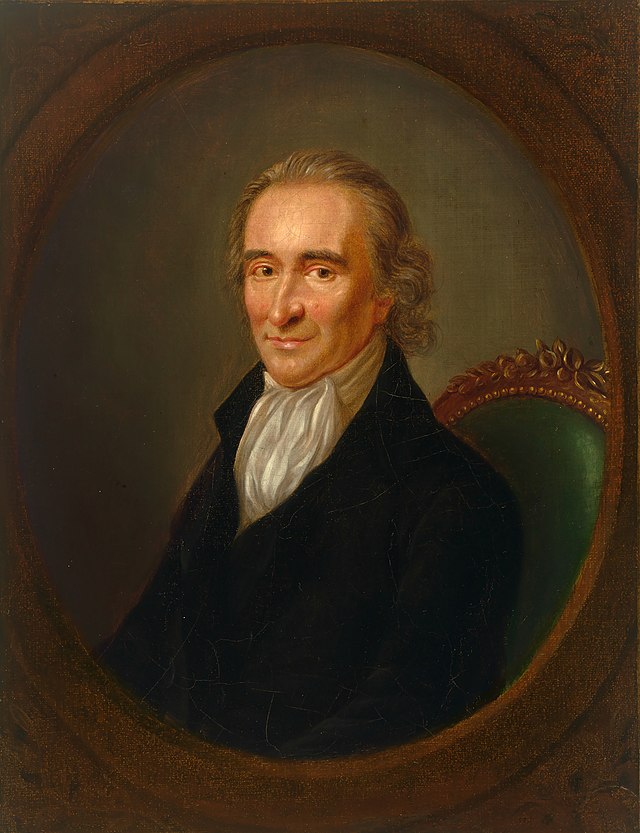
Thomas Paine
Inventor and former Deputy of the French National AssemblyWikipedia
645
MENTIONS
255
EPISODES
215
PODCASTS
Search complete. 645 mentions across 255 episodes found for "Thomas Paine".
Sep 24, 2026

Bethany McLeanHOST
But don't worry, right now the power structure will be-- remain intact.
Bethany McLeanHOST
And then as you detail through your book, all these thinkers from even Bentham to Adam Smith, of course, even Thomas Paine, whose beliefs got oversimplified.
Bethany McLeanHOST
Why did we lose the nuance in Adam Smith's argument? Why did we lose some of the nuance in Thomas Paine's argument? Is it, is it the power structures of the world take these things over, or is there something at the core of them that makes them malleable in a way that they shouldn't be?
Elizabeth AndersonGUEST
I see.
Elizabeth AndersonGUEST
Well, so, and my argument is that the Protestant work ethic at its origins in the seventeenth century, you have all these Puritans coming up with this doctrine.

speaker_6NARRATOR
In the midst of this ferment of American opinion, a bold and eloquent pamphleteer broke in upon the hesitating public with a program for absolute independence, without fears and without apologies.
speaker_6NARRATOR
In the early days of 1776, Thomas Paine issued the first of his famous tracts, Common Sense, a passionate attack upon the British monarchy and an equally passionate plea for American liberty.
speaker_6NARRATOR
Casting aside the language of petition, with which Americans had hitherto addressed George III, Paine went to the other extreme and assailed him with many a violent epithet.
speaker_6NARRATOR
He condemned monarchy itself as a system which had laid the world in blood and ashes.
28 MINS LATER
M.L. CohenNARRATOR
They pray for the American army.
M.L. CohenNARRATOR
End quote.
M.L. CohenNARRATOR
Thomas Paine never let his pen rest.
M.L. CohenNARRATOR
He had been with the forces of Washington when they retreated from Fort Lee and were harried from New Jersey into Pennsylvania.

John BradshawHOST
He wasn't able to attend college, pretty typical for people of his era, but he did enjoy books, and he learned a lot from his own studies.
John BradshawHOST
He was raised a Baptist, but in his early 20s he began to read the writings of Thomas Paine and Voltaire and Ethan Allen.
John BradshawHOST
and he became a deist.
John BradshawHOST
He believed in God, but he didn't believe that God intervened directly in the lives of human beings.

Jeffrey RosenHOST
And we wanted to tell the entire story of Dickinson in just a couple of verses.
Jeffrey RosenHOST
So you'll hear about the Townshend Act, and you'll hear about his encounter with Benjamin Rush, who encourage Thomas Paine to use the title Common Sense, and we have a jaunty new tune.
Jeffrey RosenHOST
I had not heard the original one before writing it, but they're surprisingly similar because the lyrics, as you'll hear, invite the kind of drinking song feeling.
Jeffrey RosenHOST
So here is Dickinson and Liberty, the world premiere.

Paul IsraelGUEST
He read the books in his father's library, which are largely Enlightenment thinkers.
Paul IsraelGUEST
Gibbons' Fall of the Roman Empire, most importantly Thomas Paine, who became a hero of Edison's.
Paul IsraelGUEST
In fact, Edison later wrote a short introduction to a collection of Paine's works.
Paul IsraelGUEST
And that kind of free-thinking ideas about religion were also ones that were held by Edison.

Marly HornikGUEST
You know, you can't ascribe innocence to those who know better and are leading people so terribly astray.
Marly HornikGUEST
You know, I think about the No Kings protest with Chuck Schumer leading that charge and Thomas Paine, an author from the era of the American founding, he wrote this great little pamphlet called Common Sense.
Marly HornikGUEST
You know, one thing people don't understand, like when you start to read these things, you think, oh, this is going to be hard and it's going to be history and it's going to be a drag.
Marly HornikGUEST
These guys were so funny.
Marly HornikGUEST
They were really sarcastic and they had really dry wit.
Marly HornikGUEST
Thomas Paine is hysterical.
Marly HornikGUEST
But you read this pamphlet, Common Sense, and he says, what's so great about America is in America, the law is the king.
Marly HornikGUEST
So now if you go out and you hear these no kings protesters, all of a sudden you realize they have been deliberately moved in a direction to hate the rule of law.

Mark DunleaHOST
Ben is an assistant professor of public sociology at George Mason University.
Mark DunleaHOST
People may know American Crisis, apparently one of the things that Thomas Paine during the American Revolution wrote about.
Mark DunleaHOST
So, Ben, what's the point of this particular report? What motivated you to put it out?
Ben ManskiGUEST
Well, as with pain 250 years ago, these are also times that try our souls.

Clifford BrownGUEST
I think that it's a habit, much like monarchy used to be a habit.
Clifford BrownGUEST
And when Thomas Paine wrote Common Sense during the time of our own revolution, he said, monarchy is a habit.
Clifford BrownGUEST
Humans have to get over it.
Clifford BrownGUEST
There's nothing divine about the right of kings.

speaker_16UNKNOWN
The motion is not agreed to.
John BoundCORRESPONDENT
Thomas Paine plainly wrote in Common Sense that representatives should return and mix again with the general body of the electors.
John BoundCORRESPONDENT
While George Mason said the very palladium of civil liberty required that great officers at fixed periods return to that mass from which they were at first taken, so they could experience the same laws they imposed on everyone else, instead of living out their final days in a geriatric country club, leeching off the taxpayer, completely oblivious to the lives of those they claimed to represent.
speaker_17UNKNOWN
People, you're getting applause for term limits, but how reasonable is that? I mean, how realistic is it that the Senate and Congress are going to vote themselves out? Also, states are rewarded by keeping a senator in longer, by keeping a congressman in longer.

David RoseHOST
And, you know, kudos, as we said, to Substack for stepping in with its Defender program and enabling you to, well, carry on looking where you are.
Jeff SteinGUEST
I think it's attributed to Thomas Paine, the famous American revolutionary who said, the tree of liberty is watered by the blood of patriots.
Jeff SteinGUEST
and this is what we have long done in the press, and many journalists have suffered.
Jeff SteinGUEST
It's a personal decision for you what to do.
245 more episodes mention Thomas Paine.
Create an account to see the whole feed, search across every transcript, and follow the entities you care about.