Thomas Nast
German-American caricaturist and editorial cartoonistWikipedia
24
MENTIONS
15
EPISODES
13
PODCASTS
Search complete. 24 mentions across 15 episodes found for "Thomas Nast".
Sep 15, 2026

Mark SmithNARRATOR
First modernist in America was Arthur Davies, Welsh.
Mark SmithNARRATOR
Corrupt Tweed ring in New York City smashed by cartoons of Thomas Nast, German.
Mark SmithNARRATOR
Leader in landscape painting, Frederick Dettwiller, Swiss.
Mark SmithNARRATOR
Master of miniatures, Malthy Hathawayus, Dane.

AJ RiceHOST
There is an old tradition of this.
AJ RiceHOST
Going back to the Revolutionary War, coming forward, Thomas Nast took out Boss Tweed in New York City, was running this Democrat racket in New York City.
AJ RiceHOST
James Gilray made fun of Napoleon.
AJ RiceHOST
A lot of the caricatures of Napoleon that you know as a screaming little miniature goblin came from that.

Bob EthingtonHOST
but but in terms of the um american press newspaper press this was a real kind of a new beginning for this or in it was the
Derf BackderfGUEST
big launch yeah i mean we trace the origins back to thomas nast right in the 1880s yeah with harper's magazine And, and then beyond that, the newspaper started to introduce them and that's, you know, they had a huge reach.
Derf BackderfGUEST
Right.
Derf BackderfGUEST
Right.
Bob EthingtonHOST
Right.
Bob EthingtonHOST
Some of
Derf BackderfGUEST
these cartoonists, my cartoonists, particularly Art Young, who is probably the dean of political cartooning at that time, he was a protege of Thomas Nast.
Derf BackderfGUEST
So that's how close they were to the beginning of this art form.

Derf BackderfGUEST
Well, there's a lot by Art Young, who was, um, almost completely forgotten now, but he was the dominant political cartoonist of the day.
Derf BackderfGUEST
Uh, he was a protege of Thomas Nast, who I'm sure you, you know back from the 19th century, the guy who is credited with inventing political cartoons.
Derf BackderfGUEST
He didn't, but he certainly popularized them.
Derf BackderfGUEST
And then came Art Young right after him, and he dominated the field for the next 25 years, until, uh, the trials and the government moved to crush him, and after that, his career was, was kind of greatly compromised.

Dave KellettHOST
They had this section that's literally the history of sequential art.
Dave KellettHOST
So it starts with Hogarth, and Gillray, and Cruikshank, and Thomas Nast.
Brad GeigerHOST
Mm-hmm.
Dave KellettHOST
And moves its way up into the 20th century, and then takes you through pulp, uh, pulp and pop culture, uh, publishing, and the syndicated s- process and all that sort of stuff.
Brad GeigerHOST
And it's, it's interesting because it's not a, it's not a response that's based in, like, you know, cultural significance.
Brad GeigerHOST
If you're going by cultural significance, and you're, and you're not thinking Calvin and Hobbes, uh, I, I, I, I, I'm not sure what, you know, you're thinking.
Brad GeigerHOST
And, and maybe Thomas Nast.
Dave KellettHOST
Mm-hmm.

GregHOST
And America ate this stuff up especially.
GregHOST
So in the 1800s, there was a political cartoonist in America named Thomas Nast at a magazine called Harper's Weekly right after the Civil War.
GregHOST
And And if you've ever seen these old kind of post-Civil War political cartoons in America, Boss Tweed or whatever, that was Thomas Nast.
GregHOST
But in 1871, he starts publishing all of these anti-Catholic cartoons because you had immigrants coming over, the Italians and the Irish and others that were coming over to America, and they were bringing their Catholicism.
GregHOST
Thomas Nast represented the sort of Protestant mainline in America that was against these Catholic immigrants and how they were going to undermine the country and destroy America and everything else.
GregHOST
And so he's got this series of cartoons or this one called the American River Ganges, like the River Ganges in India.
GregHOST
And it's got this picture of America with this river and you can see the Capitol building and all that.

MaxHOST
Yeah
Nathan RobinsonGUEST
... 1900s Thomas Nast illustration of, like, Mr. Moneybags running the country, really, really opens up some fertile territory for socialists to organize in.
MaxHOST
It's amazing to me how many things this man says that would have ended any other political career, including something as seemingly innocuous as, "Well, you're not gonna get $30, you'll get two, maybe." Like, anybody else is just, that, that person is burnt.
MaxHOST
They're spent.

Bruce CarlsonHOST
Goodkin at The Nation described the convention's results as dolorous or farcical or both.
Bruce CarlsonHOST
Grant or Greeley, I remain at home on election day." In Harper's Weekly, cartoonist Thomas Nast had a field day with Honest Old Horace, picturing the Tribune editor as a hopelessly nearsighted and pumpkin-headed clown.
Bruce CarlsonHOST
He did a savage takedown on Greeley's pamphlet, What I Know About Farming, in a series of cartoons labeled What I Know About Eating My Own Words and What I Know About Bolting, a savage ridicule of Greeley's appeal in his acceptance letter for North and South to clasp hands across the bloody chasm.
Bruce CarlsonHOST
Thomas Nast showed Greeley shaking hands with a rebel who had just shot a Union soldier, stretching out his hand to John Wilkes Booth across Lincoln's grave.
Bruce CarlsonHOST
Medill's newspaper, we talked about Medill, and he endorses the Liberal Republican ticket In a sense, in a way, that's not the greatest endorsement ever.
Bruce CarlsonHOST
It reflects the fact that many people had that there could have been many other people to nominate.

speaker_8NARRATOR
That's 866-967-6837.
RoverHOST
Charlie, are you going to refer to Thomas Nast? Is that...
CharlieHOST
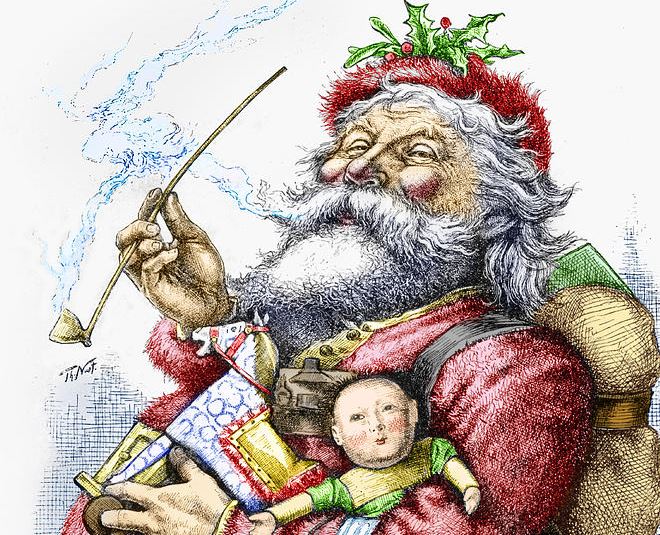
Thomas Nass did do one of the first images of current-day Santa Claus, but it is a black and white image, so it'd be hard to tell if he meant red.
CharlieHOST
But let's go ahead and look.
speaker_9NARRATOR
That's 866-967-6837.
RoverHOST
Charlie, are you going to refer to Thomas Nast?
CharlieHOST
Yeah.
CharlieHOST
Thomas Nass did do one of the first images of current-day Santa Claus, but it is a black and white image, so it'd be hard to tell if he meant red.
5 more episodes mention Thomas Nast.
Create an account to see the whole feed, search across every transcript, and follow the entities you care about.