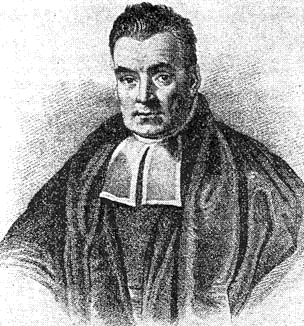
Thomas Bayes
Statistician and philosopherWikipedia
194
MENTIONS
11
EPISODES
11
PODCASTS
Search complete. 194 mentions across 11 episodes found for "Thomas Bayes".
Sep 10, 2026

Johannes WaldsteinGUEST
It has Bayesian inference.
Johannes WaldsteinGUEST
Thomas Bayes, a few hundred years ago, came up with an equation of how to go backwards.
Johannes WaldsteinGUEST
Humans are good at saying, if I do this, then this cause happens.
Johannes WaldsteinGUEST
And it's harder for humans to go the other way.

David KippingHOST
And if you think about it, all detections in science must ultimately come down to comparing two models like this.
David KippingHOST
As a result, all you can really measure is something like an odds ratio between them, given the fancy name Bayes factor, named after Thomas Bayes.
David KippingHOST
So, for example, Banekredel found that it was 459 times more likely that there was water vapour present, given the Hubble data, rather than that of a flat line.
David KippingHOST
Hence, a Bayes factor of 459 to 1.
David KippingHOST
Now, many astronomers have a curious need to convert these Bayes factors into what is called sigmas.
David KippingHOST
To me, this process is both completely unnecessary and deeply misguided.
David KippingHOST
But regardless, let's just try to do it anyway.
David KippingHOST
And in doing so, one has to tackle a fairly deep incongruence between the two schemes.

speaker_0HOST
A 93% chance of dismissal isn't poetry, but it matches how thoughtful attorneys actually think and talk, and that alignment with real legal reasoning is what makes it powerful.
speaker_0HOST
So how does it actually work? The foundation is something called Bayesian inference, named after the 18th century mathematician Thomas Bayes.
speaker_0HOST
The concept is more intuitive than its reputation suggests.
speaker_0HOST
You start with the prior, a base rate drawn from historical data.

Angela LewisHOST
The goal is to learn how to update well.
Angela LewisHOST
And that, strangely enough, is where our Woodland Heist movie runs directly into Thomas Bayes.
Angela LewisHOST
So let's start with what Bayesian updating actually is.
Angela LewisHOST
It gets its name from Thomas Bayes, an 18th century English minister and mathematician whose work on conditional probability gave us what we now call Bayes' theorem, a way of thinking about how probabilities change when we get new information, which sounds an awful lot like math.
Angela LewisHOST
And for those of us who are not so numerically minded, that does not mean that we need to immediately begin dissociating, because while there is absolutely math underneath Bayesian reasoning, The most valuable takeaway is the mental habit underneath the map, which is actually pretty intuitive.
Angela LewisHOST
In a simplified sense, you start with what you already have reason to believe.

Todd FredericksHOST
Fallacy of Wednesday.
Todd FredericksHOST
Bayesian reasoning.
Todd FredericksHOST
So I've mentioned Bayesian reasoning before, but basically Bayesian reasoning breaks down to updating your opinion of something based upon new information that reshapes what your original position was.
Todd FredericksHOST
So it's a method of thinking and decision making that involves updating your beliefs when new evidence shows up.
Todd FredericksHOST
At its core, it's given what I believe before and what I've just observed.
Todd FredericksHOST
How should I revise my belief? The basic idea is that it's based on Bayes' theorem, which combines prior probability, what you believe before seeing new evidence, likelihood, how likely the evidence is given a hypothesis, and posterior probability, your updated belief after considering the evidence.
Todd FredericksHOST
So that's what Bayesian reasoning is.
Todd FredericksHOST
So you start with an initial guess.

Joshua BrownGUEST
So for example, how likely, you know, on a scale of 0% to 100%, how likely is it that I'll get healed? Or how likely is it that miracles happen? Or how likely is it that Jesus rose from the dead, right? All of these things, you can understand beliefs as your understanding of the probability that something is true.
Joshua BrownGUEST
0% to 100%, okay? And if you think about it that way, that's actually a super useful way to conceptualize it because there was a guy in the 18th century, Reverend Thomas Bayes, who was also interested in these questions.
Joshua BrownGUEST
And he developed a way of thinking about how we form beliefs and how we update beliefs.
Joshua BrownGUEST
And so he developed something called Bayes' Rule, which is this probability theoretic construct that is used everywhere in psychology and cognitive science.

Eoin FitzpatrickGUEST
But at the same time, you have to be willing to be able to update it if needs be.
Eoin FitzpatrickGUEST
There's a guy called Thomas Bayes, who a few hundred years ago came up with this formula, and it became known as Bayesian probability or Bayesian reasoning, which is something that is used a lot even in, you know, AI and science to this day.
Eoin FitzpatrickGUEST
But it's the notion that you go into any situation with a prior.
Eoin FitzpatrickGUEST
A prior is a belief that you have currently.

Jordi VisserGUEST
Um, and my father told me there was no God.
Jordi VisserGUEST
So you grow up in a house as a young kid and you're consuming this type of information, but the advice my father gave me, which just shows how important that little example was to keep my brain open, and I'll summarize what you said for people with Thomas Bayes and with, um, Annie Duke as two people to, for them to, to spend time with.
Jordi VisserGUEST
Uh, he told me, "Nothing you will hear in life is true except two plus two is four." Now, that's obviously simplified.
Jordi VisserGUEST
You can go into f- into, into all things related to science and get up with facts.

Episode 145: Pascal’s Wager and Probability Theory
Aug 18 · 157 Mentions
Top 50%PeterHOST
If there is even a small chance that God exists and believing could lead to an infinite reward while disbelief risks an infinite loss, then believing is the rational choice, right? Also, this was completely new to me, but Blaise Pascal is the founder of probability theory all the way back in the 17th century.
PeterHOST
And even aside from his wager making a potentially problematic theological point, his famous ra- wager also raises issues related to probability theory and Bayes's theorem that came after, and even modern-day Bayesian epistemology.
PeterHOST
How do we handle it when the payoff is large or potentially infinite, in this case, in the form of eternal life? Bruce also hammers home the compelling case that Bayesian epistemology is not as false as many a critical rationalist might think, but that it could more properly be thought of as an important part of critical rationalist epistemology, which ultimately explains Bayesian reasoning.
PeterHOST
I enjoyed Bruce's unique and compelling take here, and I hope someone else gets something out of this.
PeterHOST
[piano intro]
Bruce NielsonHOST
It's about how much we believe them, or so argues Ian Hacking in his excellent History of Probability Theory, the emergence of, the Emergence of Probability: A Philosophical Study of Early Ideas about Probability, Induction, and Statistical In- Statistical Inference.
PeterHOST
Well, I'm just, uh, looking this up a bit on ChatGPT, and so far what you're saying checks out.
PeterHOST
It's the, he was a, he was into, he, this was a, a, Bla- Blaise Pascal, 1623 to 1662, but he was a French mathematician, physicist, inventor, and religious philosopher, and it sounds like what you're gonna say is he's the first Bayesian or something, or one of the first?

Owen FitzpatrickGUEST
But on the flip side, if you believe that you're useless and you, you know, it's just who you are and you have a fixed mindset about yourself, that's not useful.
Owen FitzpatrickGUEST
So I'm like, there's a concept called Bayesian reasoning or Bayesian probability from a few hundred years ago, Thomas Bayes.
Owen FitzpatrickGUEST
And the notion is that you go in with a prior, and then you update that belief with new, as new evidence comes in.
Owen FitzpatrickGUEST
And to me, when we start thinking about beliefs as something on a continuum that can continuously go and move from a probability, I'm 80% sure of this-
1 more episode mentions Thomas Bayes.
Create an account to see the whole feed, search across every transcript, and follow the entities you care about.