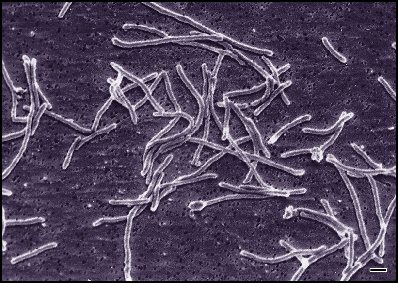
Thermus aquaticus
BacteriaWikipedia
4
MENTIONS
2
EPISODES
2
PODCASTS
Search complete. 4 mentions across 2 episodes found for "Thermus aquaticus".
Oct 23, 2026

Robert LullGUEST
That was like a, you know, maybe 2018, 2019.
Robert LullGUEST
And then the pandemic came around and the story of the bacterium Thermus aquaticus that was found in mushroom pool at Yellowstone and helped enable the PCR test that we're all very familiar with.
Robert LullGUEST
That's probably the best known story in the whole book.
Robert LullGUEST
And I said, okay, we've got the lead over there.
10 MINS LATER
Aaron WeissHOST
But I certainly didn't realize that PCR, Polymerase Chain Reaction, that all of that is thanks to a discovery that happened at Yellowstone in 1966 because of a bacteria that was living found somewhere it shouldn't have been.
Aaron WeissHOST
Just briefly walk through that story because it's crazy.
Robert LullGUEST
Yeah, so the case of Thomas Braque, the scientist here, and Thermus aquaticus, the bacteria, is just like a textbook story of a curious scientist.
Robert LullGUEST
All he really was interested in was what's the upper temperature limit for life? You know, another basic science question like how old is the Earth? And so Yellowstone turns out to be maybe the best, but certainly one of the best places on Earth to look for that.

Suzanna RyanGUEST
So we kind of make use of that and we say, "Okay, now let's do it outside the body, and we'll target specific areas." So that's how we can start with just a couple of cells, go through all these cycles, and at the end we have millions or even billions of copies.
Suzanna RyanGUEST
Where Yellowstone comes into play with all of this is there's a specific enzyme called Thermus aquaticus that was found in the Mushroom Pool in Yellowstone.
Suzanna RyanGUEST
It is an enzyme that can withstand very high heat, right? So all these hot springs and everything in Yellowstone, these enzymes has, have evolved to be able to survive there.
Suzanna RyanGUEST
So that, the reason that's important in forensics is when we're doing all these copying, this copying of DNA, the first thing we have to do is heat up the DNA.
Suzanna RyanGUEST
That's, and then that's when the DNA expands.
Suzanna RyanGUEST
If we were using a regular enzyme that's in our bodies, when it got heated up to 94 degrees, that enzyme would be completely denatured, couldn't use it, and the cycling would stop.
Suzanna RyanGUEST
So now when Taq enzyme, Thermus aquaticus, was discovered, now we can throw that Taq into that tube.
Suzanna RyanGUEST
It c- it can withstand the high heat.