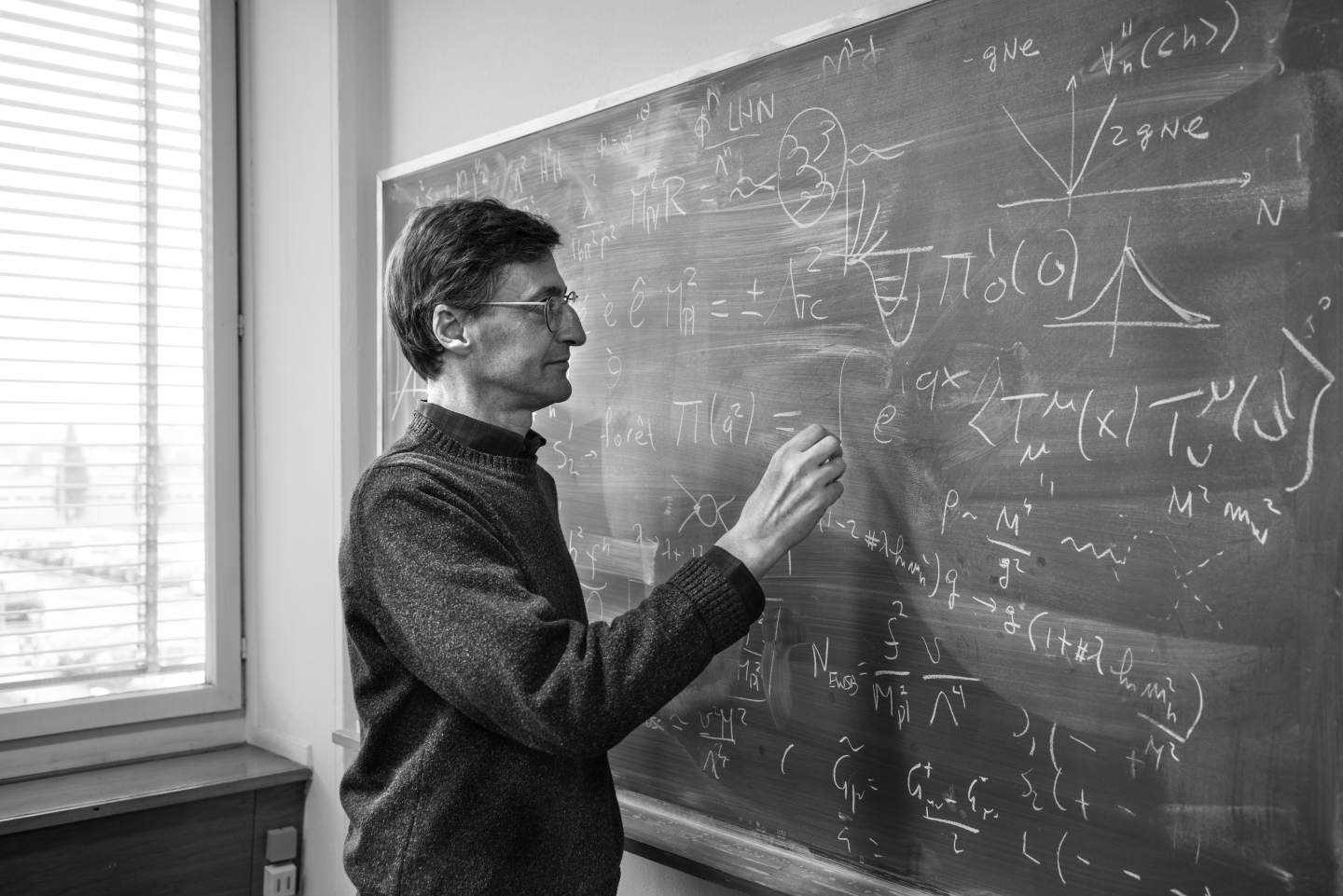
Theoretical physics
9
MENTIONS
6
EPISODES
6
PODCASTS
Search complete. 9 mentions across 6 episodes found for "Theoretical physics".
Sep 24, 2026

Rachel ThomasHOST
As we were saying, it's, it's, it's sort of an honor, it's a distinction to be asked.
Rachel ThomasHOST
As a member of, uh, the Department of Applied Maths and Theoretical Physics at, at Cambridge, are there sort of factors about being there that's contributed to you gaining this sort of international reputation to be invited to speak here?
Carola-Bibiane SchönliebGUEST
Well, I, I think Cambridge and, and the department, so DMTP, have always been extremely good to me, uh, throughout my career since I started, uh, in Cambridge.
Carola-Bibiane SchönliebGUEST
Um, and I think the key to me being at, you know, where I am now, you know, is of course self-drive and so on and so forth, but it's really also the, uh, environment giving you the opportunities and the freedom to do the things you love most.

Brian KeatingHOST
You know, I'm coming out to Brown.
Brian KeatingHOST
You know, I'm on the, uh, Stephon Alexander's, uh, Theoretical Physics, uh, Center.
Brian KeatingHOST
I'm on their boar-board of directors, so I'm supposed to come out there.
Brian KeatingHOST
So, uh, I'll-- we'll do, we'll do an in-person, uh-

Sebastian HassingerHOST
Daniel Loss is RDIA Chair Professor of Quantum Computing and Director of the Quantum Center at King Fahd University of Petroleum and Minerals in Saudi Arabia, where this work was done.
Sebastian HassingerHOST
He co-proposed the spin qubit modality in nineteen ninety-seven and was for decades Professor of Theoretical Physics at the University of Basel, where he co-founded NCCR Spin.
Sebastian HassingerHOST
He is a twenty twenty-five Clarivate Citation Laureate in Physics, and he has spent the last year or so thinking hard about a question that is older than quantum computing itself.
Sebastian HassingerHOST
Not how do we build a fault-tolerant quantum computer, but something more fundamental.
9 MINS LATER
Daniel LossGUEST
... uh, to, uh, go ahead, uh, to some extent.
Daniel LossGUEST
And all of a sudden, you know, just very esoteric fields become center, uh, also for technology and for huge promises in, uh, applications.
Daniel LossGUEST
And, uh, you know, this is the beautiful thing about physics and theoretical physics in particular.
Daniel LossGUEST
At some point, uh, you know, you're just, uh, thinking about something no one else really cares about, and all of a sudden, uh, it goes into another dimension.

Jonathan McCraeHOST
And that is why Jim Al-Khalili has written a book.
Jonathan McCraeHOST
He's a theoretical physicist, host of BBC's Life Scientific, of course.
Jonathan McCraeHOST
But he's written many books.
Jonathan McCraeHOST
This book is called On Time, in which he tries to take on this mammoth task of explaining time to us.

Brian DohertyHOST
And I can assure you we have an intriguing conversation ahead of us today with two leading experts in their field.
Brian DohertyHOST
Firstly, I am pleased to welcome Professor of Theoretical Physics at King's College London, George Booth.
Brian DohertyHOST
Professor Booth has worked as a postdoctoral research associate at both Cambridge and Princeton, and his research centres on the development of novel computational methods to accurately simulate the interactions between electrons and nuclei.
Brian DohertyHOST
George.

Harry GolubHOST
Phil Goddard, the head of data at Sportsbook platform at FDJ United and leads a 70 person data team distributed across Europe, Australia.
Harry GolubHOST
And he's coming from a really interesting journey through a PhD in theoretical physics into then data science before moving into senior leadership where I've been really sort of captured by his product centric data approach to building teams.
Harry GolubHOST
So we're going to dive into everything today from data mesh, data products, and a really interesting discussion hopefully around build versus buy.
Harry GolubHOST
And I suppose obviously where AI is taking us and what is important to organizations.
Harry GolubHOST
How are you doing today?
Phil GoddardGUEST
yeah doing really well and uh thanks so much for the introduction harry uh yeah really excited to uh to get stuck into our conversation excellent i've obviously
Harry GolubHOST
got a bit of an intro um phil but for the audience it'd be great just to hear a bit more about yourself um your career let's say from a phd in theoretical physics to where you are now and yeah how help the audience here hear a bit more about yourself
Phil GoddardGUEST
Yeah, I think, yeah, really good question.