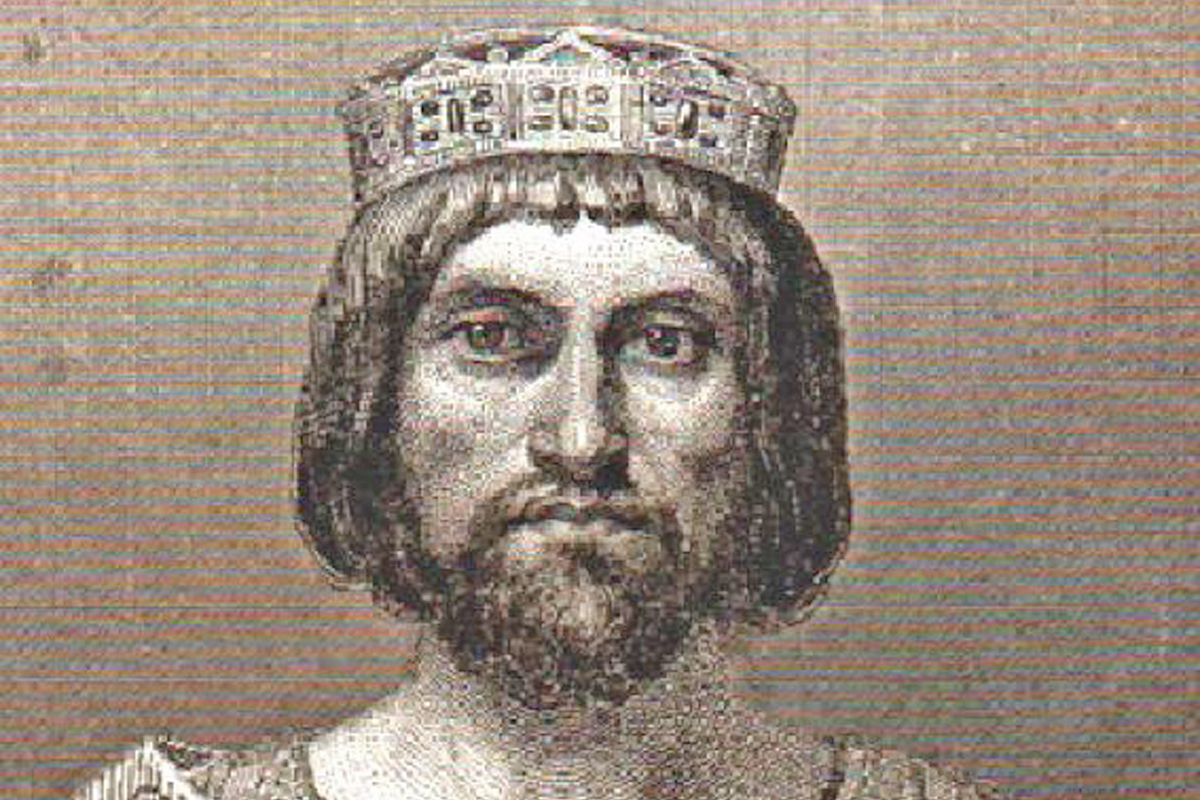
Theodoric the Great
Former King of ItalyWikipedia
334
MENTIONS
34
EPISODES
30
PODCASTS
Search complete. 334 mentions across 34 episodes found for "Theodoric the Great".
Oct 26, 2026

speaker_5NARRATOR
Through these holes he traced the letters in red ink.
speaker_5NARRATOR
Theoderic, king of the Ostrogoths, it is said, wrote his name through a gold plate in the same manner.
speaker_5NARRATOR
Tablets, or little tables of wood, as well as of metal, came at length to take the place of stone tables.
speaker_5NARRATOR
The thin wooden tables were sometimes covered with wax, which was written upon with a style or ivory pencil.

Kevin S.NARRATOR
Footnote.
Kevin S.NARRATOR
Decoratus was a minion of Theodoric.
Devorah AllenNARRATOR
We cannot consider men worthy of veneration on account of their high places, when we hold them to be unworthy of those high places.
Devorah AllenNARRATOR
But if you see a man endowed with wisdom, you cannot but consider him worthy of veneration, or at least of the wisdom with which he is endowed.
3 HRS 5 MINS LATER
Kevin S.NARRATOR
Anicius, Manlius, Severinus, Boethius born of a most distinguished family.
Kevin S.NARRATOR
493.
Kevin S.NARRATOR
Theodoric, the Ostrogothic king, becomes sole master of Italy.
Kevin S.NARRATOR
510.

Kevin S.NARRATOR
Footnote.
Kevin S.NARRATOR
Decoratus was a minion of Theodoric.
Devorah AllenVOICE_ACTOR
We cannot consider men worthy of veneration on account of their high places, when we hold them to be unworthy of those high places.
Devorah AllenVOICE_ACTOR
But if you see a man endowed with wisdom, you cannot but consider him worthy of veneration, or at least of the wisdom with which he is endowed.
2 HRS 51 MINS LATER
Kevin S.NARRATOR
Anicius, Manlius, Severinus, Boethius born of a most distinguished family.
Kevin S.NARRATOR
493.
Kevin S.NARRATOR
Theodoric, the Ostrogothic king, becomes sole master of Italy.
Kevin S.NARRATOR
510.

speaker_3NARRATOR
Anicus Manlius Severinus Boethius lived in the last quarter of the fifth century A.D., and the first quarter of the sixth.
speaker_3NARRATOR
He was growing to manhood when Theodoric, the famous Ostrogoth, crossed the Alps and made himself master of Italy.
speaker_3NARRATOR
Boethius belonged to an ancient family which boasted a connection with the legendary glories of the Republic, and was still among the foremost in wealth and dignity in the days of Rome's abasement.
speaker_3NARRATOR
His parents dying early, he was brought up by Symmachus, whom the age agreed to regard as of almost saintly character, and afterwards became his son-in-law.
speaker_3NARRATOR
by his Latin translations of the works of Aristotle.
speaker_3NARRATOR
Called early to a public career, the highest honors of the state came to him unsought.
speaker_3NARRATOR
He was sole consul in 510 A.D., and was ultimately raised by Theodoric to the dignity of magister officiorum, or head of the whole civil administration.
speaker_3NARRATOR
He was no less happy in his domestic life, in the virtues of his wife, Rustisiana, and the fair promise of his two sons, Symmachus and Boethius.

Pamela NagamiNARRATOR
They passed as friends or foes by cities that Rome had built.
Pamela NagamiNARRATOR
The ambition of their greatest leaders, of men like Alaric or Theodoric, was not to destroy but to rebuild the Roman world of ordered rule and equal justice.
Pamela NagamiNARRATOR
In Gaul and in Italy, the language and ideas of Rome turned the Frank and Lombard conquerors into Frenchmen and Italians.
Pamela NagamiNARRATOR
Meanwhile, imperial Rome became papal Rome.
Pamela NagamiNARRATOR
The Teutonic invaders brought their own contribution to the life of the Middle Ages.
Pamela NagamiNARRATOR
The idea of personal liberty that appears in early Teutonic law, the practice of commendation and the authority of the chief over his comites, the institutions of elective monarchy and the assemblies of free warriors, exercised a profound influence over the new world that was shaping itself out of the fragments of the old.
Pamela NagamiNARRATOR
The reign of Theodoric was the first attempt to harmonize the old and the new, to blend the Roman ideals of order and civilitas with the Teutonic spirit of freedom.
Pamela NagamiNARRATOR
The Arianism of the Goths and the opposition of a party among the Roman nobles made the task a difficult one, and with the death of Theodoric and the revival of the empire under Justinian, the Gothic kingdom crumbled away.

Kirsten FerreriNARRATOR
Anicus Manlius Severinus Boethius lived in the last quarter of the fifth century A.D., and the first quarter of the sixth.
Kirsten FerreriNARRATOR
He was growing to manhood when Theodoric, the famous Ostrogoth, crossed the Alps and made himself master of Italy.
Kirsten FerreriNARRATOR
Boethius belonged to an ancient family which boasted a connection with the legendary glories of the Republic, and was still among the foremost in wealth and dignity in the days of Rome's abasement.
Kirsten FerreriNARRATOR
His parents dying early, he was brought up by Symmachus, whom the age agreed to regard as of almost saintly character, and afterwards became his son-in-law.
Kirsten FerreriNARRATOR
by his Latin translations of the works of Aristotle.
Kirsten FerreriNARRATOR
Called early to a public career, the highest honors of the state came to him unsought.
Kirsten FerreriNARRATOR
He was sole consul in 510 A.D., and was ultimately raised by Theodoric to the dignity of magister officiorum, or head of the whole civil administration.
Kirsten FerreriNARRATOR
He was no less happy in his domestic life, in the virtues of his wife, Rusticiana, and the fair promise of his two sons, Symmachus and Boethius.

Phil BensonNARRATOR
In their mud huts they possessed a social distinction and a political training, such as would have graced the most sumptuous of palaces.
Phil BensonNARRATOR
in quite early days they began to put their heads together and to form a definite system of polity year by year the little community was added to battle and bloodshed continued on the mainland and men and women flocked to the islands it is curious to notice how rank and social distinction assert themselves blood will out wherever human beings are gathered together whether on the islands of the adriatic or on those of the south seas and however sorry their plight or great their general misfortune different grades will become visible men and women will place themselves one above the other the master and the man the mistress and the maid such is the law of humanity all the world over calamity did not in the long run have much effect upon the higher class of refugees and the position of the lower classes was not bettered sympathy had levelled social distinctions for a time but that was not for long soon in the natural course of events when the little colony grew into a city and the origin of the veneti had faded almost into a tradition the various ranks became distinct true they lived as sea-birds live one kind of food common to both and one kind of house sheltering both but the poor man and the rich did not live in equality as the community grew in importance they began to cultivate their islands and to build unto themselves ships by force of necessity they became expert in all matters of navigation as agile on the water as on land fearless they acquired a better means of navigation and a wider knowledge of the lagoons than any other state possessed then they began to be attacked with great courage and determination venice resisted all her foes gothic lombard byzantine and frank her position was peculiar vague she acknowledged a certain allegiance to the court of byzantium yet by her acts she recognized the supremacy of the kingdoms on the mainland neither byzantium nor ravenna and not padua could claim the lagoons venice was marvellously diplomatic she drew from east and west exactly what she wanted to make her a nation by herself while she pretended allegiance to several empires she was in reality struggling for independence in the stillness of the lagoon and the freedom of the sea air the germs of individuality grew and flourished they had a congenial soil and fitting nutriment it is wonderfully interesting to watch the progress of the little state the diplomatic way she went to work how when she was weak and unable to stand alone she feigned allegiance to a stronger power yet never bound herself by written word how she played one power against the other and how in the end when sufficiently strong under the shelter of her various foster-mothers she struck out for freedom boldly there is a letter from cassiodorus prefect of theodoric the great which throws light upon the relations of venice with the goths theodoric endeavoured to veil his power over venice under the guise of alliance or of hospitality at the time of the famine in five hundred and twenty he came to their rescue with provisions this gave him a certain hold over the venetian people it imposed upon them a debt which was not to be easily discharged a letter written by cassiodorus in five hundred and twenty three is neither more nor less than a demand to the venetians to bring supplies of oil wine and honey which the islands possessed to the goths the letter which is of florid style is one long sneer veiled in delicate flattery cassiodorus explains that the venetians own certain ships that they are well built that the sea is an easy path to them and he begs that the vessels will transport the tributes of istria to the shores of his country by this letter one realises that the venetians had already a reputation as pilots and mariners and knew well how to thread in and out of the channels of the lagoons theodoric was a generous and powerful neighbour and the only homage the venetians could give the goths in return was their water service but they felt their weakness and dependence deeply and were continually waiting for an opportunity to better their position Consequently, when the war broke out, after Theoderic's death, between his successors and the Greek Empire, the Venetians struggled to make themselves of value and took an active share in the operations.
Phil BensonNARRATOR
They sided with the Lombards and conveyed a large reinforcement of Lombard mercenaries to their destination.
Phil BensonNARRATOR
That was the beginning of their intimate connection with Constantinople.
Pamela NagamiNARRATOR
Romans and Goths forgot their own quarrels in their panic and distress.
Pamela NagamiNARRATOR
The ablest of Roman generals, Aetius, and the most powerful of the Gothic kings, Theodoric of Toulouse, joined their forces and were only just in time to save Orléans and prevent the host of Huns from bursting the barrier of the Loire, June 23, 451.
Pamela NagamiNARRATOR
Attila retired and waited for them in the plains of Chalon, plains made by nature and used in our own days for the encampment of great armies.
Pamela NagamiNARRATOR
The wild and tremendous battle of Chalon stayed the advance of the Huns into Gaul, September or October 451.
7 MINS LATER
Pamela NagamiNARRATOR
The precedent set by Alaric was not lost.
Pamela NagamiNARRATOR
After the death of Valentinian III, the unworthy grandson of the great Theodosius, the first thought of the barbarian chiefs was not to destroy or usurp the imperial name, but to secure to themselves the nomination of the emperor.
Pamela NagamiNARRATOR
Avitus, chosen in Gaul under the influence of the West Gothic king of Toulouse, Theodoric II, was accepted for a time as the Western emperor by the Roman Senate and by the court of Constantinople.
Pamela NagamiNARRATOR
But another barbarian, Ricimer the Sueve, ambitious, successful, and popular, had succeeded to the command of the federated foreign bands which formed the strength of the imperial army in Italy.

speaker_5NARRATOR
He was a Roman soldier.
speaker_5NARRATOR
Theodoric supplanted him by leave of, and actually under orders from, the emperor.
speaker_5NARRATOR
The last and greatest example, the most permanent Gaul, tells the same story.
speaker_5NARRATOR
The Burgundians are auxiliaries, regularly planted after imploring the aid of the emperor and permission to settle.
32 MINS LATER
speaker_5NARRATOR
In theory the empire was still under one control.
speaker_5NARRATOR
There then you have the picture of what held the levers of the machine of government during a period of its degradation and transformation which followed the breakdown of central authority.
speaker_5NARRATOR
Clovis in the north of France, the Burgundian chieftain at Arles, Theodoric in Italy, Athanagild later at Toledo in Spain, were all of them men who had stepped into shoes of an unbroken local Roman administration who worked entirely by it and whose machinery of administration, wherever they went, was called by the Roman and official name of Palatium.
speaker_5NARRATOR
Their families were originally of barbaric stock.

Adam BielkaNARRATOR
For by heretics in these edicts are meant all dissenters, as is manifest by the following against Eurasius, a Luciferan bishop.
Adam BielkaNARRATOR
Imperatoris Arcadius et Honorius Augusti duo Arliano pro consulis Africae haereticorum vocabulo continentur et latis adversus eos sentionibus dibant succumbere qui vel livi argumento et judicio catholicae religionis et tramiti detecti ferente deviare idioqui experiencia tua Eurysium hereticium es cognoscat datum trivus novum septembris Constantinopoli Olibrio et Probino consules AC three ninety-five The Greek emperor Zeno adopted Theodoric, king of the Ostrogoths, to be his son, made him master of the horse, and patricus, and consul of Constantinople, and recommending him to the Roman people and senate, gave him the western empire, and sent him into Italy against Odoacer, king of the Heruli.
Adam BielkaNARRATOR
Theodoric thereupon led his nation into Italy, conquered Odoacer, and reigned over Italy, Sicily, Raetia, Noricum, Dalmatia, Liburnia, Istria, and part of Suevia, Pannonia, and Gallia.
Adam BielkaNARRATOR
Whence Ennodius said in a panegyric to Theodoric, Ad limitum sum Romana regna remiase.
Adam BielkaNARRATOR
Theodoric reigned with great prudence, moderation, and felicity.
Adam BielkaNARRATOR
treated the romans with singular benevolence governed them by their own laws and restored their government under the senate and consuls he himself supplying the place of emperor without assuming the title ita sibi parentibus praefuit saith procopius et vera impetori convenias decus nullum ipsi abesse justitiae magnus et cultus legum diligens custodia terras a vicinis barbaris servavit intactus etc whence i do not reckon the reign of this king amongst the plagues of the four winds the plague of the northern wind at the sounding of the fourth trumpet was to cause the sun moon and stars that is the king kingdom and princes of the western empire to be darkened and to continue some time in darkness accordingly belisarius having conquered the vandals invaded italy a c five thirty five and made war upon the ostrogoths in dalmatia liburnia venetia lombardy tuscany and other regions northward from rome twenty years together in this war many cities were taken and retaken in retaking milan from the romans the ostrogoths slew all the males young and old amounting as procopius reckons to three hundred thousand and sent the women captives to their allies the burgundians rome itself was taken and retaken several times and thereby the people were thinned the old government by a senate ceased the nobles were ruined and all the glory of the city was extinguished and a c five fifty two after a war of seventeen years the kingdom of the ostrogoths fell yet the remainder of the ostrogoths and an army of germans called in to their assistance continued the war three or four years longer then ensued the war of the heruli who as anastasius tells us peramben cunctum italiam slew all italy this was followed by the war of the lombards fiercest of all the barbarians which began a c five sixty eight and lasted for thirty eight years together facta tali clade saith anastasius qualem ae saecula nullus meminit ending at last the papacy of sabinian a c six o five by a peace then made by the lombards three years before the war ended gregory the great then bishop of rome thus spoke of it qualiter enim et quotidianis cladis et quantis longobardorum incursionibus ecce jam per triginta quinque annorum longitudinem premimur nullus explere ubiis suggestionis velimus and in one of his sermons to the people he thus expresses the great consumption of the romans by these wars ex illa plibe innumerabili conti remansuritis aspectite et tamen adhuc quotidi flagella urgunt repetini casus opprimunt novares et improvisae clades affluunt in another sermon he thus describes the desolations destructae urbes evresso sunt castra depopulate agri in solitudinem terra redacta est nullus in agris incolae pene nullus in urbibus habitatur remansit et tamen ipsae parvae generes humani reliquiae adhuc quotidi et sine cessione feruntur et finem non habent flagella caelestis justitiae ipsa autem qua aliquando mundi domina esse videbatur qualis remansit roma conspicuus innumeris doloribus multipliciter attrita defloscione civium impressi hostium frequentia runarum ecce jam de illa omnes hujus faeculi potons ableti sunt ecce populi
Lady LuckADVERTISER
Hey guys, Lady Luck here.
24 more episodes mention Theodoric the Great.
Create an account to see the whole feed, search across every transcript, and follow the entities you care about.