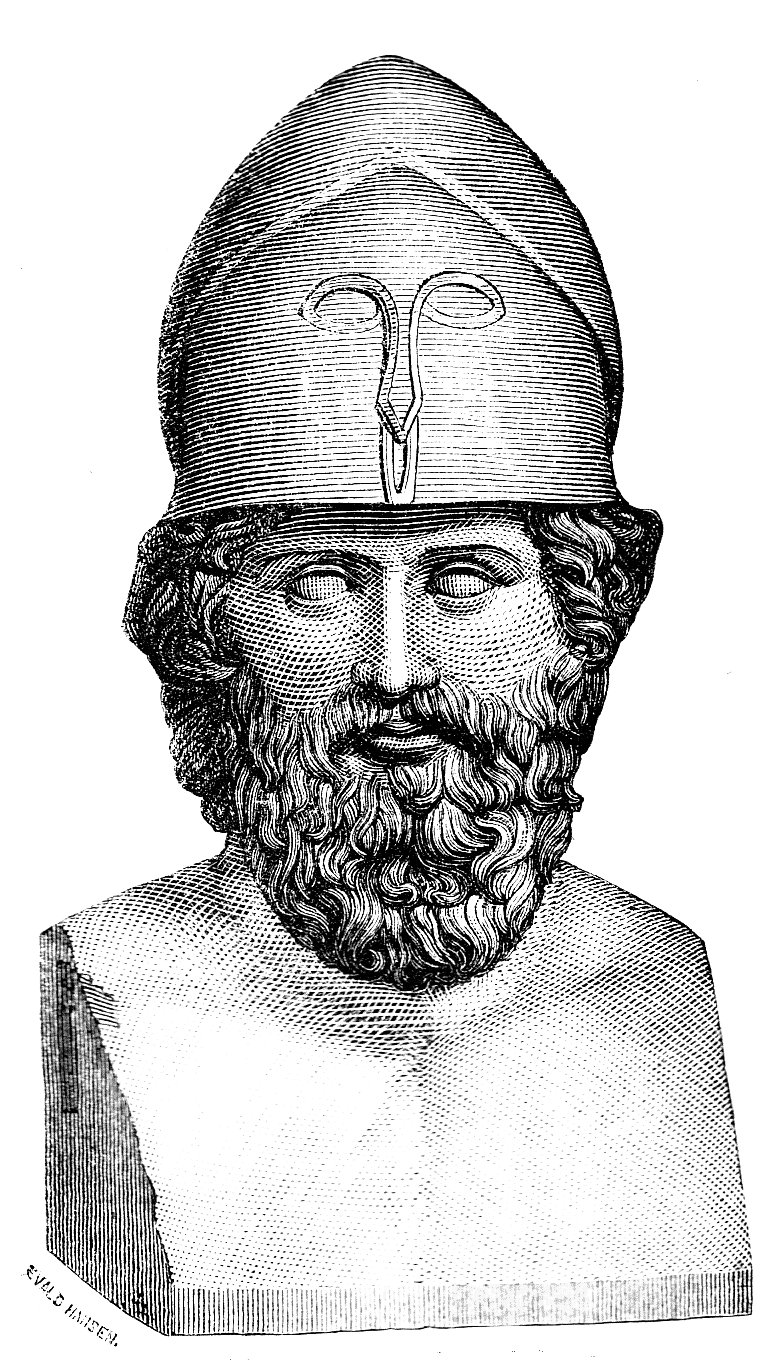
Themistocles
Athenian PoliticianWikipedia
719
MENTIONS
52
EPISODES
44
PODCASTS
Search complete. 719 mentions across 52 episodes found for "Themistocles".
Oct 17, 2026

speaker_3NARRATOR
Not, however, so much as they imagine.
speaker_3NARRATOR
I might answer them as Themistocles answered the Serphian who was abusing him and saying that he was famous, not for his own merits, but because he was an Athenian.
speaker_3NARRATOR
If you had been a native of my country or I of yours, neither of us would have been famous.
speaker_3NARRATOR
And to those who are not rich and are impatient of old age, the same reply may be made.

speaker_2NARRATOR
End footnote.
speaker_2NARRATOR
Themistocles.
speaker_2NARRATOR
Footnote.
speaker_2NARRATOR
Athenian statesman and general died 460 BC.

Kristen HandNARRATOR
As a result, Scipio, in order not to scatter his forces by laying siege to several towns, withdrew his army into winter quarters.
Kristen HandNARRATOR
Themistocles, when Xerxes was approaching, thinking the strength of the Athenians unequal to a land battle, to the defense of their territory, or to the support of a siege, advised them to remove their wives and children to Trozen and other towns, to abandon the city, and to transfer the scene of the war to the water.
Kristen HandNARRATOR
Pericles did the same thing in the same state in the war with the Spartans.
Kristen HandNARRATOR
While Hannibal was lingering in Italy, Scipio sent an army into Africa and so forced the Carthaginians to recall Hannibal.
1 HR 6 MINS LATER
Mark DiSanzoNARRATOR
In consequence, the Spartans became numerically equal to the barbarians, so far as opportunity for fighting was concerned, and being superior to them in valor, slew large numbers of them.
Mark DiSanzoNARRATOR
Nor would they have been overcome had not the enemy been led around to the rear by the traitor Ephialtes the Trachinian and thus been enabled to overwhelm them.
Mark DiSanzoNARRATOR
Themistocles, leader of the Athenians, saw that it was most advantageous for Greece to fight in the Straits of Salamis against the vast number of Xerxes' vessels, but he was unable to persuade his fellow Athenians of this.
Mark DiSanzoNARRATOR
He therefore employed a stratagem to make the barbarians force the Greeks to do what was advantageous for the latter.

Aaron ErberHOST
Like, in the eyes of...
Aaron ErberHOST
It's, like, Themistocles or something like that.
Marc AraminiGUEST
Yeah.
Aaron ErberHOST
And, um, and they're, they were saying like, "Oh, yeah, he'll be...

speaker_1NARRATOR
The other side has nothing to inspire it with courage except the weak urge of greed, which fades before danger and which can never be so keen, it seems to me, that it will not be dismayed by the least drop of blood from wounds.
speaker_1NARRATOR
Consider the justly famous battles of Miltiades, footnote, Athenian general, died 489 BC, some of his battles, expedition against Scythians, Lemnos, Imbros, Marathon, where Darius the Persian was defeated, end footnote, Leonidas, footnote, king of Sparta, died at Thermopylae in 480 BC, defending the pass with 300 loyal Spartans against Xerxes, end footnote, Themistocles, footnote, Athenian statesman and general, died 460 BC, some of his battles, expedition against Aegean Isles, victory over Persians under Xerxes at Salamis, end footnote.
speaker_1NARRATOR
Still fresh today in recorded history and in the minds of men as if they had occurred but yesterday, battles fought in Greece for the welfare of the Greeks and as an example to the world.
speaker_1NARRATOR
What power do you think gave to such a mere handful of men not the strength but the courage to withstand the attack of a fleet so vast that even the seas were burdened and to defeat the armies of so many nations, armies so immense that their officers alone outnumbered the entire Greek force? What was it but the fact that in those glorious days this struggle represented not so much a fight of Greeks against Persians as a victory of liberty over domination, of freedom over greed? It amazes us to hear accounts of the valor that liberty arouses in the hearts of those who defend it, but who could believe reports of what goes on every day among the inhabitants of some countries? Who could really believe that one man alone may mistreat a hundred thousand and deprive them of their liberty? Who would credit such a report if he merely heard it without being present to witness the event? And if this condition occurred only in distant lands and were reported to us, which one among us would not assume the tale to be imagined or invented and not really true? Obviously there is no need of fighting to overcome this single tyrant, for he is automatically defeated if the country refuses consent to its own enslavement.

Michael BoldinHOST
Now, Franklin kicked it off with a sharp contrast.
Michael BoldinHOST
First, it was the ancient Greek leader, Themistocles.
Michael BoldinHOST
I'm sure I'm pronouncing that wrong.
Michael BoldinHOST
This was a man who didn't waste any time on trivial things, trivial politics, what Franklin called fiddling, because he was too busy doing the hard work of building and expanding the society.
Michael BoldinHOST
That way you can actively provoke a rebellion, the one that you're pretending to prevent.
Michael BoldinHOST
He said, "Quarter troops among them, who by their insolence may provoke the rising of mobs, and by their bullets and bayonets suppress them.
Michael BoldinHOST
By this means, like the husband who uses his wife ill from suspicion, you may in time convert your suspicions into realities." Good leaders, and I know that's an oxymoron, but if you ever get them, they tend to, you know, make the people a little bit more loyal.
Michael BoldinHOST
So if you want to ruin your empire, make sure all the politicians, judges, bureaucrats, they're the worst of the worst, corrupt, incompetent, petty hacks at every level.

Anna SimonNARRATOR
But a ridiculous and childish fable of the belly and the rest of the members.
Anna SimonNARRATOR
And as good success had Themistocles in his of the fox and hedgehog.
Anna SimonNARRATOR
What wise man's oration could ever have done so much with the people as Sertorius' invention of his white hind? Or his ridiculous emblem of pulling off a horse's tail hair by hair? Or as Lycurgus his example of his two whelps? To say nothing of Minos and Numa, both of which ruled their foolish multitudes with fabulous inventions, with which kind of toys that great and powerful beast, the people, are led away.
Anna SimonNARRATOR
Again, what city ever received Plato's or Aristotle's laws, or Socrates' precepts? But, on the contrary, what made the Decii devote themselves to the infernal gods, or Q.

John BatchelorHOST
And who is given credit for winning that sea battle? And what happens to him?
Andrew BaylissGUEST
Well, the man who gets the credit from us for winning the sea battle is Themistocles, but the man who's the Athenian admiral, because the Athenians contributed two-thirds of the Greek fleet, but the man who actually technically won the battle is a Spartan admiral named Eurybiades.
Andrew BaylissGUEST
And the Spartans, who were not normally... very good at giving credit to others, actually made it clear how much they accepted that Themistocles was really responsible for that victory because they invited him to Sparta and they gave him a fine chariot and an official escort back out of Sparta by the 300 hippies who were normally the bodyguard of the king.
Andrew BaylissGUEST
So they really showed that they accepted that while they technically were in charge, the Athenians had really won the sea battle.
John BatchelorHOST
The Persians were an overwhelming force, outnumbered everybody.

Michael JacoGUEST
So crazy.
Michael JacoGUEST
So his fleet is defeated by Themistocles.
Michael JacoGUEST
Themistocles, like I said, was a parallel life that I was leading.
Michael JacoGUEST
So you would have to defeat their fleet, which we did, and they had a huge fleet.
Michael JacoGUEST
But the Athenians, the Greek fleet, you know, had that battering ram, that ram, and it had metal underneath the water.
9 MINS LATER
Michael JacoGUEST
Uh, and that would happen, you know, throughout time as well.
Michael JacoGUEST
Some people like Hercules, uh, Were related and so forth to the Spartans and that's that's why they became very successful You know warriors and so forth so Spartans were the best warriors at the time for a long time So that's that's one of the things that was happening there.
Michael JacoGUEST
So let's look at some other other So I talked about the mysticles as being the let me show you the mysticles and So there's busts of Themistocles and there's similarities there as well in the physicality.

EricGUEST
Notice the, the Themistoclean wall.
EricGUEST
There was a guy named Themistocles that, uh, after the Persian Wars, he decided he'd build a wall around the city to protect it.
EricGUEST
Why am I bringing up the wall? Did you know of the 50 places Paul went, over half of them were cities.
EricGUEST
Paul was an urban evangelist.
42 more episodes mention Themistocles.
Create an account to see the whole feed, search across every transcript, and follow the entities you care about.