Theia
79
MENTIONS
31
EPISODES
25
PODCASTS
Search complete. 79 mentions across 31 episodes found for "Theia".
Sep 17, 2026

Andrew DunkleyHOST
Yeah.
Fred WatsonGUEST
Perhaps, uh, there was a similar formation event to the event that formed our moon when, uh, Theia, the object size of Mars, clouted the Earth in the early history of the solar system, and eventually that coalesced to form the moon.
Fred WatsonGUEST
Uh, which by the way, I, I read a headline not very long ago that looks as though that formation of the moon from that debris cloud might have happened very, very quickly, and I can't remember how [chuckles] quickly it was, but it was-
Andrew DunkleyHOST
Yeah.
7 MINS LATER
Andrew DunkleyHOST
Yeah, and it sort of harps back to a story from a few weeks ago about, uh, how they do think they have found continental-sized, um, anomalies, but, you know, deep in our crust that suggest-
Fred WatsonGUEST
Yes
Andrew DunkleyHOST
... parts of Theia exist.
Fred WatsonGUEST
Might be parts of Theia, that's right.

Andrew DunkleyHOST
Yeah.
Fred WatsonGUEST
Perhaps, uh, there was a similar formation event to the event that formed our moon when, uh, Theia, the object size of Mars, clouted the Earth in the early history of the solar system, and eventually that coalesced to form the moon.
Fred WatsonGUEST
Uh, which by the way, I, I read a headline not very long ago that looks as though that formation of the moon from that debris cloud might have happened very, very quickly, and I can't remember how [chuckles] quickly it was, but it was-
Andrew DunkleyHOST
Yeah.
7 MINS LATER
Andrew DunkleyHOST
And it sort of harps back to a story from a few weeks ago about, uh, how they do think they have found continental-sized, um, anomalies, but, you know, deep in our crust that suggest-
Fred WatsonGUEST
Yes
Andrew DunkleyHOST
... parts of Theia exist.
Fred WatsonGUEST
Might be parts of Theia.
speaker_0HOST
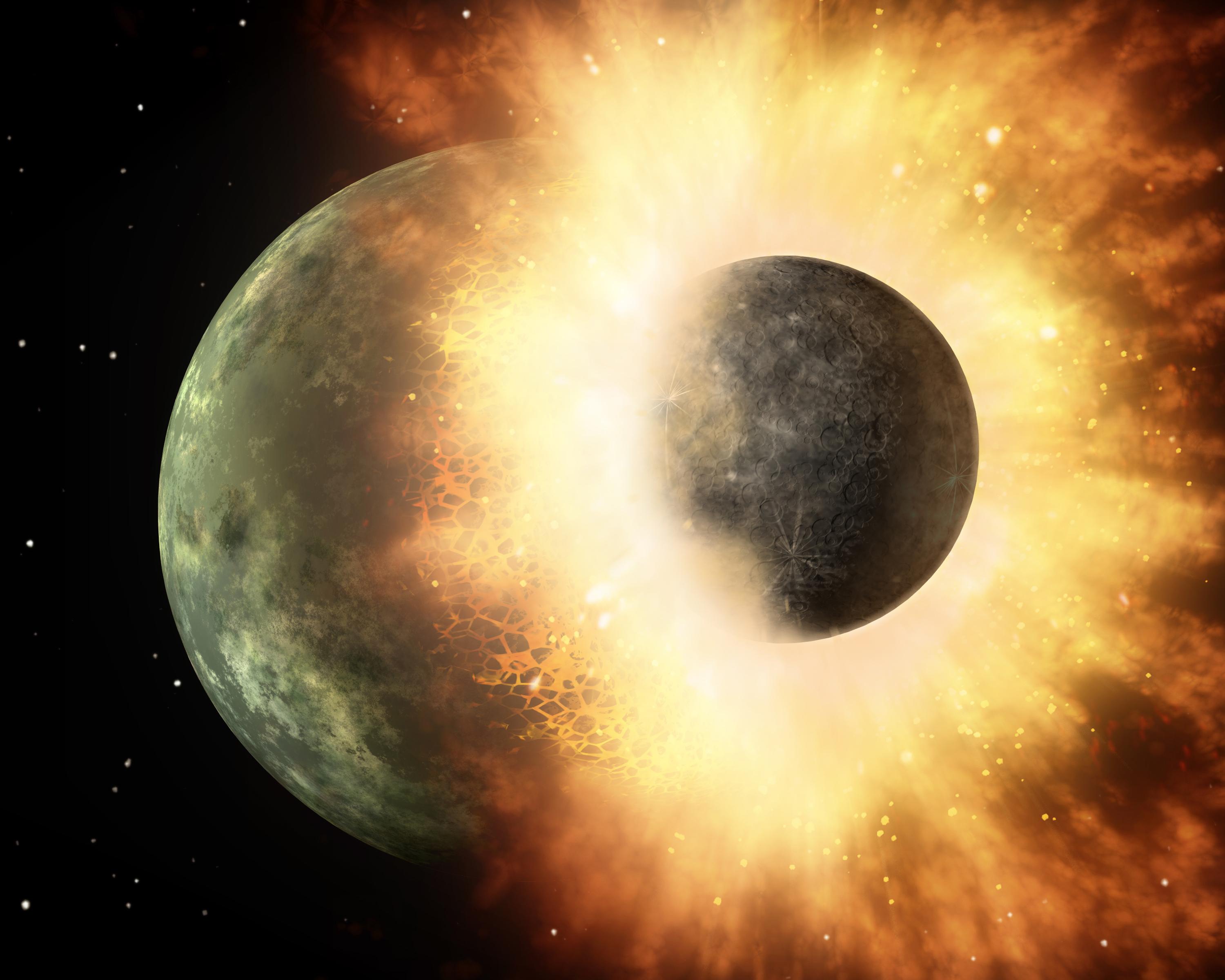
The object that hit the young Earth was very large, not a small asteroid or a stray chunk of rock, but something roughly the size of a small planet, perhaps as large as the planet Mars.
speaker_0HOST
Scientists have given this hypothetical impactor a name, Theia, after the Greek goddess who was the mother of Selene, the goddess of the moon.
speaker_0HOST
The collision between Theia and the early Earth was enormous, one of the most violent events in the history of our planet, releasing more energy than anything we can easily imagine.
speaker_0HOST
It sent molten rock into orbit around the Earth, a ring of superheated debris that glowed with the heat of the impact.
speaker_0HOST
Over time, perhaps over the course of just a few years or decades, this material clumped together, cooling as it merged until it formed a solid body.
speaker_0HOST
It cooled and became the Moon.
speaker_0HOST
So our moon came from the Earth itself, at least in part.
speaker_0HOST
It is made of material from both bodies, from the shattered remains of Theia and from the outer layers of the young Earth, blended together by the heat and violence of the collision.

speaker_3NARRATOR
One of the greatest events in Earth's story may have happened when a wandering world hit the young planet.
speaker_3NARRATOR
Scientists often call this object Theia, though no one saw it and nothing of it remains in its original form.
speaker_3NARRATOR
The impact was so immense that part of Earth's outer layers was blasted into orbit.
speaker_3NARRATOR
That debris formed a ring around the planet.

Antonio PriscoPANELIST
That's weird that that could just happen.
Frank AlvarezHOST
A proto-planet called Theia.
Antonio PriscoPANELIST
Yeah, I saw that.
Frank AlvarezHOST
Ooh.

AveryHOST
Cagan Denton and Robin Canup at the Southwest Research Institute with Erik Asphaug in Arizona in Astrophysical Journal Letters.
AveryHOST
The canonical story is a Mars-sized body called Theia hitting the proto-Earth, throwing a disc of debris into orbit, and the moon slowly accreting out of it.
AveryHOST
What this group added was something nobody had properly included, rock strength that changes with temperature.
AnnaHOST
Because previous simulations treated the rock as a fluid.
AveryHOST
The collision directly produces a single intact satellite in about five hours.
AveryHOST
Not always.
AveryHOST
A hot young Theia under 60 million years old gives the immediate moon.
AveryHOST
A cooler, older one gives the classical slow disc.
AveryHOST
Kagan Denton and Robin Canup at the Southwest Research Institute with Erik Asphaug in Arizona in Astrophysical Journal Letters.
AveryHOST
The canonical story is a Mars-sized body called Theia hitting the proto-Earth, throwing a disk of debris into orbit, and the moon slowly accreting out of it.
AveryHOST
What this group added was something nobody had properly included, rock strength that changes with temperature
AnnaHOST
Because previous simulations treated the rock as a fluid
AveryHOST
The collision directly produces a single intact satellite in about five hours.
AveryHOST
Not always.
AveryHOST
A hot young Theia under 60 million years old gives the immediate moon.
AveryHOST
A cooler, older one gives the classical slow disk

PeterHOST
As this hellscape settled, gravity would do its work, and this cloud of hot material would pull together to form a completely new planet.
PeterHOST
This is how we think the Moon formed billions of years ago, when Earth was hit by a Mars-sized object named Theia.
PeterHOST
That impact was so powerful that it launched massive globs of molten material out into space, some of which fell back to Earth, and some of which came together to form the Moon.
PeterHOST
But in this case, a direct collision with a similar-sized planet? Earth would be no more.

speaker_3NARRATOR
The object that hit the young Earth was very large, not a small asteroid or a stray chunk of rock, but something roughly the size of a small planet, perhaps as large as the planet Mars.
speaker_3NARRATOR
Scientists have given this hypothetical impactor a name, Theia, after the Greek goddess who was the mother of Selene, the goddess of the moon.
speaker_3NARRATOR
The collision between Theia and the early Earth was enormous, one of the most violent events in the history of our planet, releasing more energy than anything we can easily imagine.
speaker_3NARRATOR
It sent molten rock into orbit around the Earth, a ring of superheated debris that glowed with the heat of the impact.
speaker_3NARRATOR
Over time, perhaps over the course of just a few years or decades, this material clumped together, cooling as it merged until it formed a solid body.
speaker_3NARRATOR
It cooled and became the moon.
speaker_3NARRATOR
So our moon came from the earth itself, at least in part.
speaker_3NARRATOR
It is made of material from both bodies, from the shattered remains of Theia and from the outer layers of the young earth.

John GreenHOST
No, we got a real weird inside probably because we got hit by a Mars-shaped and sized thing early in our history, and it still- Wow ... makes it weird in there.
John GreenHOST
We've still got like hunks of Theia hanging out inside of our mantle.
John GreenHOST
That's very metaphorically resonant.
John GreenHOST
Is it? It is, yeah.
21 more episodes mention Theia.
Create an account to see the whole feed, search across every transcript, and follow the entities you care about.