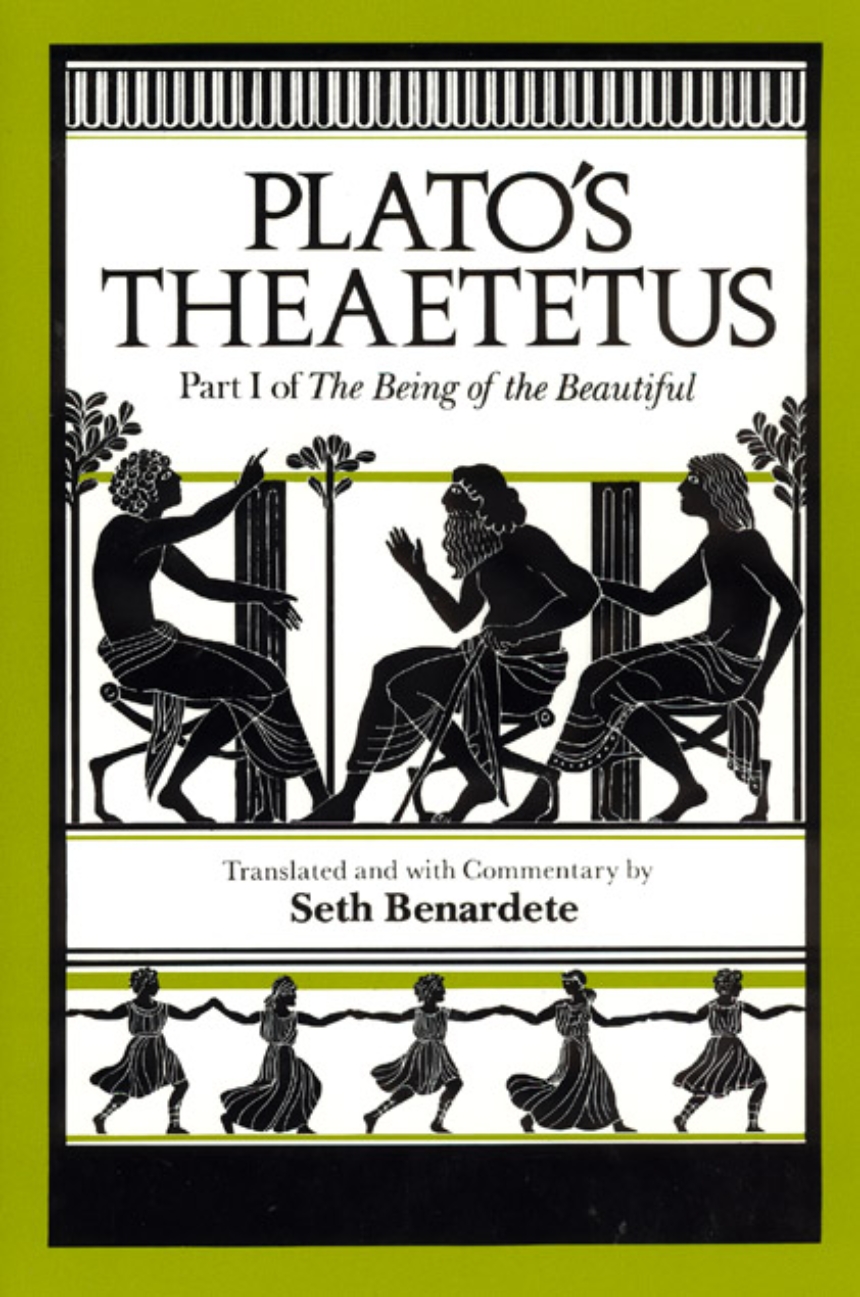
Theaetetus
Book by PlatoWikipedia
68
MENTIONS
19
EPISODES
18
PODCASTS
Search complete. 68 mentions across 19 episodes found for "Theaetetus".
Oct 10, 2026

speaker_6NARRATOR
Protagoras, we are there told, taught that man is the measure of all things, of the existence of things that are, and of the non-existence of things that are not.
speaker_6NARRATOR
you have read him asks socrates addressing the thetis oh yes again and again is the thetis reply plato was entirely opposed to the doctrine that protagoras taught it seemed to him to bring gods and men and tadpoles to one level as far as truth was concerned for he drew the deduction that if man is the measure of all things then to each man his own opinion is right plato opposed to it the theory that truth is the vision of a pure objective reality the same problem that exercised the ancient world is now again a chief centre of philosophical interest and the aim of this little book is not to decide that question but to serve as a guide and introduction to those who desire to know what the question is that divides philosophers to-day into the hostile camps of pragmatism and intellectualism the subject is not likely to interest anyone who does not care for the study of the exact definitions and abstract principles that lie at the basis of science and philosophy There are many who are engaged in the study of the physical and natural sciences, and also many who devote themselves to the social and political sciences, who hold in profound contempt the fine distinctions and intellectual subtleties that seem to them the whole content of logic and metaphysic.
speaker_6NARRATOR
The attitude of the scientific mind is not difficult to understand.
speaker_6NARRATOR
it has recently been rather graphically expressed by a distinguished and popular exponent of the principles of natural science one may regard the utmost possibilities of the results of human knowledge as the contents of a bracket and place outside the bracket the factor x to represent those unknown and unknowable possibilities which the imagination of man is never wearied of suggesting this factor x is the plaything of the metaphysician this mathematical symbol of the bracket multiplied by x to represent the unknown and unknowable possibilities beyond it will serve me to indicate with some exactness the problem with which i am going to deal the symbol is an expression of the agnostic position the popular caricature of the metaphysician and his plaything we may disregard as a pure fiction the unknowable x of the agnostic is not the meta or beyond of physics which the metaphysician vainly seeks to know the only beyond of physics is consciousness or experience itself and this is the subject matter of metaphysics our present problem is that of the bracket not that of the factor outside if there is any such factor nor yet the particular nature of the contents within there are as we shall see three views that are possible of the nature of the bracket in one view it is merely the conception of the extent which knowledge has attained or can attain it has no intimate relation to the knowledge but marks externally its limit this is the view of the realist in another view the whole of knowledge is intimately related to its particular parts the things we know are not a mere collection or aggregate of independent facts that we have discovered the bracket which contains our knowledge gives form to it and relates organically the dependent parts to the whole in one comprehensive individual system this is the view of the idealist there is yet another view human knowledge is relative to human activity and its needs the bracket is the ever-changing limit of that activity within it is all that is relevant to human purpose and personality without it is all that is irrelevant this is the view of the pragmatist it is not only the scientific mind but also the ethical and religious mind that is likely to be at least impatient if not contemptuous of this inquiry the question what is truth will probably bring to everyone's mind the words uttered by a roman procurator at the supreme moment of a great world tragedy pilot's question is usually interpreted as the cynical jest of a judge indifferent to the significance of the great cause he was trying the expression of the belief that there is no revelation of spiritual truth of the highest importance for our human nature or at least that there is no infallible test by which it can be known it is not this problem of truth that we are now to discuss there are on the other hand many minds that can never rest satisfied while they have accepted only and not examined the assumptions of science and the values of social and political and religious ideals their quest of first principles may appear to more practical natures a harmless amusement or a useless waste of intellectual energy but they are responding to a deep need of our human nature a need that it may be is in its very nature insatiable the need of intellectual satisfaction it is the nature of this intellectual satisfaction itself that is our problem of truth there are therefore two attitudes towards the problem of truth and reality that of the mind which brings a practical test to every question and that of the mind restless to gain by insight or by speculation a clue to the mystery that enshrouds the meaning of existence the first attitude seems peculiarly to characterize the man of science who delights to think that the problem of reality is simple and open to the meanest understanding between the plain man's view and that of the man of high attainment in scientific research there is for him only a difference of degree and science seems almost to require an apology if it does not directly enlarge our command over nature it would explain life and consciousness as the result of chemical combination of material elements philosophy on the other hand is the instinctive feeling that the secret of the universe is not open and revealed to the plain man guided by common sense experience alone even if to this experience be added the highest attainments of scientific research either there is far more in matter than is contained in the three-dimensional space it occupies or else the universe must owe its development to something beyond matter the universe must seem a poor thing indeed to a man who can think that physical science does or can lay bare its meaning it is the intense desire to catch some glimpse of its meaning that leads the philosopher to strive to transcend the actual world by following the speculative bent of the reasoning power that his intellectual nature makes possible chapter one

LennieNARRATOR
The soul is prior to the body, thirty-four C, the intelligible and unseen to the visible and corporeal, twenty-eight.
LennieNARRATOR
There is the same distinction between knowledge and opinion, thirty-seven C, which occurs in the Theaetetus and Republic, the same enmity to the poets, nineteen D, the same combination of music and gymnastics, eighty-eight C.
LennieNARRATOR
The doctrine of transmigration is still held by him, ninety E and the following, as in the Phaedrus and Republic.
LennieNARRATOR
And the soul has a view of the heavens in a prior state of being, 41e.

Chiquito CrastoNARRATOR
There is another sort of progress from the general notions of Socrates who ask simply, what is friendship? What is temperance? What is courage? As in the Lysis, Charmides, Laches, to the transcendentalism of Plato, who in the second stage of his philosophy sought to find the nature of knowledge in a prior and future state of existence.
Chiquito CrastoNARRATOR
The difficulty in framing general notions which has appeared in this and in all the previous dialogues recurs in the Gorgias and the Theaetetus.
Chiquito CrastoNARRATOR
as well as in the Republic.
Chiquito CrastoNARRATOR
In the Gorgias, too, the statesmen reappear, but in stronger opposition to the philosopher.
Chiquito CrastoNARRATOR
In the Republic, the relation of knowledge to virtue is described in a manner more consistent with modern distinctions.
Chiquito CrastoNARRATOR
The existence of the virtues without the possession of knowledge in the higher or philosophical sense is admitted to be possible.
Chiquito CrastoNARRATOR
Right opinion is again introduced in the Theaetetus as an account of knowledge, but is rejected on the ground that it is irrational, as here, because it is not bound by the tie of the cause, and also because the conception of false opinion is given up as hopeless.
Chiquito CrastoNARRATOR
The doctrines of Plato are necessarily different at different times of his life, as new distinctions are realized or new stages of thought attained by him.

LeniNARRATOR
The soul is prior to the body, thirty-four C, the intelligible and unseen to the visible and corporeal, twenty-eight.
LeniNARRATOR
There is the same distinction between knowledge and opinion, thirty-seven C, which occurs in the Theaetetus and Republic.
LeniNARRATOR
The same enmity to the poets, 19d, the same combination of music and gymnastics, 88c.
LeniNARRATOR
The doctrine of transmigration is still held by him, 90e and the following, as in the Phaedrus and Republic, and the soul has a view of the heavens in a prior state of being, 41e.
3 HRS 45 MINS LATER
Patti CunninghamNARRATOR
Compare Aristotle Metaphysics I, four comma nine.
Patti CunninghamNARRATOR
But though in these respects he differs from them, he is deeply penetrated by the spirit of their philosophy.
Patti CunninghamNARRATOR
He differs from them with reluctance and gladly recognizes the generous depth of the Parmenides, Theaetetus 183e.
Patti CunninghamNARRATOR
There is a similarity between the Timaeus and the fragments of Philolaus, which by some has been thought to be so great as to create a suspicion that they are derived from it.

LennyNARRATOR
The soul is prior to the body, 34c, the intelligible and unseen to the visible and corporeal, 28.
LennyNARRATOR
There is the same distinction between knowledge and opinion, 37c, which occurs in the Theaetetus and Republic, the same enmity to the poets, 19d, the same combination of music and gymnastics, 88c.
LennyNARRATOR
The doctrine of transmigration is still held by him, 90e and the following, as in the Phaedrus and Republic, and the soul has a view of the heavens in a prior state of being, 41e.
LennyNARRATOR
The ideas also remain, but they have become types in nature, forms of men, animals, birds, fishes, 39e.
3 HRS 42 MINS LATER
Patty CunninghamNARRATOR
Compare Aristotle Metaphysics I, four, comma, nine.
Patty CunninghamNARRATOR
But though in these respects he differs from them, he is deeply penetrated by the spirit of their philosophy.
Patty CunninghamNARRATOR
He differs from them with reluctance and gladly recognizes the generous depth of the Parmenides, Theaetetus, one-eighty-three, E. There's a similarity between the Timaeus and the fragments of Philolaus, which by some has been thought to be so great as to create a suspicion that they are derived from it.
Patty CunninghamNARRATOR
Philolaus is known to us from the Phaedo of Plato as a Pythagorean philosopher residing at Thebes in the latter half of the fifth century BC, after the dispersion of the original Pythagorean society.

speaker_4NARRATOR
He had the misfortune, common at that time, to offend the religious Athenians; for he spoke slightingly of the gods, proposing to "banish their existence or non-existence from writing and speech." He was convicted of atheism, and his books were publicly burnt, and he himself, then seventy years of age, was either banished or at least was obliged to flee from Athens, and on his way to Sicily he lost his life in a shipwreck.
speaker_4NARRATOR
Our knowledge of this book of Protagoras is due to the preservation of its argument by Plato in the dialogue Theaetetus.
speaker_4NARRATOR
Protagoras, we are there told, taught that "man is the measure of all things, of the existence of things that are, and of the non-existence of things that are not." "You have read him?" asks Socrates, addressing Theaetetus.
speaker_4NARRATOR
"Oh, yes, again and again," is Theaetetus's reply.
speaker_4NARRATOR
Plato was entirely opposed to the doctrine that Protagoras taught.
speaker_4NARRATOR
It seemed to him to bring gods and men and tadpoles to one level as far as truth was concerned.
2 HRS 26 MINS LATER
Kyle StrandNARRATOR
Chapter 8 of The Problem of Truth This is a LibriVox recording.
Kyle StrandNARRATOR
All LibriVox recordings are in the public domain.

speaker_0NARRATOR
He had the misfortune, common at that time, to offend the religious Athenians, for he spoke slightingly of the gods, proposing to "banish their existence or non-existence from writing and speech." He was convicted of atheism, and his books were publicly burnt; and he himself, then seventy years of age, was either banished or at least was obliged to flee from Athens, and on his way to Sicily he lost his life in a shipwreck.
speaker_0NARRATOR
Our knowledge of this book of Protagoras is due to the preservation of its argument by Plato in the dialogue Theaetetus.
speaker_0NARRATOR
Protagoras, we are there told, taught that "man is the measure of all things, of the existence of things that are, and of the non-existence of things that are not." "You have read him?" asks Socrates, addressing Theaetetus.
speaker_0NARRATOR
"Oh yes, again and again," is Theaetetus's reply.

Doug CampbellHOST
I'm Doug Campbell, an assistant professor in the Department of Philosophy at Alma College in Michigan, and I'm also the host of the Ancient Philosophy Podcast, which is the podcast that explores important topics in the history of ancient philosophy, whether that's in Greece or Rome or India or China or the Near East or beyond.
Doug CampbellHOST
And in today's episode, I have the pleasure of speaking with Ermioni Prokopaki about the one of Plato's most famous and important and fun dialogues, the Theaetetus.
Doug CampbellHOST
It also happens to be incredibly complicated, so I'm very thankful to have Hermione walking us through this, especially because this is an area on which she is an expert.
Doug CampbellHOST
She completed her PhD in 2023 at the University of Chicago, and she recently published a paper on Theaetetus, the Thea Titus.
Doug CampbellHOST
This is her paper that appeared recently in Aperon entitled Understanding Why the Dream Theory, which appears at Thea Titus 201D to 202C, is objectionable.
Doug CampbellHOST
And we talk about the dream theory in this episode.
Doug CampbellHOST
So we have Hermione, you know, talking about her bread and butter issue, the things that she is supremely knowledgeable at, And we benefit from her expertise in this episode.
Doug CampbellHOST
So we are really, you know, circling around this question about, you know, what is knowledge? And we're going to see like that involves other questions like what is perception? What sort of things do we have to be in order to know things? And what does the world have to be like in order to know things? You know, Armioni walks us through some of the questions here, but just to give you some knowledge right before we enter into the interview.

LennyNARRATOR
The soul is prior to the body, 34c, the intelligible and unseen to the visible and corporeal, 28.
LennyNARRATOR
There is the same distinction between knowledge and opinion, 37c, which occurs in the Theaetetus and Republic, the same enmity to the poets, 19d, the same combination of music and gymnastics, 88c.
LennyNARRATOR
The doctrine of transmigration is still held by him, 90e and the following, as in the Phaedrus and Republic, and the soul has a view of the heavens in a prior state of being, 41e.
LennyNARRATOR
The ideas also remain, but they have become types in nature, forms of men, animals, birds, fishes, 39e.
3 HRS 42 MINS LATER
Patty CunninghamNARRATOR
Compare Aristotle Metaphysics I, 4, 9.
Patty CunninghamNARRATOR
But though in these respects he differs from them, he is deeply penetrated by the spirit of their philosophy.
Patty CunninghamNARRATOR
He differs from them with reluctance and gladly recognizes the generous depth of the Parmenides, Theaetetus 183e.
Patty CunninghamNARRATOR
There is a similarity between the Timaeus and the fragments of Philolus, which by some has been thought to be so great as to create a suspicion that they are derived from it.
9 more episodes mention Theaetetus.
Create an account to see the whole feed, search across every transcript, and follow the entities you care about.