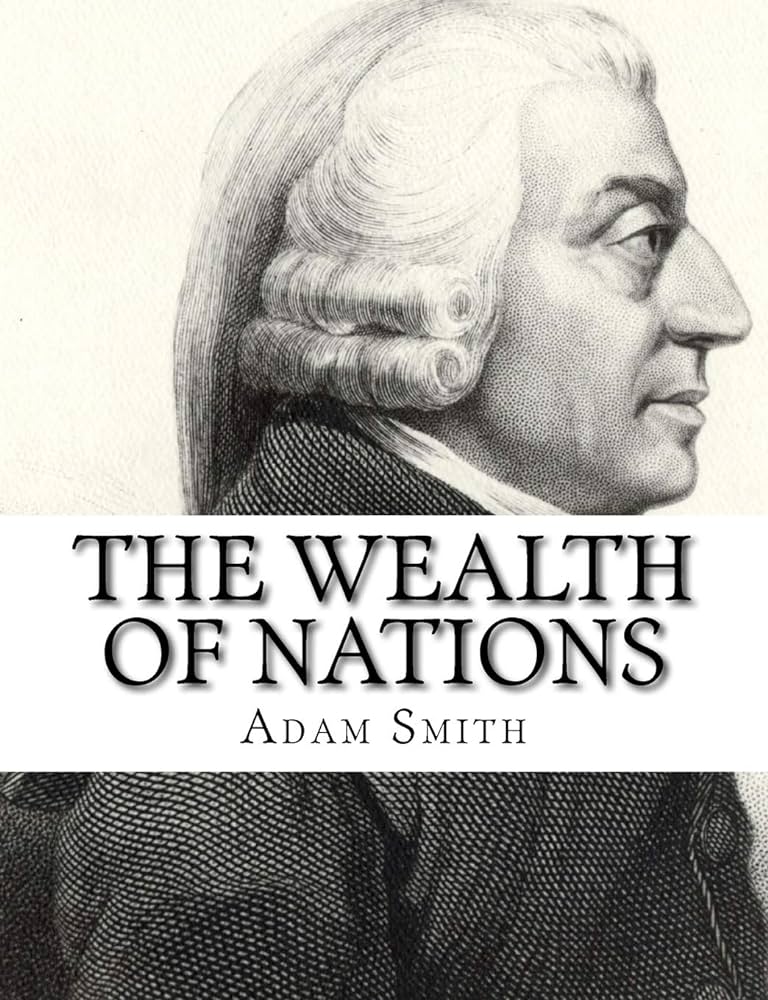
The Wealth of Nations
Book by Adam SmithWikipedia
226
MENTIONS
97
EPISODES
91
PODCASTS
Search complete. 226 mentions across 97 episodes found for "The Wealth of Nations".
Oct 30, 2026

Ravi ChaudhryGUEST
There are forces at work on that and I'll explain how they are impacting it.
Ravi ChaudhryGUEST
So the proposition I see emerging and which I have dealt with at length in my book brings home the message that this the rulers in politics and leaders in business have to do not for philanthropy.
Ravi ChaudhryGUEST
It has become essential for their survival.
Ravi ChaudhryGUEST
If they want to stay in power, they can change instantaneously.
Daniela BomatterHOST
But I hear you say that you think it's also not sustainable for the people in power.
Ravi ChaudhryGUEST
It's no longer sustainable, people in power, because I often refer to Aldous Huxley's Brave New World and George Orwell's 1984.
Ravi ChaudhryGUEST
They wrote these books, which was a dystopia.
Ravi ChaudhryGUEST
But they wrote it, not that they expected it to come.

Sean O'TooleGUEST
It's, you know, I got all my American genre here.
Sean O'TooleGUEST
1776 was actually the year that Adam Smith published the book, The Wealth of Nations.
Sean O'TooleGUEST
So we had our revolution because during that late part of the enlightenment around the world, human beings started to realize that they could create wealth.
Sean O'TooleGUEST
And so the book was kind of, I won't call it the Bible, but it was a guide to economics and how to price real estate, how to price goods, how to price commodities.
Sean O'TooleGUEST
Don't give them access to their land.
Sean O'TooleGUEST
So our movement is 1776-ing, very U.S. forward, very capitalistic forward.
Sean O'TooleGUEST
The number is really about Adam Smith and the wealth of nations.
Sean O'TooleGUEST
But without that, I don't think the U.S. would have had the understanding of what King George was doing when he was taking away their property rights.

David TizzardGUEST
Even the professors are struggling to explain why it's popular because, for example, A professor will be explaining Jane Austen's Emma.
David TizzardGUEST
They will segue into Adam Smith, Wealth of Nations, take a diversion through Immanuel Kant's Enlightenment.
David TizzardGUEST
And you think, why would people want to be doing this? But they do.
David TizzardGUEST
Freshman year.

Vance GinnHOST
I mean, this does go back to Adam Smith, which I have his book right over here behind me on my bookshelf.
Vance GinnHOST
But Which one? The Wealth of Nations.
Vance GinnHOST
I also have the Theory of Moral Sentiments.
Vance GinnHOST
There's also

Maria GarciaHOST
And it's also in the late 1700s when the Bible of Modern Capitalism is published.
Maria GarciaHOST
A book called The Wealth of Nations.
Maria GarciaHOST
And this is important because when capitalism takes hold of European society, there's a further repression of sex because capitalism benefits from a nuclear family as that's a main way to create a stable, compliant labor force.
Maria GarciaHOST
And so capitalism further incentivizes the hetero family by setting up systems, industries, employers that only validate supposed traditional families.

NobodyHOST
And so basically I'd argue with them about economics.
NobodyHOST
They were always quoting the wealth of nations to me.
NobodyHOST
And finally I was like, I'm going to read this book and debunk it.
NobodyHOST
And so I did, and to my astonishment, it debunked me.

Dominic PinoGUEST
And so you just read the whole book and you read the whole book and you – and talk about it and it's really great.
Dominic PinoGUEST
And when you get to the end of it, like Don says, like you're in like the 99th percentile of economists for having actually read The Wealth of Nations because very few – Very few have read it all.
Dominic PinoGUEST
And Don is probably number one because he's read it 15 times at this point because he teaches this class every year.
Kevin WilliamsonHOST
Yeah, I never had a chance to sit down in one of his classes, but he's always struck me as someone who was probably just a wonderful professor.

James EllisHOST
The system is designed to be extractive and that's the nature of capitalism.
James EllisHOST
I think if you, I'm in the process of rereading Wealth of Nations because I like to go back to the source material every once in a while.
James EllisHOST
And even Adam Smith is talking about how the role of the state is to ameliorate some of these failures.
James EllisHOST
The market is not infinitely wise, despite what everybody wants to say.

GoldyHOST
And this is not some radical lefty assertion.
GoldyHOST
This is right there in Adam Smith's Wealth of Nations.
GoldyHOST
He points this out, that employers inherently have more power than their employees because, you know, they can last out a strike.
GoldyHOST
Because they're not going to have a problem putting food on their table or paying their rent.

Christopher MarquisGUEST
I mean, I think that, you know, it's a sort of mindset of extraction a lot of times and short-term benefit as opposed to sort of long-term, you know, co-equal mutual benefits.
Christopher MarquisGUEST
You know, Adam Smith, in addition to writing, you know, The Wealth of Nations, another book he wrote was a sort of a theory of moral sentiments where he actually talks about the importance of of trust and fostering community around economy.
Christopher MarquisGUEST
I think that you look back in US history and there used to be a much deeper engagement between the local environment and the businesses, and that's really been broken now.
Brian LehrerHOST
We're starting to run out of time on how you fix this.
87 more episodes mention The Wealth of Nations.
Create an account to see the whole feed, search across every transcript, and follow the entities you care about.