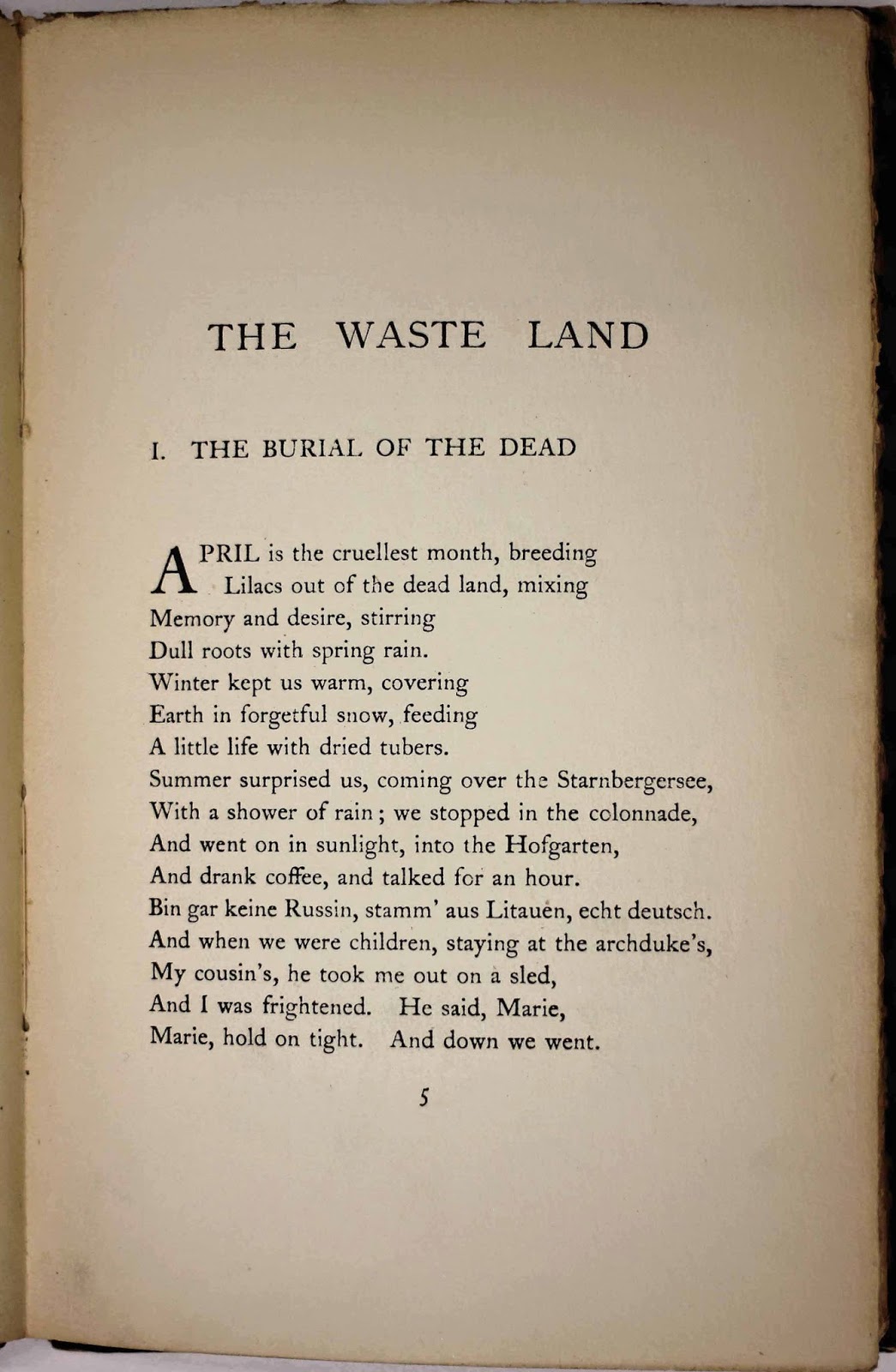
The Waste Land
Poem by T. S. EliotWikipedia
31
MENTIONS
20
EPISODES
19
PODCASTS
Search complete. 31 mentions across 20 episodes found for "The Waste Land".
Sep 13, 2026

Annarose SteinkeGUEST
So you can see, for example, with Eliot, he didn't just suddenly, you know, turn away from the faith of his childhood.
Annarose SteinkeGUEST
His grandfather was a minister when he was writing The Wasteland and then just suddenly shift into something entirely different into this Christian poet.
Annarose SteinkeGUEST
just overnight when he started writing things like Ash Wednesday and Four Quartets.
Annarose SteinkeGUEST
You can really see, and a lot of other scholars have written about this too, some of whom I cite in the book, that there was this real development over time and it started with everything he was reading, even as far back as his undergraduate days majoring in philosophy at Harvard.

Ben CardallHOST
The technique went quiet for a long stretch and then came back came roaring back with the modernists.
Ben CardallHOST
There was Ezra Pound's Kantos, T.S. Eliot's The Wasteland.
Ben CardallHOST
They both lean on exactly this kind of instinct.
Ben CardallHOST
It's just other voices stitched rather than invented.

John DanversHOST
We can trace many of these currents of thought and sensibility in the work of Ezra Pound, particularly as elucidated by Hugh Kenner in his seminal book titled The Pound Era.
John DanversHOST
Writing about T.S. Eliot's The Wasteland, James Joyce's Ulysses, and Ezra Pound's long sequence of poems The Cantos, early iconic modernist works, Kenner suggests that the province of these works is the entire human race speaking in time as well as space.
John DanversHOST
and he notes the borrowings from Greek, Latin, Chinese, Italian, French, Provençal, Spanish, Arabic and Egyptian hieroglyphic languages.
John DanversHOST
He describes Pound's mind as acting as a conduit and a meeting place, a watering hole for long-dead scholar monks and parched troubadours.

Matthew RuberyGUEST
And I think the e-book has evolved.
Matthew RuberyGUEST
So I remember even as long as 10 years ago, there was an early publication of T.S. Eliot's famous poem, The Wasteland.
Matthew RuberyGUEST
Instead of just giving us the poem itself, you could also look at the original manuscripts, or you could hear a recording of T.S. Eliot reading it, or you could watch a video of an Irish actress performing the poem.
Matthew RuberyGUEST
So I think e-books are starting to experiment, and will continue to experiment more and more with, what can electronic formats do that printed books can't?

Dan ScottGUEST
So I have my favorites, um- I'll throw a, a couple things that have really impacted me and stayed with me.
Dan ScottGUEST
Um, I have had a, a long-term relationship with, uh, T.S. Eliot and The Waste Land.
Margot TantowHOST
Nice.
Dan ScottGUEST
Um, I wrote a whole play, uh, uh, thing called, uh, American Pastime around that, which was a-

Sarah HolperHOST
If you're really after green skin, I'm afraid you're going to have to resort to cosmetics.
Sarah HolperHOST
In the 1920s, the poet T.S. Eliot inexplicably started wearing green face powder after the release of his somber poem, The Wasteland.
Sarah HolperHOST
He never disclosed why, but one theory was a desire to look interesting and cadaverous, mirroring the alienated, hollow tone of his poem.
Sarah HolperHOST
Blue skin is much easier to procure than green.

Malcolm GuiteGUEST
Then there was the pandemic flu and the sense of all the old certainties and art responded with terror.
Malcolm GuiteGUEST
you know, Picasso and poetry responded with T.S. Eliot and particularly with a poem called The Wasteland, which he writes these fragments of short against my ruin.
Malcolm GuiteGUEST
Now, during that difficult period after the First World War, before the second, Eliot wrote an essay in which he said, in order to be good and adequate to the moment, poetry is going to have to be difficult.
Malcolm GuiteGUEST
And he was right for that time and place.

Gary ButterfieldHOST
Yeah.
Kay RothHOST
Um, you know, opens with shots of, like, you know, the wasteland and things from Ca- Fallout one and two, uh, cut scenes and stuff.
Gary ButterfieldHOST
Mm-hmm.
Kay RothHOST
Uh, along with a passage from the very good T.S. Eliot poem, The Wasteland.
Gary ButterfieldHOST
Yeah.
Kay RothHOST
Um-
Kay RothHOST
No.
Gary ButterfieldHOST
Uh, complete total mismatch.

Samuel D. HunterGUEST
And I remember pulling out the liner and reading all these Allen Ginsberg poems and just being like, what is this? And so then I sought out Ginsberg at the local library and really fell in love with him.
Samuel D. HunterGUEST
And then I remember our English teacher in, I think this was 10th grade, she read selections from The Wasteland, T.S. Eliot's The Wasteland, out loud in order to demonstrate how bad it is.
Samuel D. HunterGUEST
Like this is a secular piece of garbage writing.
Samuel D. HunterGUEST
And I remember she read it and I was just like, what? It put me under her spell.

John DeeGUEST
In other words, Rita possessed the key and now Betty has the lock.
John DeeGUEST
Reminds me, there's a bit in T.S. Eliot's The Wasteland.
John DeeGUEST
I've heard the key turn in the lock once and once only.
John DeeGUEST
And of course, we see it happened.
10 more episodes mention The Waste Land.
Create an account to see the whole feed, search across every transcript, and follow the entities you care about.