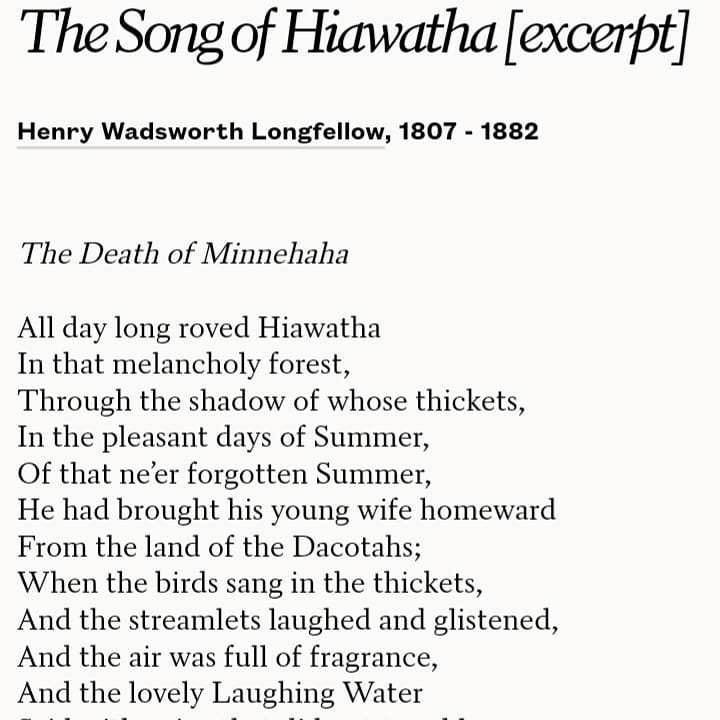
The Song of Hiawatha
Poem by Henry Wadsworth LongfellowWikipedia
16
MENTIONS
8
EPISODES
8
PODCASTS
Search complete. 16 mentions across 8 episodes found for "The Song of Hiawatha".
Sep 14, 2026

Martin VauxHOST
Okay.
Martin VauxHOST
Well, Pukwudgies I've heard of because Longfellow, of course, included them in the Song of Hiawatha, and therefore I had to read about them, and I'm imagining there's connections between them and the Celtic Puca or Pook.
Eleanor ConlonHOST
I mean, it seems pretty likely, doesn't it?
Martin VauxHOST
Yeah.

TavarishNARRATOR
He was changed into a beaver.
TavarishNARRATOR
Henry Wadsworth Longfellow The Song of Hiawatha End of section 17 This recording is in the public domain.
TavarishNARRATOR
Section 18 of Birds and Nature, Volume 9, No. 4, April 1901.
TavarishNARRATOR
Recorded for LibriVox.org by Tavarish.

Jeffrey Richmond-MollGUEST
One of the things that I do think is challenging for 21st century audiences is to understand the process of how a marble sculpture is made.
Jeffrey Richmond-MollGUEST
And to wrap our heads around the fact that some of Lewis's most important and today most valuable objects exist in multiples, how can this be that the Virginia Museum of Fine Arts acquired a major sculpture by Lewis, Hiawatha's Marriage, setting the auction price at $1.6 million several years ago, and yet there are seven other examples of that work? So we really, first of all, we realized that we needed to help visitors to grasp how Lewis made her work, which is a way of acknowledging her place within a larger artistic community.
Jeffrey Richmond-MollGUEST
sculptors did not work in isolation.
Jeffrey Richmond-MollGUEST
This was, I think, even in Lewis's own time, a false assumption that the public had, particularly when it came to women sculptors.
27 MINS LATER
Tyler GreenHOST
The fourth theme that you all raise is Lewis's address of Native Americans in her work, which for me is more complicated than the literature often reflects.
Tyler GreenHOST
So, for example, one particularly well-known group of work is Lewis's Six Marble Sculptures Featuring Native People.
Tyler GreenHOST
based on Henry Wadsworth Longfellow's notoriously infamously appropriative Song of Hiawatha.
Tyler GreenHOST
And of course, Longfellow based Hiawatha on early ethnographic work by U.S. Indian agent Henry Rose Schoolcraft, John Heckwelder's late 18th century account of a visit to the Wabash, and various other accounts kind of from the native inland sea region, but filtered through white authors.

Kimberly SassenNARRATOR
The little stalk holding the anther is forked in the birches, but is distinct to the base in the alders.
Kimberly SassenNARRATOR
References Song of Hiawatha, Longfellow, Hiawatha's Sailing, Picture Writing, The Birch Tree, Lowell, An Indian Summer Reverie, Lowell End of Chapter 5 Chapter 6 of Ten Common Trees This is a LibriVox recording.
Kimberly SassenNARRATOR
All LibriVox recordings are in the public domain.
Kimberly SassenNARRATOR
For more information or to volunteer, please visit LibriVox.org Recording by Jennifer Dallman Ten Common Trees By Susan Stokes The White Oak What is a tree? Is it only a wooden trunk with wooden branches, a bark, and leaves? There is something more.

Kirk ZieglerNARRATOR
Oliver Wendell Holmes was forty-eight when he wrote The Autocrat of the Breakfast Table, his first great work.
Kirk ZieglerNARRATOR
Longfellow wrote Hiawatha when he was forty-eight, and much of his best work followed.
Kirk ZieglerNARRATOR
Whittier wrote Snowbound and Maud Mueller at fifty-nine, and continued writing until he was seventy-nine.
Kirk ZieglerNARRATOR
Tennyson was still writing at eighty-three.

Betty B.NARRATOR
Most of the Indian stories here given were gathered by Schoolcraft, the distinguished student of the American Indian and collector of their legends.
Betty B.NARRATOR
It was from Schoolcraft that Longfellow derived his material for Hiawatha, and that poem may fitly be used as a sequel to these tales as the children grow older.
Betty B.NARRATOR
Monabazho, who appears in the frontispiece of this volume, was the Algonquin Hiawatha.
Betty B.NARRATOR
Of many of the tales from India, an explanation may again be found in a current belief.
Betty B.NARRATOR
The teaching of the Buddha included the doctrine of transmigration of souls, and both the frequency of animal stories and the constant teaching of kindness to animals are due to this belief, a belief which becomes very vivid when one realizes that according to it, one's dog may have the soul of one's father.

Denise Finnegan-HillHOST
Music of Antonin Dvorak, written while he was in the United States.
Denise Finnegan-HillHOST
His Symphony No. 9, New World, based on the poem of Henry Wadsworth Longfellow, Song of Hiawatha.
Denise Finnegan-HillHOST
This is just the first movement performed by the Vienna Philharmonic Orchestra under the direction of Herbert von Karajan.
Denise Finnegan-HillHOST
¶¶ ¶¶ ¦ ¦ ¦ Thank you.

Matt PerrardNARRATOR
The white pelican, as it calmly floats on the surface of the water some distance from the shore, has been mistaken for the sail of a boat as the moist white feathers glisten in the sunshine.
Matt PerrardNARRATOR
Longfellow has beautifully woven this fact into The Song of Hiawatha.
Matt PerrardNARRATOR
O'er the water floating, flying, Something in the hazy distance, Something in the mists of morning, Loomed and lifted from the water, Now seemed floating, now seemed flying, Coming nearer, nearer, nearer.
Matt PerrardNARRATOR
Was it Shingebis the diver? Or the pelican, the Shada? Or the heron, the Sha-sha-ga? Or the white goose, Waw-be-wawa, With the water dripping, flashing From its glossy neck and feathers? It was neither goose nor diver, Neither pelican nor heron, O'er the water floating, flying, Through the shining mist of morning, But a birch canoe with paddles Rising, sinking on the water.