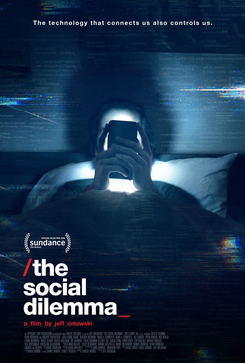
The Social Dilemma
2020 filmWikipedia
80
MENTIONS
52
EPISODES
51
PODCASTS
Search complete. 80 mentions across 52 episodes found for "The Social Dilemma".
Oct 30, 2026

Aza RaskinGUEST
So Center for Humane Technology, like our goal is to realign technology with humanity's best interests or, you know, Earth's and all of beings best interest.
Aza RaskinGUEST
And so most people know us for the film The Social Dilemma, which came out in 2020.
Aza RaskinGUEST
It's I think Netflix still most watched documentary.
Aza RaskinGUEST
And it's really it's a whole bunch of insiders coming out and explaining technology.
Aza RaskinGUEST
the mechanisms behind how in 2013 we could predict that social media was absolutely going to create a more polarized, narcissistic, um, democracy backsliding and, uh, like a place with the breakdown of truth kind of place.
Aza RaskinGUEST
And
Neil deGrasse TysonHOST
the reason why, wait a minute, was that the documentary where you, you reenacted a scenario where you, uh, you wanted to gain the attention of someone on their smartphone.
Neil deGrasse TysonHOST
And if they didn't pay attention to something, you send them an alert or an update.

Lex RofebergHOST
Stephanie Lepp is an award-winning producer and storyteller.
Lex RofebergHOST
She's the former executive producer at the Center for Humane Technology, the organization at the heart of the Netflix documentary, The Social Dilemma.
Lex RofebergHOST
Today, she leads Synthesis Media, a nonprofit production studio devoted to expanding hearts and minds.
Lex RofebergHOST
Learn more at antidebate.org. That's anti-debate.org. Stephanie Lepp, welcome to Judaism Unbound.

speaker_0HOST
So I sort of, uh, around like 20, uh, 2011 or 2012, I think, like when sort of Facebook and that sort of started to come up a little bit.
speaker_0HOST
And then after that, like, there's also a documentary like, is it called The Social Dilemma? It's on, it used to be on Netflix, but it talks about like the correlation between like when social media started to come out, like Facebook, Instagram, all of that kind of stuff, Snapchat, and then like mental health or like even like youth suicide, it just went like both of them started to grow at the same time, which is pretty interesting because like they look at other things like, oh, was it this event that made this happen or this event that made things happen? But the same trend like not only happened like in America or like New Zealand, it like happened all over the world.
speaker_0HOST
And so they're like, oh, why did that happen? And so they had a look at different things and they only really think that they could, there's, you know, like global economy crashes or whatever.
speaker_0HOST
But then it was like that regained and that it sort of came right.

John BriggsGUEST
Yes.
John BriggsGUEST
But what is it most people, especially now, I don't know if people have watched the documentary Social Dilemma.
John BriggsGUEST
Yeah.
John BriggsGUEST
But most people have been trained now through algorithms.

Dave SmithHOST
You know, my mind is not for sale.
Dave SmithHOST
And they say this in the Social Dilemma documentary.
Dave SmithHOST
If the app is free, if the product is free, then you are the product.
Dave SmithHOST
Anything that you download for free, it's free because you're the product.

Lawrence LessigSOUNDBITE_SPEAKER
Now the first contact we had with this AI, as Tristan Harris described it, came from social media.
Lawrence LessigSOUNDBITE_SPEAKER
Tristan Harris, who started the Center for Humane Technology, co-founded it, famous in this extraordinary documentary, The Social Dilemma.
Lawrence LessigSOUNDBITE_SPEAKER
Before he was famous, he was just an engineer at Google, And at Google, he was focused on the science of attention, using AI to engineer attention to overcome resistance to increase human engagement with the platform, because engagement is the business model.
Lawrence LessigSOUNDBITE_SPEAKER
Compare this to...

JasonHOST
And I think if everybody at least did that as a bare minimum, we'd be a thousand times farther than we are right now.
JasonHOST
Even if you look at the topic of artificial intelligence, as controversial as it is, I was watching a documentary recently.
JasonHOST
And the guy was trying to figure out...
JasonHOST
He was talking to two sets of people.
JasonHOST
I think it's called the AI documentary.
JasonHOST
I know you said you'd seen at least part of it, right? Oh, yeah, yeah.
JasonHOST
On Netflix.
JasonHOST
But back in like the early two thousands, when I was a kid in high school, you would always hear sex sells, right? And remember the Carl's Jr.

Ben RallHOST
Maybe there's trillions of dollars of marketing that are trying to convince you of something.
Ben RallHOST
I remember when I watched this documentary called The Social Dilemma.
speaker_1NARRATOR
Maybe.
Ben RallHOST
I can't remember.
Ben RallHOST
This is several years ago.
Ben RallHOST
Worth watching.
Ben RallHOST
I think it's called the social dilemma.
Ben RallHOST
And I was talking about the impacts of social media.

Steven HassanHOST
So it's humanetech.com is the nonprofit.
Steven HassanHOST
And he and Tristan Harris did the famous documentary Social Dilemma.
Steven HassanHOST
So they're partners in this.
Steven HassanHOST
But I'm mentioning Aza because he freaking feels guilty because he created doom scrolling.

Rich JohannesenHOST
I do believe, especially with social media the way it is, that there's substantially more women under stress because of the social media.
Rich JohannesenHOST
And a lot of that was borne out for me when I watched The Social Dilemma on Netflix, and there was some powerful research, university-based research that was talking about the impact that social media was having on women.
Rich JohannesenHOST
And if that is the case, and just indulge me for a moment with the argument, And that then puts women in a position where they're spending more time in the sympathetic expression of their nervous system that would suggest to me that they then are more immunosuppressive.
Rich JohannesenHOST
If they're more immunosuppressive, more likely to be vulnerable to becoming chronically ill from a bug bite.
42 more episodes mention The Social Dilemma.
Create an account to see the whole feed, search across every transcript, and follow the entities you care about.