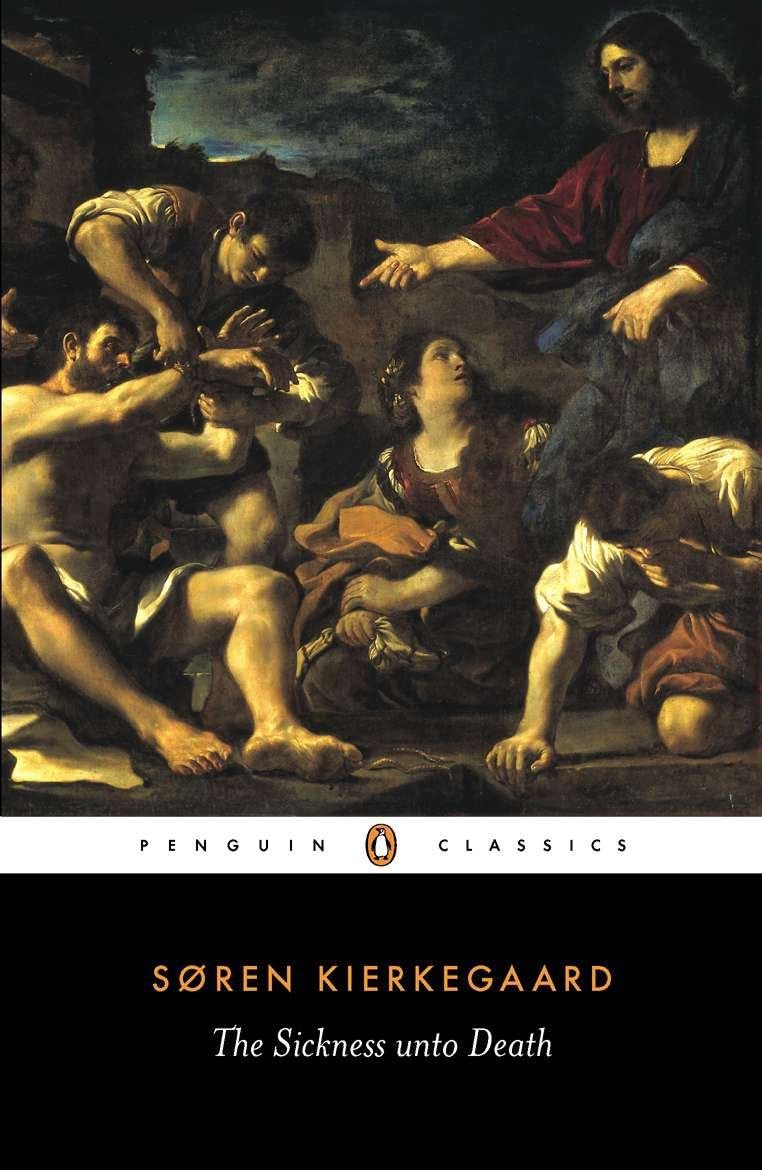
The Sickness unto Death

The Sickness unto Death

Book by Søren KierkegaardWikipedia

Search complete. 62 mentions across 20 episodes found for "The Sickness unto Death".

Sep 29, 2026

speaker_4NARRATOR
82:49
when
speaker_3NARRATOR
82:49
such a moment occurs the man stands face to face with a great alternative this knowledge in which each one who has not been reconciled to his god will necessarily feel himself unworthy of communion with god must either lead to repentance to godly sorrow in which he then lays hold of grace in faith in the forgiveness of sins or it must pass into despair into an absolute renunciation of all hope desperation despair is the last result of sin except an escape from this hell can be gained by means of repentance despair is the essence and the proper meaning of hell wherefore the inferno in dante bears that inscription all hope abandoned ye who enter here that sin is not repented of must lead to despair is evident in those men who have made greater progress in the path of sin the farther a man proceeds in this path the more a secret despair moves within him note one in sir kirkegaard's paradoxical utterance in his book the sickness unto death that all men are in a state of despair even though they do not know it themselves we can only acknowledge the general truth that in every human heart in consequence of the state of sin there exists a germ of despair but it may also with as good reason be said that in every human heart a germ of hope is present and that man's hope his hope however indefinite of salvation is only fully extinguished in the extreme stages of sin and guilt the conception of despair can as we apprehend only be set forth with the definiteness belonging to it when it is fully defined in its relation to the conceptions of hope and futurity however many false prospects and hopes the guilt-laden one may conjure up there yet lies at
speaker_4NARRATOR
84:46
the bottom of his soul a secret hopelessness
speaker_3NARRATOR
84:48
not merely regarding the event of his special egoistic efforts but above all a hopelessness in regard of his own person his future

2 HRS 34 MINS LATER

speaker_3NARRATOR
239:15
In the spring of the following year there were published anonymously two remarkable theological essays.
speaker_3NARRATOR
239:22
Has a man the right to allow himself to be put to death for the truth and the difference between a genius and an apostle? The former, with an indirect bearing upon the atonement, and the latter attempting to clear up the Christian concept of authority.
speaker_3NARRATOR
239:42
To the second half of Kierkegaard's religious authorship may be assigned the following volumes, The Sickness Unto Death, 1849, Practical Introduction to Christianity, 1850, and For Self-Examination, 1851.
speaker_3NARRATOR
240:03
In these writings, Kierkegaard presents the Christian teaching in its highest ideality and with a reference to the prevailing state of religion in the Christian world.
Kirk ZieglerNARRATOR
11:08
laid at the door of both
Kirk ZieglerNARRATOR
11:09
teacher and pupil many of his works have been translated into german e g christenthum u kirche hamburg 1861 de lilleen etc holly eighteen seventy seven ho priester eighteen seventy seven a in christentum eighteen seventy eight Die Krankheit zum Tode, 1881.
Kirk ZieglerNARRATOR
11:40
Fürcht und Sittern erlangen, 1882.
Kirk ZieglerNARRATOR
11:45
Entweder oder, Leipzig, 1885.
EricHOST
13:12
And he says that collapse is an invitation to turn inward and find what is really valuable in life that does not involve anyone else, or how they feel, or what they like.
EricHOST
13:26
Kierkegaard in The Sickness Unto Death, 1849, He says that despair is nearly universal and almost nobody knows that they're in it.
EricHOST
13:37
But when they begin to perceive their mortality more clearly, they will begin to feel it.
EricHOST
13:42
In all four cases, the grand journey of a deep transformation begins for those who are willing to go on it.
Andrew SnyderHOST
17:23
Otherwise, when I say that socialism is poison to the soul, it's kind of vague as to what I mean by that.
Andrew SnyderHOST
17:30
In The Sickness Unto Death, Kierkegaard says that a human being is spirit, by which he means that the essential component of man is that which chooses, which orients himself in the world, which fundamentally decides how it relates to itself, to the world, and to God.
Andrew SnyderHOST
17:45
Because although we are born into a context, a history, a time, a place, and a people, we ultimately decide what to do with that.
Andrew SnyderHOST
17:54
We are more than our situation.

28 MINS LATER

Andrew SnyderHOST
46:11
Our study on The Psychology of Soren Kierkegaard, Life in Anxiety and Despair begins the week of October 4th.
Andrew SnyderHOST
46:18
This is not a side offer.
Andrew SnyderHOST
46:20
It's the next layer of the same work that we're doing with anxiety, despair, freedom, envy, and the self before God as we read through the concept of anxiety and the sickness unto death.
Andrew SnyderHOST
46:31
Fellows and companions receive Mythic Mind Academy courses, including the upcoming Kierkegaard course and those that are already available, such as the Fiction and Philosophy of C.S. Lewis, Lord of the Rings, Silmarillion, Plato's Stoicism Until We Have Faces.

Unknown podcast

Short Nonfiction Collection, Vol. 073-Various

Sep 26 · 4 Mentions

speaker_4NARRATOR
297:47
Some thirteen years ago I was eyeing the shelves of a book repository when the queer title of an unassuming volume captured my attention.
speaker_4NARRATOR
297:56
It was Kierkegaard's The Sickness Unto Death in a Swedish translation, the main opus of his second or religious period as defamed either or 1843 of his first or psychological ascetic period.
speaker_4NARRATOR
298:14
Out of sheer curiosity I read that deep but difficult analysis of religious despair as the sickness unto death.
speaker_4NARRATOR
298:23
Strange phraseology, novel form, profound paradoxes made the task rather tantalizing.
speaker_4NARRATOR
298:30
All I at that time gained was the mysterious sense of a mind of eminent power and of a spirit at home in the intensest toils of the human soul, able to pierce beneath all the glittering shams of life to the fundamentals.

11 MINS LATER

speaker_4NARRATOR
309:58
Three, the religious and religious philosophical period with occasional literary efforts.
speaker_4NARRATOR
310:06
Morsels to the ascetics from a now avowedly religious author.
speaker_4NARRATOR
310:11
Here are such masterly things as Edifying Addresses, 1847, The Works of Love, 1847, Christian Addresses, 1847, The Viewpoint for My Author Activity, posthumously published 1859, Two Ethical Religious Minor Essays, 1849, The Sickness Unto Death, 1849, Exercise in Christianity, 1850, Concerning My Author Activity, 1851, Judge for Yourselves, posthumous 1876, For Self-Trial, 1852, and others.

Unknown podcast

Short Nonfiction Collection, Vol. 073-Various

Sep 25 · 4 Mentions

speaker_3NARRATOR
293:57
Some thirteen years ago I was eyeing the shelves of a book repository when the queer title of an unassuming volume captured my attention.
speaker_3NARRATOR
294:06
It was Kierkegaard's The Sickness Unto Death in a Swedish translation, the main opus of his second or religious period as defamed either or 1843 of his first or psychological ascetic period.
speaker_3NARRATOR
294:24
Out of sheer curiosity I read that deep but difficult analysis of religious despair as the sickness unto death.
speaker_3NARRATOR
294:33
Strange phraseology, novel form, profound paradoxes made the task rather tantalizing.
speaker_3NARRATOR
294:40
All I at that time gained was the mysterious sense of a mind of eminent power and of a spirit at home in the intensest toils of the human soul, able to pierce beneath all the glittering shams of life to the fundamentals.

11 MINS LATER

speaker_3NARRATOR
305:37
Three, the religious and religious philosophical period with occasional literary efforts.
speaker_3NARRATOR
305:45
Morsels to the ascetics from a now avowedly religious author.
speaker_3NARRATOR
305:51
Here are such masterly things as Edifying Addresses, 1847, The Works of Love, 1847, Christian Addresses, 1847, The Viewpoint for My Author Activity, posthumously published 1859, Two Ethical Religious Minor Essays, 1849, The Sickness Unto Death, 1849, Exercise in Christianity, 1850, Concerning My Author Activity, 1851, Judge for Yourselves, posthumous 1876, For Self-Trial, 1852, and others.

Unknown podcast

Soren Kierkegaard, Various Readings-Various

Sep 24 · 4 Mentions

speaker_3NARRATOR
81:19
when such a moment occurs the
speaker_2NARRATOR
81:21
man stands face to face with a great alternative this knowledge in which each one who has not been reconciled to his god will necessarily feel himself unworthy of communion with god must either lead to repentance to godly sorrow in which he then lays hold of grace in faith in the forgiveness of sins or it must pass into despair into an absolute renunciation of all hope desperation despair is the last result of sin except an escape from this hell can be gained by means of repentance despair is the essence and the proper meaning of hell wherefore the inferno in dante bears that inscription all hope abandoned ye who enter here that sin is not repented of must lead to despair is evident in those men who have made greater progress in the path of sin the farther a man proceeds in this path the more a secret despair moves within him note one in sir kirkegaard's paradoxical utterance in his book the sickness unto death that all men are in a state of despair even though they do not know it themselves we can only acknowledge the general truth that in every human heart in consequence of the state of sin there exists a germ of despair but it may also with as good reason be said that in every human heart a germ of hope is present and that man's hope his hope however indefinite of salvation is only fully extinguished in the extreme stages of sin and guilt the conception of despair can as we apprehend only be set forth with the definiteness belonging to it when it is fully defined in its relation to the conceptions of hope and futurity however many false prospects and hopes the guilt-laden one
speaker_3NARRATOR
83:14
may conjure up there yet lies at the bottom of his soul a secret hopelessness
speaker_2NARRATOR
83:18
not merely regarding the event of his special egoistic efforts, but above all, a hopelessness in regard of his own person, his future.

2 HRS 33 MINS LATER

speaker_2NARRATOR
236:46
In the spring of the following year there were published anonymously two remarkable theological essays, has a man the right to allow himself to be put to death for the truth and the difference between a genius and an apostle, the former with an indirect bearing upon the atonement and the latter attempting to clear up the Christian concept of authority.
speaker_2NARRATOR
237:13
To the second half of Kierkegaard's religious authorship may be assigned the following volumes.
speaker_2NARRATOR
237:20
The Sickness Unto Death, 1849, Practical Introduction to Christianity, 1850, and For Self-Examination, 1851.
speaker_2NARRATOR
237:34
In these writings, Kierkegaard presents the Christian teaching in its highest ideality and with a reference to the prevailing state of religion in the Christian world.

Unknown podcast

Soren Kierkegaard, Various Readings-Various

Sep 22 · 1 Mention

speaker_4NARRATOR
12:09
at the door of both
speaker_3NARRATOR
12:10
teacher and pupil many of his works have been translated into german e g christenthum u kirche hamburg eighteen sixty one de etc holly eighteen seventy seven ho priester eighteen seventy seven in christentum eighteen seventy eight Die Krankheit zum Tode, 1881.
speaker_3NARRATOR
12:41
Fürcht und Sittern erlangen, 1882.
speaker_3NARRATOR
12:45
Entweder oder, Leipzig, 1885.
speaker_4NARRATOR
12:38
may be laid at the door of both
speaker_3NARRATOR
12:40
teacher and pupil many of his works have been translated into german for example christenthum u kirche hamburg eighteen sixty one de etc holly eighteen seventy seven ho priester eighteen seventy seven in christian eighteen seventy eight Die Krankheit zum Tode, 1881.
speaker_3NARRATOR
13:11
Fürcht und Sittern Erlangen, 1882.
speaker_3NARRATOR
13:15
And weder oder.

Unknown podcast

Soren Kierkegaard, Various Readings-Various

Sep 19 · 4 Mentions

speaker_6NARRATOR
84:08
when such a moment occurs
speaker_5NARRATOR
84:10
the man stands face to face with a great alternative this knowledge in which each one who has not been reconciled to his god will necessarily feel himself unworthy of communion with god must either lead to repentance to godly sorrow in which he then lays hold of grace in faith in the forgiveness of sins or it must pass into despair into an absolute renunciation of all hope desperation despair is the last result of sin except an escape from this hell can be gained by means of repentance despair is the essence and the proper meaning of hell wherefore the inferno in dante bears that inscription all hope abandoned ye who enter here that sin is not repented of must lead to despair is evident in those men who have made greater progress in the path of sin the farther a man proceeds in this path the more a secret despair moves within him note one in sir kirkegaard's paradoxical utterance in his book the sickness unto death that all men are in a state of despair even though they do not know it themselves we can only acknowledge the general truth that in every human heart in consequence of the state of sin there exists a germ of despair but it may also with as good reason be said that in every human heart a germ of hope is present and that man's hope his hope however indefinite of salvation is only fully extinguished in the extreme stages of sin and guilt the conception of despair can as we apprehend only be set forth with the definiteness belonging to it when it is fully defined in its relation to the conceptions of hope and futurity end of note however many false prospects and hopes the guilt-laden one may conjure up there yet
speaker_6NARRATOR
86:03
lies at the bottom of his soul a secret hopelessness
speaker_5NARRATOR
86:07
not merely regarding the event of his special egoistic efforts, but above all, a hopelessness in regard of his own person, his future.

2 HRS 33 MINS LATER

speaker_5NARRATOR
239:10
In the spring of the following year there were published anonymously two remarkable theological essays, has a man the right to allow himself to be put to death for the truth and the difference between a genius and an apostle, the former with an indirect bearing upon the atonement and the latter attempting to clear up the Christian concept of authority.
speaker_5NARRATOR
239:37
To the second half of Kierkegaard's religious authorship may be assigned the following volumes.
speaker_5NARRATOR
239:44
The Sickness Unto Death, 1849, Practical Introduction to Christianity, 1850, and For Self-Examination, 1851.
speaker_5NARRATOR
239:58
In these writings, Kierkegaard presents the Christian teaching in its highest ideality and with a reference to the prevailing state of religion in the Christian world.

10 more episodes mention The Sickness unto Death.

Create an account to see the whole feed, search across every transcript, and follow the entities you care about.

We value your privacy

We use cookies to understand how you use our platform and to improve your experience. Click “Accept All” to consent, or “Decline non-essential” to opt out of non-essential cookies. Read our Privacy Policy.