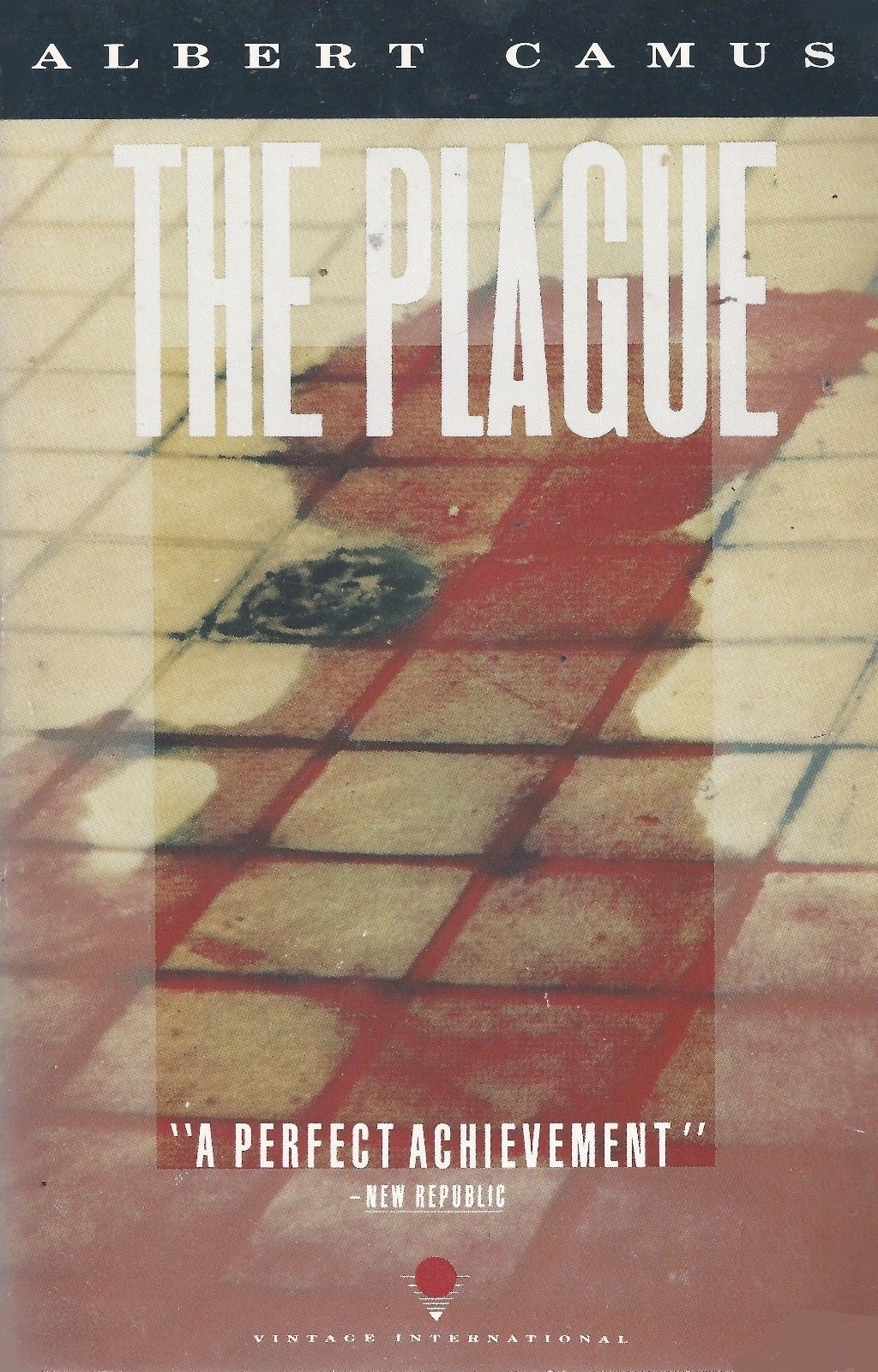
The Plague
Novel by Albert CamusWikipedia
24
MENTIONS
11
EPISODES
11
PODCASTS
Search complete. 24 mentions across 11 episodes found for "The Plague".
Oct 14, 2026

Martha CarlinGUEST
Um, and so that was really interesting for me.
Martha CarlinGUEST
And then I f- I was sort of into French literature in college, and, uh, Albert Camus, "The Plague", there's a ch- there's a little paragraph at the very end of the story and it's talking about the doctor who's involved in the plague, and, you know, all the people in the city are celebrating because it's gone and he's, you know, he's sitting there reflecting and it says, you know, because he knows what those people don't know but could know if they read books, is that these microbes come back.
Martha CarlinGUEST
They hide out in cabinets and all, you know, lists off all these places, and they come back for basically the enlightenment of men.
Martha CarlinGUEST
And I was like, oh wow, that is really a, an interesting statement.

Joanne LiuGUEST
Well, just with respect to what has inspired me is when I was a teenager, and I was, uh, in, uh, in this sequence of my life of a quest for meaning in life, I read books that inspired me, and one of them was a physician who was volunteering for MSF as a surgeon at, at the frontline of crisis in war zones.
Joanne LiuGUEST
And the other book I read is The Plague from Albert Camus.
Joanne LiuGUEST
And I think that's probably the, the book that stayed most with me because I remember at one point the protagonist, the Dr. Rieux, is being asked, "What is driving you? Why do you keep going when your patient are dying and you don't have treatment to offer them, and you don't e- even believe in God?" And then the doctor answer, "I never got used to death.
Joanne LiuGUEST
I don't know more." And I remember telling myself that I will never trivialize death, and I will basically fight for life.

Alain de BottonNARRATOR
[upbeat music] In January 1941, the 28-year-old French writer Albert Camus began work on a novel about a virus that spreads uncontrollably from animals to humans and ends up destroying half the population of a representative modern town.
Alain de BottonNARRATOR
It was called La Peste, The Plague, eventually published in 1947 and frequently described as the greatest European novel of the second half of the 20th century.
Alain de BottonNARRATOR
The book, written in sparse, haunting prose, takes us through a catastrophic outbreak of a disease in the lightly fictionalized town of Oran on the Algerian coast, as seen through the eyes of the novel's hero, a Dr. Rieux, a version of Camus himself.
Alain de BottonNARRATOR
As the novel opens, an air of eerie normality reigns.
Alain de BottonNARRATOR
Proper recognition of this absurdity should not lead us to despair, pure and simple.
Alain de BottonNARRATOR
It should, rightly understood, be the start of a redemptive, tragicomic perspective.
Alain de BottonNARRATOR
Like the people of Oran before the plague, we assume that we've been granted immortality, and with this naivety come behaviors that Camus abhorred: a hardness of heart, an obsession with status, a refusal of joy and gratitude, a tendency to moralize and judge.
Alain de BottonNARRATOR
The people of Oran associate plague with something backward that belongs to another age.

AC WilsonHOST
So the government isolates a team of scientists in a multi-level underground bunker called Wildfire to basically study this extraterrestrial microorganism.
speaker_2HOST
What makes Hosbrick's analysis in the Collider piece so sharp, I think, is how he links The Andromeda Strain to Albert Camus' The Plague.
AC WilsonHOST
Oh, right.
speaker_2HOST
He highlights its intense relevance in our post-COVID reality, you know?

Michael BurchPANELIST
You feel, you, you get that feeling like where you, something is happening to you, but it's not really, and you don't know how to connect with it, and that's what that book does.
Michael BurchPANELIST
And then you take into account that he wrote this during war times, just like he wrote The Plague- After being occupied by the Nazis, you know, the play was very much an allegory, obviously, for something that, you know, affected everyone.
Michael BurchPANELIST
And I don't know, the fantastic books, I'd, I'd definitely hit those if you could.
Michael BurchPANELIST
And then that led to I had to hit William Shirer's Rise and Fall of the Third Reich.

Marcus PeterHOST
Without that without the Judeo-Christian context, gosh, like you said, you're just Nietzsche, you're the madman, and you're looking at this in complete futility.
Tod WornerGUEST
This is a little bit, so one of the rotations I give to fourth-year medical students, we read The Plague from Camus, and if anybody's read this, you know, it's sort of a little bit of a harsher version of COVID, where you have a quarantined North African or Algerian town, French Algeria, And you have a cadre of kind of sort of misfits and a doctor that get together and do the work that they can do, and to try to just basically alleviate or ameliorate people's suffering.
Tod WornerGUEST
And they make very little difference.
Tod WornerGUEST
A plague comes, many people die, they do certain things, then it all kind of goes away.
Tod WornerGUEST
One is to the light and the other is to darkness.
Marcus PeterHOST
Right.
Marcus PeterHOST
Because even when you consider Camus and the plague and the way he talks about the faith and the church's organized response to the plague, sure, he leans towards the strong language of judgment.
Marcus PeterHOST
You know, like quoting that priest, for example, a calamity has befallen all of us and you deserved it.

Rusty RenoGUEST
It held out a hope that in a world where everything had been destroyed, we can in, in some small way make a habitable place.
Rusty RenoGUEST
At least, you know, in Camus, in, in, uh, The Plague, which is his novel about World War, about Nazism.
Rusty RenoGUEST
In The Plague, we can at least, we can have friendship.
Rusty RenoGUEST
We can be humane to each other, you know, in, in some quotidian way.
Rusty RenoGUEST
Uh, it's an admirable vision, but it's pretty thin-rolled, and the open society consensus as it works its way through in the '50s, '60s, '70s, and '80s and gets more and more intense and more flesh-eating, um, were I 21 years old today, you know, you're living in a liquid world where everything has been disintegrated.

Dick ShanleyHOST
We might grumble about the economy or the prospect of another far-off war or listen approvingly to radical voices from either end of the political spectrum, but we don't expect our world to be turned upside down.
Dick ShanleyHOST
We would do better if we heed the warning of another French writer, an Albert Camus's post-war novel, The Plague.
Dick ShanleyHOST
When dead rats appear in the streets of the Algerian city of Iran and people fall ill with a mysterious disease, the local government and most of the citizens ignore the signs until it's too late.
Dick ShanleyHOST
There have been as many plagues as wars in history, Camus' narrator says, yet always plagues and wars take people equally by surprise.

Dick ShanleyNARRATOR
We might grumble about the economy or the prospect of another far-off war or listen approvingly to radical voices from either end of the political spectrum, but we don't expect our world to be turned upside down.
Dick ShanleyNARRATOR
We would do better if we heed the warning of another French writer, an Albert Camus's post-war novel, The Plague.
Dick ShanleyNARRATOR
When dead rats appear in the streets of the Algerian city of Iran and people fall ill with a mysterious disease, the local government and most of the citizens ignore the signs until it's too late.
Dick ShanleyNARRATOR
There have been as many plagues as wars in history, Camus' narrator says, yet always plagues and wars take people equally by surprise.

Matthew PetrusekHOST
The former is the intellectual consent we give to propositions, and the latter is the visceral affirmation that we give to matters concretely observed and deeply felt." Close quote.
Matthew PetrusekHOST
And in his haunting novel, The Plague, Albert Camus wrote, quote, "Since a dead man has no substance unless one has actually seen him dead, a hundred million corpses broadcast through history are no more than a puff of smoke in the imagination.
Matthew PetrusekHOST
The thousand dead may have about five times-- made about five times the audience in a biggish cinema.
Matthew PetrusekHOST
Yes, that was how it should be done.
1 more episode mentions The Plague.
Create an account to see the whole feed, search across every transcript, and follow the entities you care about.