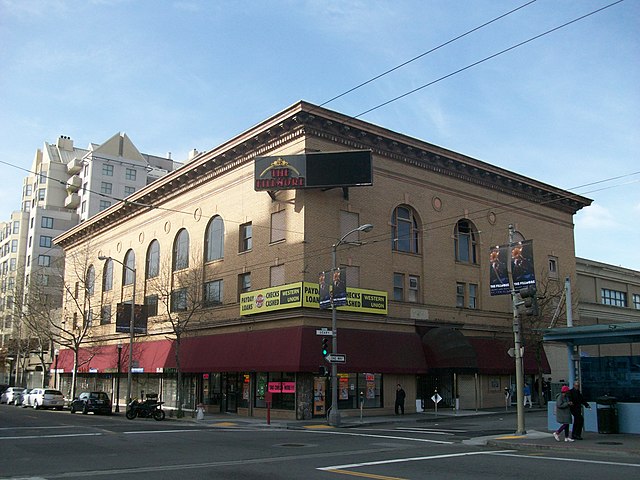
The Fillmore
Music venue in San Francisco, CaliforniaWikipedia
115
MENTIONS
44
EPISODES
27
PODCASTS
Search complete. 115 mentions across 44 episodes found for "The Fillmore".
Oct 29, 2026

Jon FaddisGUEST
And it was whether he was selling out or not.
Jon FaddisGUEST
And I actually went to hear, maybe it was a couple of years later, probably about 1970, Miles played with a group at the Fillmore, Fillmore West in San Francisco.
Jon FaddisGUEST
And I went over there, and I got a ticket.
Jon FaddisGUEST
And I don't even know if I was with a friend or not.

Rich BonnifaceNARRATOR
By 1965, he was managing the San Francisco Mime Troupe, and when they got busted for performing without a permit, he threw a benefit to pay their legal bills.
Rich BonnifaceNARRATOR
The show made money, real money, so he did it again a month later, December 10, 1965, at the Fillmore Auditorium.
Rich BonnifaceNARRATOR
Bigger venue, bigger crowd, same chaotic energy.
Rich BonnifaceNARRATOR
And somewhere around this time, probably late November, maybe early December, the Warlocks picked a new name out of a dictionary, Grateful Dead.
Rich BonnifaceNARRATOR
He wasn't just some promoter looking to cash in on the scene.
Rich BonnifaceNARRATOR
He cared about the music, about the bands, about making sure the shows actually happened, even when he thought you were completely insane.
Rich BonnifaceNARRATOR
So when Graham leased the Fillmore Auditorium full-time and started booking regular shows in early 1966, the Dead became part of his roster.
Rich BonnifaceNARRATOR
January 8, 1966, their first official Fillmore show.

Kevin BrightGUEST
Miles Davis opening up for Neil Young.
Kevin BrightGUEST
Can you imagine that kind of show? It only happened at the Fillmore East.
Kevin BrightGUEST
It happened at Fillmore West too, but it had a profound effect.
Kevin BrightGUEST
So I started collecting posters from Fillmore East because unlike Fillmore West, there aren't many.
Kevin BrightGUEST
There's only like maybe 12 posters that Fillmore East ever put out.
Kevin BrightGUEST
So I'll... give you my favorite one right here wow an original jimmy hendrix first time at the film worries poster and you know you can tell why i love it for so many reasons but

JohnHOST
But man...
JohnHOST
The Fillmore, the Fillmore, the 11th of April.
JohnHOST
How amazing.
JohnHOST
How did that go? Yeah, how amazing.
Paul MedewGUEST
Yeah, it was fantastic.
Paul MedewGUEST
You know, some of those shows were really good and some of them weren't so good, but yeah.
JohnHOST
Well, the Fillmore was one of the good ones.
Paul MedewGUEST
Yeah, the film was one of the good ones.
Rich BonnifaceNARRATOR
The audience recognizes it and cheers, and then somebody leans into the taper's microphone and announces, in a cheerful radio voice, that they're going to do a little turn on your love light for everybody out there in Radioland.
Rich BonnifaceNARRATOR
there was no radio it was one fan's tape recorder but for a moment in that crowded hall somebody decided the whole world was listening and introduced the song to it nobody agrees on this and nobody ever has where did the dead actually learn love light the obvious answer is bobby bland the man the song was written for the kind of record pigpen had grown up hearing but the dead's earliest versions came along in the same stretch of time that them's cover was out in the world a rougher garage band reading by a group of young white rockers much closer in spirit to what a bar band from palo alto might sound like the writer michael kaler tracing where the dead's version came from sets both records out side by side did pigpen bring it straight from the soul record the way he brought so much or did the band hear it second-hand through an Irish rock group, and only later trace it home, or did it simply arrive the way songs arrived in those years, from a jukebox, a friend, the radio, nobody quite sure which, come back up now, away from the man in the leather vest away from the drummers up past the amplifiers into the dark above the crowd the song is still going down there the groove holding steady on its two chords from up here it's only a warm faint thump and a field of people slowly turning to say hello listen to the room before anybody arrives a big upstairs hall in the Fillmore district of San Francisco wooden floor high ceiling the kind of place that was built for dances long before anybody called them concerts with nobody in it it ticks and settles a radiator knocks somewhere a door downstairs swings on its hinge and thuds shut the floorboards give a long low creak as the building cools and then go quiet again out on the street a bus sighs to a stop and pulls away later tonight this room will be full and loud but right now it's just a dance hall waiting for the dancing that's worth remembering about the early grateful dead they were a dance band they stretched every song out farther than anybody had asked them to and they would keep stretching for thirty years but at the root of it the job was to keep a room full of people moving so it makes a kind of sense that one of the songs they picked up early was a recent motown hit about exactly that people dancing in the street dancing in the street belonged to martha and the vandellas it came out of detroit and went high in the charts a bright urgent joyful record written by a team at motown that included a young marvin gay The dead started playing it in the year they were living in and around the hay.
Rich BonnifaceNARRATOR
One careful history of the song suggests they may have played it even earlier, back in the warlocks' days, though if they did, no tape survives to prove it.
Rich BonnifaceNARRATOR
What the dead did with it was what they did with everything.
16 MINS LATER
Rich BonnifaceNARRATOR
But here's your tape oddity for tonight, those folding chairs.
Rich BonnifaceNARRATOR
The Fillmore was a dance hall.
Rich BonnifaceNARRATOR
Its whole reason for being was a big open floor where people moved around all night, and for these shows according to the most careful chronicler of the band's early dates the hall set out rows of folding chairs and most of the tickets for otis had been bought by people from the neighborhood the largely african-american residents of the fillmore district a great soul singer was coming to their own street they sat down to listen nobody agrees on this and nobody ever has who exactly was in that room bill graham remembered it as a mixed audience later writers retelling the story sometimes made it sound like a summit of worshipful young white musicians the whole san francisco scene crowded in to learn at the feet of the master and the man who has done the most patient work on these dates points out that the story has been told many times and that it sometimes grows in the retelling the neighborhood bought most of the tickets he says so whose night was it the musicians who later told the story or the people from the district who filled the folding chairs and never wrote anything down about it at all after the last show some one stacks the folding chairs against the wall one on top of another with a long metal clatter that echoes up into the ceiling the coat rack stands empty the coffee urn has gone cold and out on the street the people from the neighborhood are walking home in their good coats through the cold december air it's warm inside warmer than you expect the heat of a small room with too many amplifiers in it and not enough air it smells of spilled beer and old wood and of the electric dust that rises off a tube amplifier after it's been on for a few hours the fog is pressing against the door from outside cool and wet and every time somebody comes in a little of it rolls across the floor before the warmth eats it up this is the matrix a small club on fillmore street in san francisco at the turn of a new decade by then it had stopped being much of a place for headliners it had become a musician's hang-out and by the end of that year one writer noted it was mostly jerry garcia's hangout on monday nights garcia had been jamming there with an organ player named howard wales long far-out instrumentals no songs to speak of the three or four of them following each other wherever the music went then wales left garcia who you might think could hold any stage with just his guitar apparently didn't want to carry it without an organ beside him And the bass player, John Kahn, had an idea.
Rich BonnifaceNARRATOR
He said he had just done some sessions with a guy named Merle Saunders.

Adam KamisHOST
Um, But also was the band that opened up for the Sex Pistols on their final show ever in San Francisco.
Adam KamisHOST
I want to say the Fillmore West, but don't quote me on that.
Adam KamisHOST
But they disintegrated shortly thereafter, and yeah, the nuns opened for them.
Adam KamisHOST
So cool stuff there.

Jimy BleuGUEST
Meaning he had from a previous association with a guitar player, he had the costumes and He had the era equipment.
Jimy BleuGUEST
He had the light show that he licensed from Joshua White, who did the Fillmore and everything.
Jimy BleuGUEST
He had everything, but he didn't have the Jimi Hendrix.
Jimy BleuGUEST
And so when he met me, I was touring with Billy Cox, Jimmy's bass player.
Jimy BleuGUEST
And that's how I met my partner, Mike Gotch.
Jimy BleuGUEST
And it's marriage made in heaven.
Jimy BleuGUEST
Basically, what we do is we portray all of Jimmy's important concerts, Monterey Pop, the Fillmore years, Band of Gypsies, Woodstock, Rainbow Bridge, and the Cry of Love, final Cry of Love tour.
Jimy BleuGUEST
We do this in era costumes, era equipment.

Joe MagistroGUEST
So this is kind of the transition and getting away from the, It's all worked out.
Joe MagistroGUEST
But what I will say is when I toured most of 2010 doing percussion with the Crows, and the band already knew that at the end of 2010 at the Fillmore, that that would be it for the foreseeable future for the band.
Joe MagistroGUEST
So what would tend to happen, and I'm sure Steve loved this, but what would happen is... after sound check, which sound checks are generally pretty fast with The Crows.
Joe MagistroGUEST
It's just like, play the verse, play the chorus, and on a cover.
Joe MagistroGUEST
Yeah, it's funny going... going through this i'm just going to go a little rogue here i was listening in the upstairs area of the house here and uh that's where i was listening to this album because cat went out and she's like what are you going to do now and i'm like i better listen to this album before the plot podcast so i know which songs are on the album and in front of me is this uh movie poster that we got uh my wife's she's from Denmark.
Joe MagistroGUEST
So we were, we were in Copenhagen.
Joe MagistroGUEST
It was immediately after 2010, Kat and I flew from the Fillmore back to Copenhagen for Christmas in 2010 and stayed for a few weeks, maybe three weeks.
Joe MagistroGUEST
And we went to a film festival, uh, at the Danish film Institute, which is like a walk from the apartment and in Copenhagen.
Rich BonnifaceNARRATOR
In the same talk he remembered spending his nights in places like Paris, sitting in with jazz players and with Count Basie.
Rich BonnifaceNARRATOR
One careful researcher has wondered aloud whether the Basie part is a scramble of the later Basie story, The Night at the Fillmore.
Rich BonnifaceNARRATOR
One history places him at a base in Southern California and never mentions Spain.
Rich BonnifaceNARRATOR
and an old band biography typed up on the grateful dead's own letterhead a few years later says he came out of the air force a captain and then became a private investigator in new york and that he carried a gun nobody agrees on this and nobody ever has which of those men was the real one the jazz drummer in paris the judo teacher or the private eye the barracks are dark now a ceiling fan turns slowly overhead out on the plain the white road has gone gray in the dusk and somewhere along it a single truck is driving home with its lights on and the sound of its engine fades and fades until it's gone the hum of a big old ballroom with the house lights up chairs scraping on a wooden floor, the soft clink of glasses at the back, a brass section warming up somewhere behind a curtain, a trumpet running a scale and stopping halfway, and under the chatter, a ride cymbal being tested, tapped and tapped again, bright and shimmering by a drummer who has played a thousand rooms like this, This is the Fillmore Auditorium in San Francisco, at the end of a summer, and the band tonight is Count Basie's Orchestra.
Rich BonnifaceNARRATOR
It was an unusual booking for that hall.
Rich BonnifaceNARRATOR
The posters there were usually for the new local bands, but this was a big band night, and the crowd was a mix, older fans from the neighborhood who had come for Basie, and young people with long hair who had come because the light show was running on the bandstand the drummer that week was sonny payne who had spent years driving the bassy band and who had a reputation as one of the most theatrical drummers in jazz mickey hart was there to see him the two were friends by mickey's account from his air force days in europe and they hung out whenever the basie band came through mickey was by now working at his father's drum store on the peninsula and he thought of himself as a big band drummer He knew the name of the Grateful Dead.

Jimmy SengenbergerHOST
They do have the best live album ever, I'll give you that, and they are incredible.
Jimmy SengenbergerHOST
I am guessing you mean live at the Fillmore East, 1971, because it is fantastic.
Jimmy SengenbergerHOST
Now, have you heard live at the Fillmore West? Also phenomenal, but only released in the last several years.
Jimmy SengenbergerHOST
I forget which year it came out, but it is fantastic as well.
Jimmy SengenbergerHOST
I'm Jimmy Sengenberger, talking music, politics, and more as we continue on KOA.
34 more episodes mention The Fillmore.
Create an account to see the whole feed, search across every transcript, and follow the entities you care about.